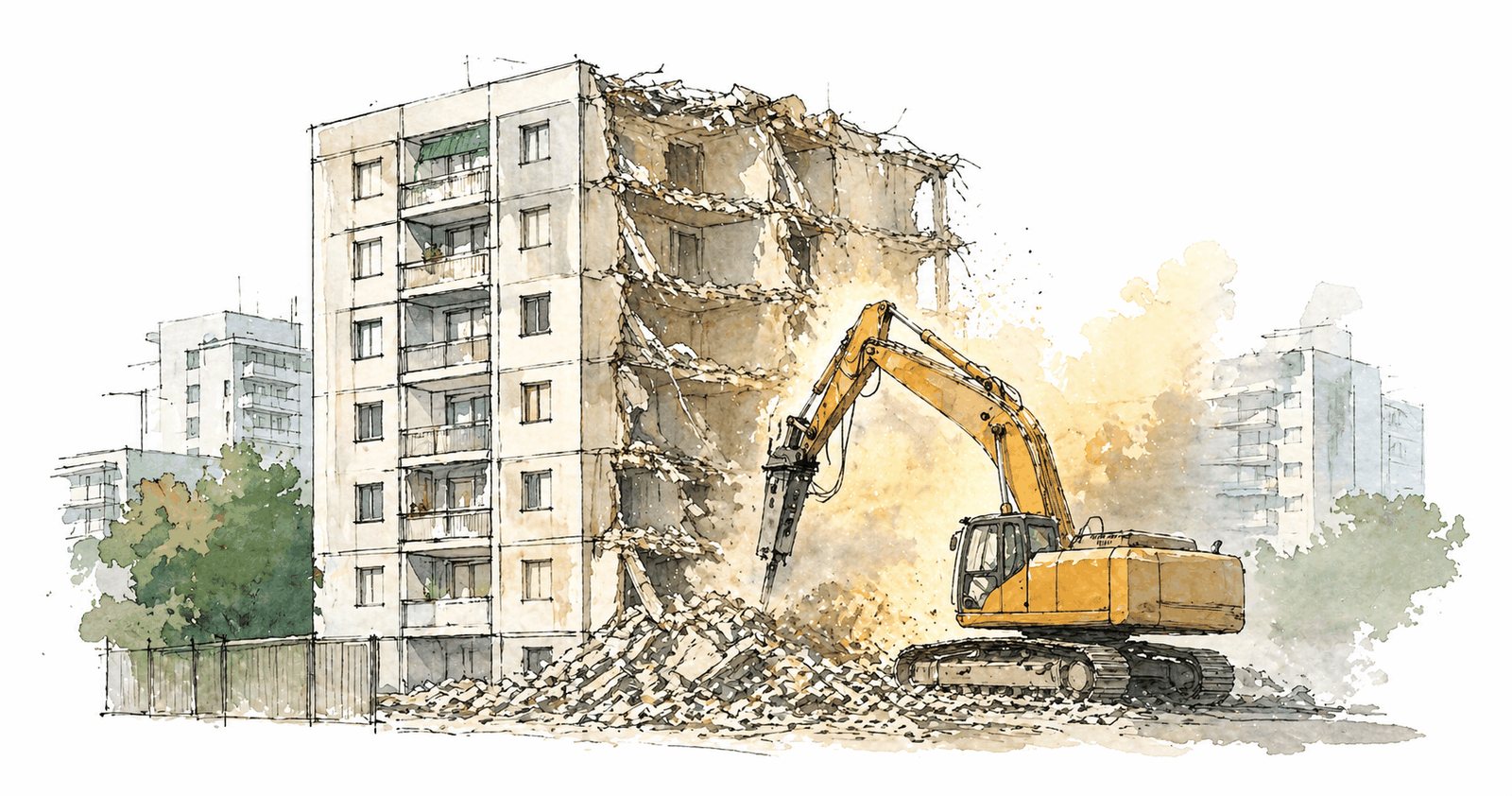
A 1970s residential block turns fifty, its slab passes a technical inspection, its frame can take another fifty years and, even so, it is declared «obsolete» and torn down. The urban operation is sold as regeneration, the press shows green renderings and, before the first new concrete has cured, the project has already emitted more CO₂ than the demolished building would have emitted over the rest of its useful life. The «obsolete» label is rarely placed by the structural engineer; it is placed by the developer's balance sheet, by the buildable volume coefficient in the urban plan and by the bank's financing curve. The uncomfortable question is whether decisions to demolish are being made with IPCC data on the table, or without them.
Obsolescence is not physical: the data
Berglund-Brown and colleagues published in 2025 in Buildings & Cities a study on 14,879 demolished buildings across four European cities (Amsterdam, Copenhagen, Helsinki and Zurich) and nine US cities. The mean lifetime at demolition was 71 years with a standard deviation of 28; in Europe the median falls to 64 years. What matters is not the mean: it is the tail. For reinforced concrete, prior US data place more than half of demolished buildings in the 26-to-50-year bracket. The problem is not that buildings collapse: it is that they are demolished long before they would.
The cause is also not what the public imagines. A widely cited review in the demolition literature attributes 44% of demolitions to subjective perception (aesthetics, image, valuation), 26% to change of use and only 17% to actual physical deterioration. Functional obsolescence remains, in percentage terms, a real-estate management decision far more than a structural failure. Whether a building «holds up» normally has a positive technical answer even when the financial answer is negative.
What demolition charges in CO₂
The buildings and construction sector accounts, according to UNEP's Global Status Report for Buildings and Construction 2024/2025, for 32% of global energy consumption and 34% of CO₂ emissions. The complementary UNEP-Yale CEA report Building Materials and the Climate (2023) raises the figure to 37% of global emissions when materials production and use are included, and specifically attributes 23% of the world's emissions to cement, steel and aluminium. Its projection is blunt: the share of embodied carbon in buildings will rise from 25% today to roughly 49% by 2050 as operational use is decarbonised.
The IPCC, in chapter 9 of its Sixth Assessment Report on buildings, states that mitigation in the sector relies, among other levers, on «limiting the amount of new floor area built». In other words: every new square metre adds embodied carbon that is hard to recover; every existing square metre that is refurbished avoids it. The arithmetic is brutal and rarely appears in the municipal planning reports that justify a demolition.
Refurbishment versus demolition: how much is actually saved
The figure most commonly used in the British sector, supported by consultancies such as AECOM and by Historic England, places the carbon footprint of a deeply refurbished building at roughly half that of the same building replaced by new construction. A Circular Ecology analysis of twenty-year cycles raises the saving to 59% comparing refurbishment against full demolition and rebuild. The reason is elementary: the elements with the highest carbon load (foundations, concrete and steel structure, rigid cores) represent emissions already incurred. Keeping them is, literally, not emitting them again.
Reusing recycled materials or recovered components can save up to 95% of the embodied carbon compared with buying new product. The point is not that refurbishment is perfect: it is that it starts from a carbon position already paid, while new construction starts from zero and counts upwards. Every time a plan substitutes buildings with buildings, it shifts carbon from the historical asset to the present liability and the atmosphere foots the bill.
The Spanish stock: 45% pre-1980 and the shadow of aluminous cement
Spain's Long-Term Strategy for Energy Renovation in the Building Sector (ERESEE 2020) starts from a clear diagnosis: roughly 45% of Spanish buildings predate 1980 and around one million homes are in poor condition. The picture is not one of ruin: it is the normal ageing of a stock built en masse during the development boom, with virtually no thermal codes until NBE-CT-79 and a modern Building Code (CTE) only arriving in 2006.
One real shadow hangs over that stock, often misapplied: aluminous cement, used in Spain between the 1950s and 1977 and effectively phased out by the entry into force of EH-77, with an estimated useful life of around 50 years. Aluminosis is still cited as justification to demolish older blocks, but current technical consensus is that an affected slab can in many cases be reinforced or partially replaced without demolishing the whole building. Turning a localised problem into a demolition order is an administrative shortcut, not a forensic verdict.
Why Spain refurbishes ten times less than France
The Housing and Land Observatory of the Spanish Ministry of Housing and Urban Agenda counts approximately 25,000 refurbishment permits annually in 2023, a stock-based ratio of 0.1%. The European comparison is damning: France refurbishes 2% of its stock per year, Germany 1.5%, Italy 0.8%. The gap is not explained by lack of technical knowledge or industrial capacity: it is explained by incentives.
On paper, Spain has tools. VAT on refurbishment works is reduced to 10% when the requirements of article 20.One.22.B of the VAT Act are met: more than 50% of cost dedicated to structure, façades or roofs and a total amount above 25% of the building's pre-renovation value. The personal income tax (IRPF) deduction for energy-renovation works reaches 60% of the base, with a cap of €5,000 per year and €15,000 per dwelling, extended through December 2026. There are also Recovery Plan programmes funded by EU money (component 2). In practice, the citizen finds that the deduction requires energy certificates before and after, that the homeowners' association cannot reach the legal majority, that the technical inspection (ITE) detects collateral defects that double the budget, and that the bank finances new development more readily than scattered refurbishment projects.
The economic crime: when demolishing is more profitable
If refurbishment is environmentally superior, the next logical step is to ask why demolition continues. The answer is financial. A demolition-and-new-build operation lets the developer optimise buildable volume when the urban plan has been amended upwards, redistribute typologies towards the most profitable product of the moment, recover input VAT on shorter timeframes, benefit from accelerated accounting depreciation and, in many cases, secure a higher bank financing ratio than refurbishment. For municipally owned land, an upward rezoning becomes saleable capital gain.
The cost not booked in that balance is carbon. While the operational footprint of buildings is regulated (energy certification, EPBD, CTE DB-HE), embodied construction carbon is not part of any binding calculation in Spain. The consequence is that the developer does the maths the law requires and leaves out precisely the column where refurbishment would win. If embodied carbon were taxed the way operational energy is, half of demolition-and-new-build projects would become unviable overnight.
What would have to change
The recast EPBD (Directive 2024/1275) introduces, for the first time in EU law, the concept of «whole-life-cycle global warming potential» (GWP) of buildings and requires it to be calculated for new construction from 2028 for buildings over 1,000 m² and from 2030 for the rest. Spain's transposition is the real lever. If the GWP calculation is not reduced to a documentary formality but is compared against an equivalent refurbishment baseline, demolition projects will be forced to justify the environmental surplus before a municipal permit.
Three concrete changes would re-balance the bias against demolition: equalising bank financing for refurbishment and new construction, requiring an embodied carbon balance in urban planning files as a permit condition, and tying multi-year property tax (IBI) abatements to the conservation of existing buildings. None of this requires constitutional reform. All of it lies in the hands of those who sign general plans and municipal ordinances.
Conclusion
A concrete building demolished at thirty is not a building exhausted: it is a building whose financial balance expired before its structure did. Whether half or all of the carbon is released today is decided by planning, not by structural engineering. As long as embodied carbon is not taxed and refurbishment remains administratively harder than demolition, the sector will keep optimising what the law rewards and the atmosphere will keep paying what the law forgets. Obsolescence, almost always, is not declared by the building. It is declared by the balance sheet.
References
- Berglund-Brown, J., Dobie, I., Hewitt, J., De Wolf, C., & Ochsendorf, J. (2025). Lifetimes of demolished buildings in US and European cities. Buildings & Cities, 6(1). DOI: 10.5334/bc.588
- United Nations Environment Programme. (2025). Global Status Report for Buildings and Construction 2024/2025. Nairobi: UNEP.
- United Nations Environment Programme & Yale Center for Ecosystems + Architecture. (2023). Building Materials and the Climate: Constructing a New Future. Nairobi: UNEP.
- IPCC. (2022). Chapter 9: Buildings. In Climate Change 2022: Mitigation of Climate Change. Contribution of Working Group III to the Sixth Assessment Report of the Intergovernmental Panel on Climate Change. Cambridge University Press. DOI: 10.1017/9781009157926.011
- Ministry of Transport, Mobility and Urban Agenda. (2020). Long-Term Strategy for Energy Renovation in the Building Sector in Spain (ERESEE 2020). Madrid.
- Ministry of Housing and Urban Agenda. (2024). Housing and Land Observatory. Annual Bulletin 2024. Madrid.
- Directive (EU) 2024/1275 of the European Parliament and of the Council of 24 April 2024 on the energy performance of buildings (recast). Official Journal of the European Union, L of 8 May 2024.



Comments 0
No comments yet. Be the first!
Leave a comment