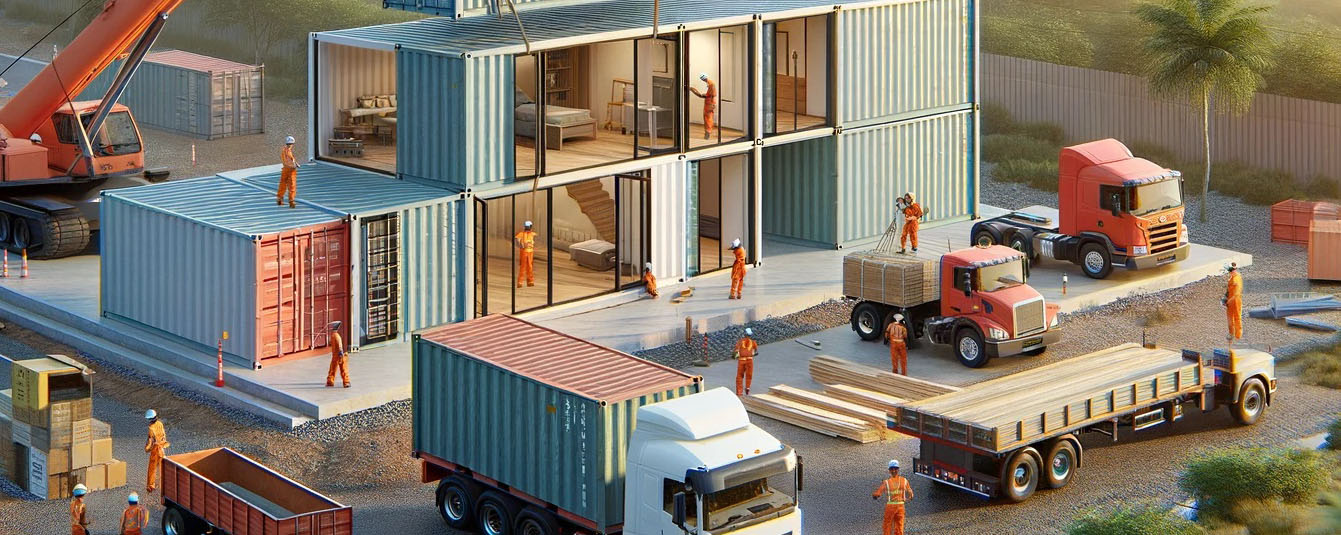
Foundations and current scale of sustainable prefabricated construction
Sustainable prefabricated construction shifts between 60% and 90% of building processes to controlled factory environments, where dimensional precision reaches tolerances of ±2 mm compared to the ±10-20 mm typical of conventional on-site work. According to a McKinsey & Company report (2019), industrialized production can improve construction sector productivity by 5 to 10 times relative to the traditional craft-based model. In Europe, the offsite construction market share reached 9.4% in 2023, led by Sweden (45% of single-family homes), Germany (20%), and the United Kingdom (15%), according to data from the European Federation of Precast Concrete (BIBM, 2023). Global modular construction revenue stood at 157 billion USD in 2023, with a compound annual growth rate of 6.1% projected through 2030 (Grand View Research, 2024).
The sustainability component of prefabrication lies in the resource optimization that factory settings enable. Factory manufacturing reduces material waste by 52% to 70% compared to on-site construction, according to a study by WRAP (Waste & Resources Action Programme, 2018) that analyzed 120 projects in the United Kingdom. Timber waste drops by 74%, concrete waste by 63%, and packaging waste by 56%. The plant's environmental controls allow optimal concrete curing at 20-25°C and 60-80% relative humidity, reducing defects and rework by 30-40%. Three-dimensional volumetric modules arrive at the site with electrical installations, plumbing, finishes, and joinery already integrated, which cuts on-site time by 30-50% and reduces disturbances to the surrounding urban environment (noise, dust, truck traffic) by 50% to 70%. This shortened timeline yields financial savings of 12-18% in indirect construction costs.
Quantified environmental advantages of prefabrication
Life cycle assessment (LCA) of prefabricated construction shows consistent environmental advantages. A comparative study by Quale et al. (2012), published in Energy and Buildings, evaluated 4 modular homes against 4 equivalent conventional homes and found reductions of 43% in embodied energy and 36% in CO₂ emissions during the construction phase. Prefabrication with cross-laminated timber (CLT) panels amplifies these advantages: each cubic meter of CLT stores approximately 0.8 tCO₂ of biogenic carbon and replaces materials with a higher footprint, resulting in a negative embodied carbon balance of -150 to -250 kgCO₂e/m² of built area (Darby et al., 2013). The Mjøstårnet building in Brumunddal (Norway), standing 85.4 m tall with 18 stories in laminated timber structure, stores 1,600 tCO₂ in its structure and avoided the emission of an additional 2,000 tCO₂ compared to a reinforced concrete alternative.
The operational energy efficiency of prefabricated buildings matches or exceeds that of conventional ones when the design integrates high levels of insulation and airtightness. Factory manufacturing precision allows airtightness values of n₅₀ ≤ 0.6 air changes/hour (Passivhaus standard) to be achieved systematically, whereas in conventional construction this requires specialized oversight and is accomplished on the first attempt in fewer than 20% of cases. Companies such as Passive House Prefab (Austria) and Energiesprong (Netherlands) produce energy retrofit modules that reduce heating demand in existing homes from 150-250 kWh/m²·year down to 25-40 kWh/m²·year, with installation in 1-2 weeks versus 3-6 months for a conventional retrofit. The Energiesprong program has renovated more than 5,500 homes in the Netherlands, France, and the United Kingdom since 2013, with 30-year energy performance guarantees financed by utility bill savings. Factory manufacturing energy consumption is 30-45% lower than that of equivalent on-site processes thanks to waste heat recovery, logistics optimization, and reduced heavy machinery use on site.
Technical, economic, and regulatory challenges
Sustainable prefabricated construction faces significant technical barriers. Transportation limits module dimensions to 3.5 m wide, 4.5 m tall, and 12-16 m long in Europe (per road transport regulations), which constrains architectural typology and requires resolving joints between modules that constitute potential thermal bridges (increase in linear thermal transmittance ψ of 0.05-0.15 W/m·K at each joint). Structural connections between modules account for 70% of pathologies in modular buildings: water infiltration, poor airborne sound insulation (a difference of 3-8 dB compared to continuous floor slabs), and complex seismic behavior. The fire resistance of unprotected CLT is limited to REI 60-90 (charring rate of 0.65 mm/min), which is insufficient for buildings over 5 stories under many national codes without fire-resistant claddings that add 8-15% to the structural cost.
On the economic front, the initial investment in prefabrication plants ranges from 10 to 50 million EUR depending on capacity and automation, requiring minimum production volumes of 200-500 homes/year to reach financial breakeven. The unit cost of a modular home in Spain ranges from 1,100 to 1,500 EUR/m², comparable to mid-range conventional construction (1,000-1,400 EUR/m²), but the real economic advantage lies in timeline reduction: a modular project of 50 homes is completed in 8-12 months versus 18-24 months using traditional methods. On the regulatory front, only 7 of the 27 EU countries have specific regulatory frameworks for offsite modular construction (ECSO, 2021). The Spanish CTE does not include assessment procedures adapted to factory manufacturing, which forces obtaining individual Technical Suitability Documents (DIT) with processing timelines of 6-12 months and costs of 15,000-40,000 EUR per construction system.
Outlook and recommendations
Advanced automation and robotics are transforming prefabricated construction. Production lines equipped with welding robots, 5-axis CNC milling, and automated insulation placement achieve manufacturing speeds of 1 complete module every 4-8 hours, compared to 2-4 weeks of equivalent manual assembly. The company Autovol (USA) produces volumetric modules at a rate of 16 units/day in its 24,000 m² plant in Boise, Idaho. 3D concrete printing complements prefabrication with non-standardized geometries: ICON (USA) has printed homes of 60 m² in 24-48 hours at a cost of 4,000-10,000 USD per structural unit. The combination of BIM in the design phase, digital fabrication in the plant, and robotized on-site assembly defines what is known as Construction 4.0, with the potential to reduce total cost by 20-30% and construction process emissions by 40-60% (Boston Consulting Group, 2023).
For sustainable prefabricated construction to reach its potential, coordinated action is needed on three fronts. In regulation, the harmonization of European product standards through the revised Construction Products Regulation (CPR, 2024) should facilitate the free movement of prefabricated modules between member states, a market of 2.4 billion m² of new construction planned for 2030-2050 in the EU. In financing, NextGenerationEU funds allocate 72 billion EUR to building renovation, where modular prefabrication can accelerate the retrofit pace from the current 0.2 million homes/year to the 3 million/year needed to meet 2050 climate targets. In training, the transition from craft-based to industrial skills requires reskilling 25-30% of the 14 million workers in the European construction sector (Eurostat, 2023). Sustainable prefabricated construction does not replace traditional construction, but it offers a proven pathway to address the triple crisis of productivity, emissions, and labor shortages facing the industry.
References
- [1]Reinventing Construction: A Route to Higher ProductivityMcKinsey & Company.
- [2]Waste Reduction Potential of Offsite Volumetric ConstructionWRAP.
- [3]Construction Matters: Comparing Environmental Impacts of Building Modular and Conventional Homes in the United StatesJournal of Industrial Ecology, 16(2), 243-253.
- [4]A Case Study to Investigate the Life Cycle Carbon Emissions and Carbon Storage Capacity of a Cross Laminated Timber, Multi-Storey Residential BuildingSB13 Munich — Implementing Sustainability: Barriers and Chances. ISBN: 978-3-8167-9025-3
- [5]Digitalisation in the Construction SectorEuropean Commission.

Comments 0
No comments yet. Be the first!
Leave a comment