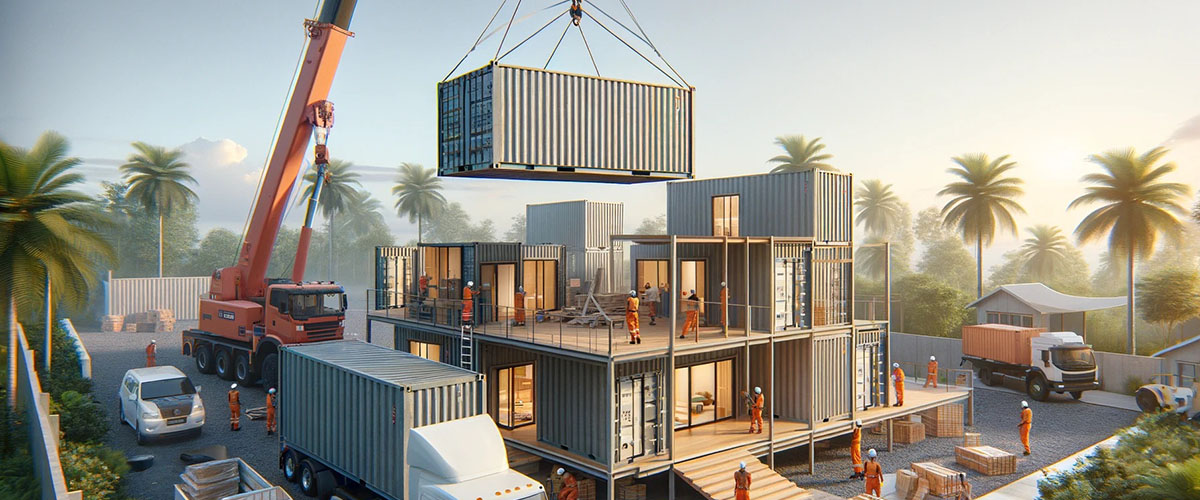
Foundations of Modular Construction. Off-Site Fabrication as a Production System
The building industry is undergoing a structural transformation driven by modular construction. The green revolution reshaping the building industry has a quantifiable basis: off-site fabrication transfers 60-90% of construction operations to a factory with a controlled environment (temperature 18-22°C, humidity 40-60%, illumination >500 lux), where sequential workstations apply lean manufacturing principles with cycle times of 8-12 minutes per station. A volumetric module factory produces 1,000-3,000 modules/year on assembly lines 80-150 m long, achieving productivities of 0.15-0.25 person-hours/m² (compared to 0.5-1.0 ph/m² in conventional construction).
The fabrication process follows an industrial sequence: (1) welding/bolting the structural chassis of galvanized steel (C/Z profiles of 1.2-3.0 mm thickness) or assembly of CLT panels (100-200 mm), (2) factory-installed insulation (mineral wool 120-200 mm, λ = 0.032-0.040 W/mK), (3) routing of electrical and plumbing services with push-fit quick connections, (4) placement of interior finishes (plasterboard, flooring, joinery), (5) Blower Door airtightness test of each individual module (target: n₅₀ ≤ 0.6 ACH) and (6) protection, packaging and loading for transport. Quality control at each station detects 95-98% of defects before the module leaves the factory, compared to the typical 60-70% detected through on-site inspection.
Modular Typologies: Volumetric, Panelized and Hybrid
Modular construction is classified into three typologies according to the degree of factory completion. Volumetric modular (3D) manufactures complete three-dimensional modules of 12-16 m × 3.0-4.5 m × 3.0-3.5 m (dimensions constrained by road transport) with structure, envelope, services and finishes incorporated — factory completion degree of 85-95%. Each module weighs 8-20 tonnes depending on the material and dimensions. Panelized modular (2D) manufactures flat wall, floor and roof panels in the factory (completion degree of 50-70%) that are assembled on site in 2-5 days per floor. The panels have thicknesses of 150-350 mm with integrated insulation and U-values of 0.10-0.18 W/m²K.
Hybrid modular combines in-situ structure (concrete cores for lifts/stairs, foundations) with stacked volumetric modules and prefabricated facade panels — this is the fastest-growing typology, representing 40-50% of the European modular market (Buildoffsite, 2022). The company CIMC MBS (China) produces 100,000 modules/year across 8 factories, while TopHat (United Kingdom) operates the most automated factory in Europe with capacity for 4,000 homes/year using robotic welding, CNC cutting and AGVs (automated guided vehicles). In Spain, AEDAS Homes industrializes 30-40% of its housing production with panelized concrete systems and complete bathroom modules, reducing the construction timeline from 18-24 months to 10-14 months.
Structural Materials: CLT, Light Steel and Precast Concrete
The choice of structural material defines the environmental performance of the module. Cross-laminated timber (CLT) offers the best carbon profile: a GWP of -50 to -100 kgCO₂eq/m² per module (net biogenic capture), density of 450-550 kg/m³ (module weight: 5-10 tonnes), fire resistance REI 60-90 without additional protection for 120-200 mm sections, and a manufacturing water footprint 50-60% lower than concrete. A reference CLT modular project is Dalston Works (London, 2017, Waugh Thistleton Architects) — 121 dwellings across 10 stories with a CLT structure, 2,400 m³ of timber storing 2,000 tCO₂eq.
Light gauge steel framing (LGSF) uses galvanized profiles of 0.8-2.5 mm forming self-supporting frames with tolerances of ±1 mm through CNC cutting. Its GWP is +80 to +150 kgCO₂eq/m² per module, but the 95-98% recyclability and lightness (30-50 kg/m² of floor slab compared to 200-350 kg/m² for concrete) reduce transport and foundation emissions. Precast concrete dominates in high-load modules (hotels, hospitals): panels of 150-250 mm with pre-positioned reinforcement and 35-50 MPa concrete, GWP of +150 to +300 kgCO₂eq/m² but a service life of 100+ years and minimal maintenance. The emerging trend is low-clinker concrete (GGBS 50-70%, fly ash 20-30%) that reduces GWP by 30-50% while maintaining mechanical performance.
Logistics, Transport and Assembly: The Complete Modular Chain
Transport is the critical link in the modular chain: volumetric modules require special vehicles (extendable platforms of 13.6-18 m), special transport permits for loads exceeding 3.5 m wide or 4.5 m tall, and routes studied to avoid low bridges, tight roundabouts and gradients exceeding 12%. Transport cost ranges from 15-40 EUR/km per module depending on dimensions and distance, representing 5-12% of the total module cost. The optimal economic radius is 150-300 km from the factory; beyond 500 km, transport erodes the modular economic advantage.
On-site assembly of the modules is carried out with mobile cranes of 100-500 tonnes capacity (tower cranes for buildings exceeding 6 stories), at placement rates of 4-8 modules/day. A 50-dwelling building (100-150 modules) is assembled in 3-5 weeks. Connections between modules include: high-strength bolted structural joints (M16-M24, class 8.8-10.9), MEP connections (mechanical, electrical, plumbing) with quick couplings completed in 15-30 minutes per connection point, and external joint sealing with EPDM membranes or structural silicone to guarantee weathertightness. The project 461 Dean Street (New York, 2016, SHoP Architects) assembled 930 steel modules across 32 stories — the tallest modular building in the world at the time — with structural assembly completed in 19 days.
Quantified Environmental Impact and Market Outlook
Aggregated data from multiple studies confirm the environmental advantage of modular construction. A meta-analysis by Fenner et al. (2020) — reviewing 81 articles with LCA studies of modular versus conventional buildings — concludes that modular construction reduces global warming potential (GWP) by 25-40% across phases A1-A5, construction waste by 50-70%, on-site water consumption by 40-60% and noise and air pollution in the surrounding area by 30-50%. The WRAP (Waste and Resources Action Programme) in the United Kingdom documented that modular construction generates 67% less waste than conventional construction in a study of 16 paired projects.
The global modular construction market reached 91 billion USD in 2023 (Fortune Business Insights) and is projected to reach 150-170 billion USD by 2030, with a CAGR of 7-8%. The growth drivers are: the shortage of skilled labor (deficit of 2.2 million workers in the EU by 2025), the decarbonization targets for the sector (responsible for 37% of global CO₂ emissions), pressure on delivery timelines for social housing, and digitalization through BIM-to-fabrication that connects the digital model directly to CNC machines. The standard ISO 22539:2024 (Off-site construction — Vocabulary and general requirements) and the Eurocode adaptation for modular structures (EN 1993-1-3) provide the regulatory framework driving adoption at industrial scale across Europe.
References
- [1]The carbon footprint of buildings: A review of methodologies and applicationsRenewable and Sustainable Energy Reviews, 120, 109642.
- [2]Current Practices and Future Potential in Modern Methods of Construction (WAS003-001)Waste and Resources Action Programme.
- [3]Offsite Construction Industry Survey 2022: Market Size, Trends and BarriersBuildoffsite / Construction Leadership Council.
- [4]Modular Construction Market Size, Share & COVID-19 Impact Analysis, 2023-2030Fortune Business Insights Pvt. Ltd..
- [5]Offsite Architecture: Constructing the FutureRoutledge. ISBN: 978-1-138-82116-3



Comments 0
No comments yet. Be the first!
Leave a comment