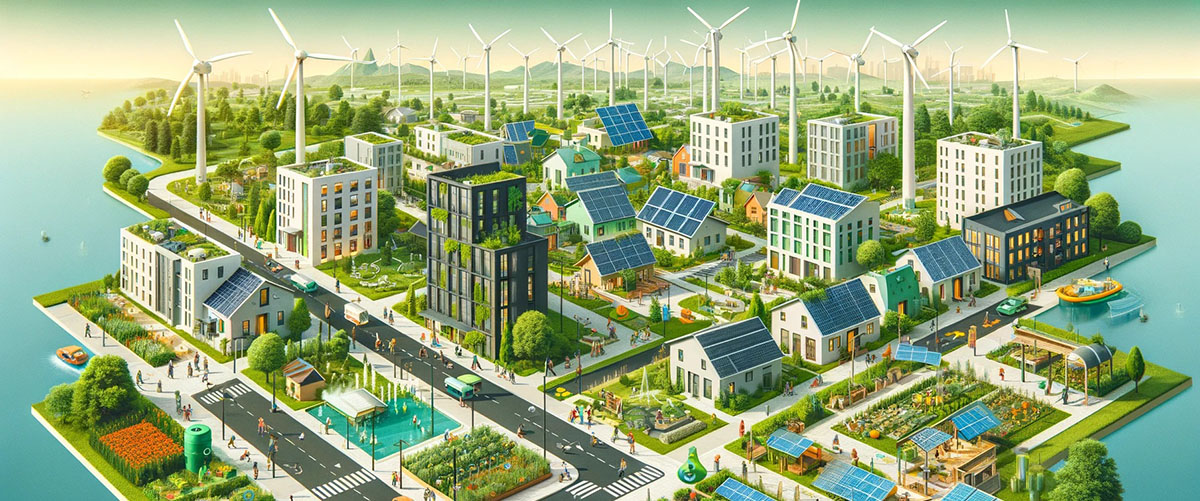
Technical definition of a sustainable community
A sustainable community is a human settlement planned to minimize its environmental footprint, be economically viable in the long term, and maximize the well-being of its residents. Unlike an isolated sustainable building, a sustainable community operates at the neighborhood or district scale, integrating energy, water, transport, waste, and public space systems interdependently.
The concept has roots in urbanists such as Jane Jacobs (The Death and Life of Great American Cities, 1961; ISBN 978-0679741954), who championed mixed uses, human density, and street vitality as the foundation of functional communities, and Jan Gehl (Cities for People, Island Press, 2010; ISBN 978-1597265737), who systematized pedestrian-centered urban design. The current institutional framework stems from Agenda 21 (Rio Conference, 1992) and SDG 11 of the 2030 Agenda: "Make cities and human settlements inclusive, safe, resilient and sustainable."
Measurable criteria for a sustainable community
A sustainable community is defined not by intentions but by metrics. The most rigorous evaluation frameworks —BREEAM Communities, LEED for Neighborhood Development (LEED-ND), and Bioregional's One Planet Living Framework— converge on evaluating the following dimensions:
Energy: energy consumption per dwelling below national standards, with a significant percentage of on-site renewable generation. Reference targets are the Passivhaus standard (heating demand of 15 kWh/m² per year or less) or nearly zero-energy buildings (nZEB) required by the European Energy Performance of Buildings Directive (EPBD).
Mobility: reduction of private car dependency, measured as the percentage of trips by public transport, bicycle, or on foot. Reference communities exceed 60% non-motorized trips.
Water: reduction of potable water consumption relative to the national average, rainwater harvesting, and greywater reuse.
Waste: recycling, composting, and recovery rates. The goal is to trend toward zero waste.
Biodiversity: green space per inhabitant (WHO recommends a minimum of 9 m² per person), ecological connectivity, and integration of native flora and fauna.
Social cohesion: diversity of housing typologies (including affordable housing), community spaces, access to basic services within a 15-minute walk (Carlos Moreno's "15-minute city" concept).
Vauban, Freiburg (Germany): the European benchmark
The Vauban district, built between 1998 and 2006 on a former French military base in Freiburg im Breisgau, houses 5,500 residents in 2,000 dwellings and is probably the most thoroughly documented sustainable community in the world.
Energy: all dwellings meet a low-energy standard of 65 kWh/m² per year (equivalent to the Swiss SIA 380/1 standard). Additionally, 42 buildings meet the Passivhaus standard (15 kWh/m² per year or less) and 100 dwellings are plus-energy (producing more energy than they consume). A combined heat and power plant (CHP) fueled by wood chips, connected to a district heating network, covers approximately 65% of electricity demand and 90% of heating demand.
Mobility: Vauban is a car-restricted district. Residents who own a vehicle must park it in one of two peripheral parking garages (at a cost of 17,500 euros per space). The result: only 17% of households own a car (compared to the German average of 50%). The tram connects Vauban to Freiburg city center in 15 minutes, and the cycling network is dense and safe.
Participation: Vauban's development was citizen-led through Forum Vauban, a residents' association that actively participated in urban planning, material selection, and the definition of community rules.
Hammarby Sjostad, Stockholm (Sweden): the urban metabolism model
Hammarby Sjostad is a district of 11,000 dwellings and 26,000 residents built between 1995 and 2017 on former industrial and port land south of Stockholm. Its uniqueness lies in the Hammarby Model, an integrated urban metabolism system where energy, water, and waste flows are interconnected in closed loops.
The integrated cycle: organic waste is processed in a biogas plant that produces fuel for the district's buses and heat for the district heating network. Wastewater is treated and the resulting biogas is fed into the heating network. Rainwater is collected, filtered through constructed wetlands, and returned to Lake Hammarby. Non-recyclable combustible waste is incinerated in a plant that generates electricity and district heat.
Measured results: Hammarby Sjostad has achieved a 30-40% reduction in energy consumption per dwelling compared to the Stockholm average, a 50% reduction in potable water consumption (from 200 l/person/day to 100 l/person/day), and 40% of trips are made by public transport (complemented by car-sharing and the district's ferry network).
Masdar City, Abu Dhabi (UAE): ambition and its limits
Masdar City, designed by Foster + Partners in 2006, was conceived as the world's first zero-carbon, zero-waste city. The reality, two decades later, is more nuanced, making it a case study as valuable for its achievements as for its lessons.
Verified achievements: the first phase of the district (partially completed) includes the Masdar Institute (now part of Khalifa University), a complex that consumes 54% less energy and 55% less water than conventional buildings in Abu Dhabi. A 10 MW solar photovoltaic plant generates renewable energy for the district. The urban design incorporates traditional Arab urbanism principles: narrow streets oriented to maximize shade, wind towers (barjeel) for passive ventilation, and high-reflectance materials to reduce the urban heat island effect.
Limitations: the original zero-carbon city goal was abandoned in 2016. The underground automated transport system (PRT) was drastically scaled back. The planned population of 50,000 residents and 40,000 workers has not been achieved; in 2023, Masdar City housed approximately 4,000 residents. Infrastructure costs spiraled and the 2008 financial crisis slowed development. Masdar City demonstrates that technological ambition without economic viability and real social demand is insufficient to create a sustainable community.
Common principles and lessons
The three cases share transferable lessons:
A sustainable community is not just technology: Vauban works because its residents actively participated in its design. Masdar City has cutting-edge technology but lacks organic community life. Social sustainability is as important as environmental sustainability.
Closed loops are more efficient than isolated systems: the Hammarby model demonstrates that integrating energy, water, and waste flows into a single urban metabolism system produces synergies that multiply the individual efficiency of each component.
Mobility defines overall sustainability: in all three cases, transport management is the factor that most influences the district's total carbon footprint. Private car restriction (Vauban) or its replacement with efficient public transport (Hammarby) are requirements, not options.
Time is a critical factor: a sustainable community is not built in a single founding act but evolves with its residents. Vauban took a decade to mature; Hammarby, two; Masdar remains under development after nearly twenty years. Planning must be flexible enough to adapt.
References
- [1]The Egan Review: Skills for Sustainable CommunitiesOffice of the Deputy Prime Minister, UK Government. ISBN: 1-85946-142-5
- [2]Green City Freiburg — Approaches to SustainabilityStadt Freiburg im Breisgau.
- [3]BedZED — The UK's First Major Zero Carbon Community — Monitoring Report 2007-2013BioRegional Development Group.
- [4]The End of Automobile Dependence: How Cities Are Moving Beyond Car-Based PlanningIsland Press. ISBN: 978-1-61091-613-4
- [5]Predicted vs. actual energy performance of non-domestic buildings: Using post-occupancy evaluation data to reduce the performance gapApplied Energy, 97, 355-364.
- [6]Reference Framework for Sustainable Cities (RFSC) — Indicator Set v3.0European Commission, DG Regional and Urban Policy.


Comments 0
No comments yet. Be the first!
Leave a comment