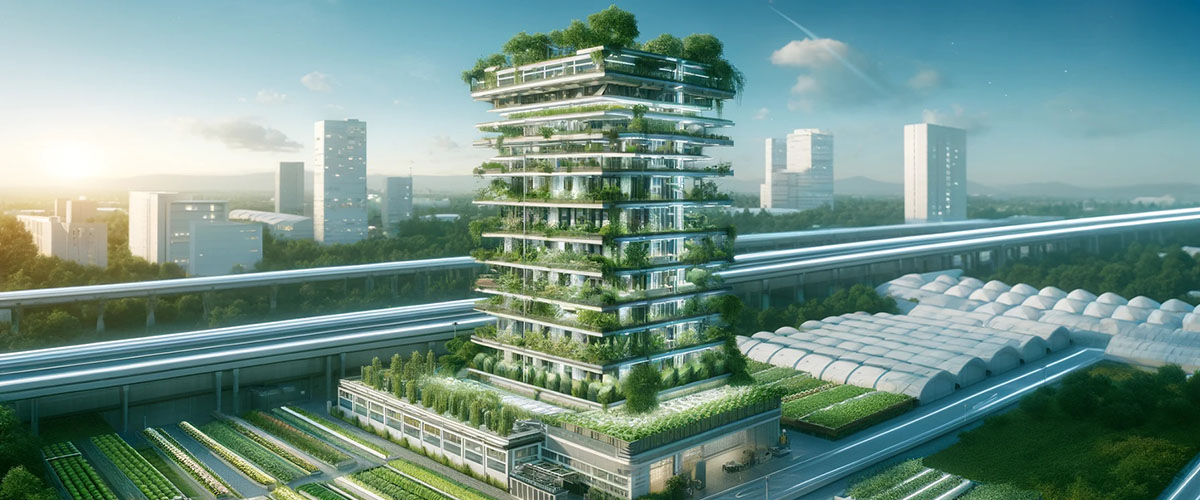
Vertical farming: definition, metrics and sector scale
Innovative technologies and systems for vertical farming respond to a quantifiable challenge: feeding 9.7 billion people by 2050 (UN) with 50% more agricultural production, while cultivable land per capita declines from 0.22 ha (2000) to 0.15 ha (2050). Vertical farming grows food in stacked layers inside buildings — factories, warehouses, shipping containers — with total control of light, temperature, humidity, CO₂ and nutrients. The key metric is volumetric productivity: a 10-level vertical farm produces 50-100 kg of lettuce/m²·year (compared to 3-5 kg/m²·year in open field) — a production factor 10-30× higher per unit of land.
The global vertical farming market reached 5.5 billion USD in 2023 (MarketsandMarkets) with a projected CAGR of 24% through 2030. The predominant crops are: leafy greens (lettuce, spinach, arugula: 60-70% of production), aromatic herbs (basil, cilantro, mint: 15-20%), strawberries and berries (5-10%) and microgreens (5-10%). Leading companies include AeroFarms (Newark, USA: 8,800 m² of growing area), Plenty (San Francisco: vertical column technology) and Infarm (Berlin: modular units in supermarkets). In Spain, Ekonoke (Bilbao) and Groots (Madrid) have inaugurated facilities of 500-2,000 m² of growing area.
Horticultural LED lighting: spectrum, efficacy and photoperiod
Horticultural LED lighting is the technology that has made vertical farming viable at commercial scale. Plants primarily use photosynthetically active radiation (PAR) between 400-700 nm, with absorption peaks in blue (430-450 nm, chlorophyll a/b) and red (640-680 nm, chlorophyll a). Current horticultural LEDs (Samsung LM301H, Osram Oslon Square) achieve efficacies of 3.0-3.5 μmol/J (micromoles of photons per electrical joule), compared to 1.5-2.0 μmol/J of first-generation LEDs (2012) and 0.8-1.2 μmol/J of HPS (high-pressure sodium) lamps.
The optimized spectrum for lettuce combines 80-85% red (660 nm) + 10-15% blue (450 nm) + 2-5% far-red (730 nm, for stem elongation and phytochrome control). The optimal light intensity (PPFD — Photosynthetic Photon Flux Density) is 200-400 μmol/m²·s for lettuce and 400-800 μmol/m²·s for strawberries and tomato. The photoperiod (hours of light/darkness) is programmed at 16-20 hours of light/4-8 hours of darkness to maximize photosynthesis without inducing premature flowering photoperiod. Lighting electricity consumption represents 40-60% of the total operating cost of a vertical farm, equivalent to 30-70 kWh/kg of lettuce production. The incorporation of photovoltaic panels on the vertical farm roof can cover 15-30% of electricity consumption in locations with GHI > 1,500 kWh/m²·year.
Hydroponics, aeroponics and aquaponics: soilless cultivation
Soilless cultivation systems eliminate soil as a growth medium, using nutrient solutions that deliver the 16 essential elements (N, P, K, Ca, Mg, S + micronutrients) directly to the roots. NFT (Nutrient Film Technique) hydroponics circulates a 2-5 mm film of nutrient solution (EC: 1.2-2.5 mS/cm, pH: 5.5-6.5) through inclined channels where the roots absorb water and nutrients. Water consumption is 5-10 liters/kg of lettuce, 90-95% less than field cultivation (150-200 liters/kg). DWC (Deep Water Culture) systems submerge the roots in aerated nutrient solution with bubble diffusers (dissolved O₂ ≥ 6 mg/l).
Aeroponics nebulizes the nutrient solution in droplets of 5-50 μm (high-pressure aeroponics) or 50-200 μm (low-pressure) directly onto roots suspended in air. Advantages include: maximum root oxygenation (100% air exposure), water consumption 40-50% lower than hydroponics (3-5 liters/kg of lettuce), and planting density 20-30% higher due to the compactness of the root system. Aquaponics combines aquaculture (fish farming: tilapia, trout, perch) with hydroponics: fish waste (ammonia NH₃) is converted by nitrifying bacteria (Nitrosomonas, Nitrobacter) into nitrates (NO₃⁻) that feed the plants, which in turn filter the water for the fish. A 100 m² aquaponic system simultaneously produces 2,000-4,000 kg/year of vegetables and 200-500 kg/year of fish, with water consumption 90-95% lower than producing both separately. The company Gotham Greens (USA) operates 50,000 m² of hydroponic greenhouses on urban rooftops with production of 1,000+ tonnes/year of vegetables.
Climate control, CO₂ and automation with AI
The climate control of a vertical farm maintains constant optimal conditions: temperature of 18-24°C (day) and 14-18°C (night), relative humidity of 60-75%, CO₂ concentration of 800-1,200 ppm (compared to 420 ppm outdoors) and air velocity of 0.3-1.0 m/s (to strengthen stems and prevent fungi). CO₂ supplementation to 1,000 ppm increases the photosynthetic rate by 30-50% in C3 crops (lettuce, tomato), accelerating the production cycle from 35-45 days (head lettuce) to 25-30 days.
AI and machine learning systems optimize cultivation parameters in real time: recurrent neural networks (LSTM) process data from 50-200 sensors (temperature, humidity, CO₂, EC, pH, PPFD, tray weight, multispectral cameras) and adjust irrigation, nutrition and light spectrum to maximize production while minimizing energy consumption. The company Plenty uses 7,000+ sensors and harvesting robots that process 200 plants per hour at its Compton farm (California, 9,300 m²). Seeding, transplanting and harvesting robotics reduce labor from 15-25 workers (manual farm of 2,000 m²) to 3-5 technicians (equivalent automated farm). The production cost of vertical lettuce is 3-8 EUR/kg (2024), compared to 0.5-1.5 EUR/kg in field agriculture — the gap narrows by 10-15% annually with improvements in LED efficiency, facility scale and automation.
Building integration: vertical farms as urban infrastructure
The integration of vertical farming into buildings transforms food production into an additional building service, alongside energy, water and HVAC. Rooftop farms take advantage of natural light (reducing LED consumption by 30-50%) and residual building heat (air preheating in winter). The company Lufa Farms (Montreal) operates 3 rooftop greenhouses totaling 14,000 m² that produce 11,000+ baskets of vegetables/week, distributing them directly to urban subscribers (food-as-a-service).
Container farms (Freight Farms, CropBox: 12 m shipping containers equipped with LED, hydroponics and climate control) produce 2,000-5,000 kg/year of vegetables in 30 m² of ground area — ideal for restaurants, hospitals and university campuses. The environmental balance of vertical farming is mixed: it consumes 30-70 kWh/kg of lettuce (compared to 0.5-2 kWh/kg in the field), but eliminates transportation of 1,500-3,000 km (cold chain, trucking, warehousing), pesticides (0% in enclosed vertical cultivation), water consumption (reduction of 90-95%) and use of agricultural land. If electricity comes from renewable sources, the carbon footprint of vertical lettuce is 0.5-1.5 kgCO₂/kg, comparable to field lettuce with transportation (0.8-2.0 kgCO₂/kg including refrigerated transport). The LEED ND (Neighborhood Development) certification recognizes local food production as an innovation credit, and the WELL v2 standard (Nourishment N01-N14) promotes access to fresh and local food within the building.
References
- [1]Smart Plant Factory: The Next Generation Indoor Vertical FarmsSpringer. ISBN: 978-981-13-1064-5
- [2]The Vertical Farm: Feeding the World in the 21st CenturyThomas Dunne Books / St. Martin's Press. ISBN: 978-0-312-38368-2
- [3]Vertical Farming Market — Global Forecast to 2030MarketsandMarkets Research Pvt. Ltd..
- [4]Plant factories versus greenhouses: Comparison of resource use efficiencyAgricultural Systems, 160, 31-43.
- [5]Future food-production systems: vertical farming and controlled-environment agricultureSustainability: Science, Practice and Policy, 13(1), 13-26.


Comments 0
No comments yet. Be the first!
Leave a comment