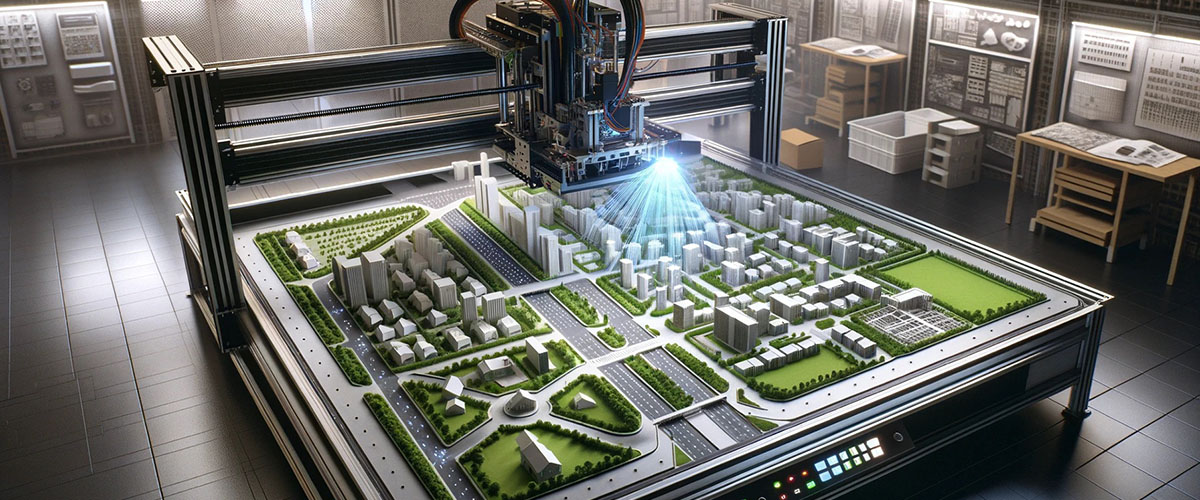
3D concrete printing: from prototypes to habitable structures
Emerging technologies in sustainable construction are redefining how buildings are designed, fabricated, and operated. Among the most disruptive is 3D concrete printing (3DCP), which deposits cementitious material layer by layer under robotic control, eliminating conventional formwork and enabling complex geometries unachievable with traditional casting. The TECLA dwelling in Massa Lombarda, Italy, demonstrated that an entire 60 m² shell could be printed from locally sourced raw earth in 200 hours using a WASP Crane system, while the Milestone project in Eindhoven delivered five commercially rented concrete homes meeting Dutch building-code requirements. COBOD International, whose BOD2 printer reaches 14.6 metres in width, has deployed units in 20 countries and printed structures exceeding three storeys.
The sustainability gains are quantifiable: 3DCP uses 30-60% less concrete than conventional construction by optimising wall cross-sections through topology algorithms, and it eliminates 50-70% of formwork waste, a stream that accounts for a substantial fraction of site-generated debris. Print speeds of 0.5-1.0 m³/hour and labour reductions of 60-80% compress schedules and lower workforce-related emissions. Challenges remain in interlayer bond strength, reinforcement integration, and the lack of harmonised building codes; Buswell et al. (2018) mapped the research frontier, identifying printable fibre-reinforced mixes achieving compressive strengths above 80 MPa and interlayer tensile bonds exceeding 2 MPa. As regulatory frameworks mature, 3DCP is positioned to scale from demonstration projects to mainstream housing supply in arid, disaster-recovery, and labour-scarce markets.
Digital twins: real-time optimisation of building performance
A digital twin is a dynamic virtual replica of a physical building, continuously updated through IoT sensor feeds and capable of simulating future scenarios to optimise energy, comfort, and maintenance. The Edge in Amsterdam exemplifies the concept at full maturity: its 40,000 m² office integrates 28,000 sensors monitoring occupancy, lighting, temperature, and air quality, feeding data to a cloud-based BIM model that adjusts HVAC set-points and lighting zones in real time. The result is an energy-use intensity of 70 kWh/m²/year, a BREEAM Outstanding score of 98.36%, and a 70% reduction in energy consumption compared with a typical Dutch office of equivalent size.
Gartner projected that by 2027, 50% of large industrial companies would deploy digital twins, a trajectory that building owners are now following. Meta-analyses of digital-twin-enabled retrofits report 15-30% reductions in annual energy consumption, achieved primarily through predictive HVAC scheduling, fault detection and diagnostics, and continuous commissioning. The implementation stack typically comprises a BIM authoring layer (Revit, ArchiCAD), an IoT middleware platform (Siemens MindSphere, Azure Digital Twins), and a visualisation/analytics front end. Costs range from 2 to 5 EUR/m² for sensor infrastructure and 1 to 3 EUR/m²/year for platform licensing, yielding payback periods of three to six years in buildings with annual energy budgets above 50,000 EUR. Standardisation through ISO 23247 and buildingSMART data dictionaries is gradually reducing interoperability barriers that have historically fragmented the market.
Cross-laminated timber: structural carbon storage at scale
Cross-laminated timber (CLT) has emerged as a structural system capable of replacing reinforced concrete in mid-rise and tall buildings while locking atmospheric carbon into the building fabric. Each cubic metre of CLT stores approximately 0.7-0.9 tonnes of CO₂ captured during tree growth, turning the structure into a long-term carbon sink rather than a source. The Mjøstårnet tower in Brumunddal, Norway, at 85.4 metres and 18 storeys, holds the record for the world's tallest timber building, demonstrating that engineered wood can meet stringent structural, fire-safety, and acoustic requirements through charring-layer design and encapsulation strategies aligned with Eurocode 5.
The global CLT market has grown at approximately 15% per year since 2015, driven by revised fire codes in Austria, Canada, and Scandinavia that permit timber structures up to 18 storeys. Stora Enso, one of Europe's largest CLT producers, reports manufacturing energy of 500-700 MJ/m³, roughly one-fifth of the embodied energy per functional unit of reinforced concrete. CLT panels arrive on site pre-cut and pre-drilled, reducing erection time by 25-30% relative to in-situ concrete frames and substantially cutting site noise, dust, and waste. Life-cycle assessments consistently show 40-60% lower cradle-to-gate global warming potential for CLT structures compared with concrete equivalents, provided the timber originates from sustainably managed forests certified under FSC or PEFC schemes. The primary design constraints remain span limitations (typically 6-9 metres without post-tensioning), moisture management during transport and erection, and acoustic flanking through connections, all addressable with current engineering solutions.
Phase-change materials: passive thermal regulation without mechanical systems
Phase-change materials (PCMs) absorb and release large quantities of latent heat during solid-liquid transitions, smoothing indoor temperature fluctuations without active energy input. Microencapsulated paraffin products such as BASF Micronal DS 5001X, with a melting point of 23°C and latent-heat capacity of 110 kJ/kg, can be integrated into gypsum plasterboard, concrete, or ceiling tiles at loadings of 20-30% by weight. When ambient temperatures rise above the transition point, the PCM absorbs 200-330 kJ/m² of wall area, equivalent to the thermal mass of a 12-15 cm concrete slab without the associated structural weight.
Cabeza et al. (2011) reviewed experimental studies across Mediterranean and continental climates and documented peak indoor temperature reductions of 2-4°C in PCM-enhanced rooms compared with conventional lightweight construction, translating to cooling-energy savings of 15-30% during summer months. The technology is particularly effective in lightweight timber or steel-frame buildings that lack inherent thermal inertia. Commercial deployment has expanded to include PCM-enhanced underfloor heating systems, chilled-ceiling panels, and ventilated facade cavities where night-time convection regenerates the storage capacity. Current barriers include cycle degradation over 5,000-10,000 melt-freeze cycles, cost premiums of 30-60 EUR/m² over standard finishes, and the need for careful melting-point selection matched to local climate and occupancy schedules. Bio-based PCMs derived from fatty acids and salt hydrates with sharper transition profiles are entering the market, broadening the design palette available to specifiers.
AI-driven building management: predictive control and demand response
Artificial intelligence applied to building energy management systems (BEMS) represents the convergence of data availability, computing power, and advanced control algorithms. The landmark case remains DeepMind's 2016 deployment at Google data centres, where a neural-network controller reduced cooling energy by 40% compared with the preceding rule-based system by predicting thermal loads five minutes ahead and optimising chiller, pump, and free-cooling sequences in concert. BrainBox AI has commercialised analogous model-predictive control (MPC) for commercial HVAC, reporting verified savings of 15-25% in over 100 deployments across North America and Europe, with payback periods under two years and no requirement for hardware replacement.
Beyond individual buildings, AI enables participation in demand-response programmes where grid operators signal peak events and the BEMS pre-cools or pre-heats zones to shift load, earning 10-20% reductions in electricity cost while supporting grid stability. The global smart-building market, valued at 5.9 billion USD in 2023, is projected to reach 24.7 billion USD by 2030, reflecting compound annual growth of 22.5%. Key enablers include edge-computing gateways that process sensor data locally with latencies below 100 ms, cloud-based digital-twin platforms that train reinforcement-learning agents on historical operational data, and open protocols (BACnet, Haystack, Brick Schema) that allow multi-vendor integration. Regulatory drivers such as the EU Energy Performance of Buildings Directive (EPBD) recast mandate building-automation and control systems in all non-residential buildings above 290 kW thermal output by 2025, creating a compliance-driven adoption pathway that will accelerate AI-BEMS penetration across the European stock.
References
- [1]3D printing using concrete extrusion: A roadmap for researchCement and Concrete Research.
- [2]Top Strategic Technology Trends — Digital TwinsGartner.
- [3]CLT by Stora Enso — Technical DocumentationStora Enso.
- [4]Materials used as PCM in thermal energy storage in buildings: A reviewEnergy and Buildings.
- [5]DeepMind AI Reduces Google Data Centre Cooling Bill by 40%DeepMind Blog.


Comments 0
No comments yet. Be the first!
Leave a comment