Definition and waste hierarchy
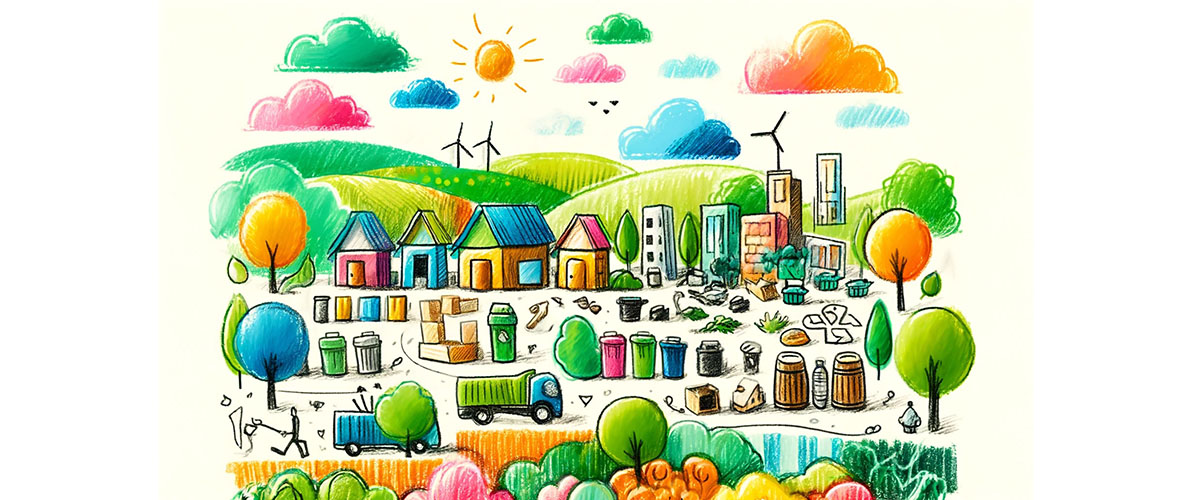
What is waste management is answered from the European regulatory framework: it is the planning, execution, and verification of actions necessary to minimise, manage, and recover waste generated during the construction, use, refurbishment, and demolition of a building. The Waste Framework Directive 2008/98/EC (amended by 2018/851) establishes the 5-level hierarchy that governs all waste management: (1) prevention, (2) preparing for reuse, (3) recycling, (4) other recovery (including energy recovery), and (5) landfill disposal. Each lower level should only be activated when the one above is not technically or economically viable.
In the construction sector, construction and demolition waste (CDW) represents the largest waste stream in the EU: 374 million tonnes/year (Eurostat, 2020), 35% of the total. The Directive requires a recovery rate of 70% by weight by 2020, a target Spain has not achieved: the actual rate stands at 40% (PEMAR 2016–2022), compared to 90% in the Netherlands or 85% in Germany. This gap defines the urgency of waste management in Spanish building construction.
Spanish regulation: from RD 105/2008 to Ley 7/2022
Royal Decree 105/2008 regulates the production and management of CDW in Spain: it requires a Waste Management Plan for any construction project with a budget exceeding €50,000, mandates on-site separation of fractions when thresholds are exceeded (80 t of concrete, 40 t of metals, 1 t of plastics), and establishes a bond of 120% of the estimated management cost as a guarantee of compliance.
Ley 7/2022 on Waste and Contaminated Soil for a Circular Economy significantly strengthens the framework: it requires mandatory source separation into at least 7 fractions (wood, mineral fractions, metals, glass, plastics, gypsum, textiles), establishes a landfill tax of €30–40/t (depending on waste type) that will be progressively increased, and introduces the obligation to use a minimum of 5% recycled materials in public works (with gradual increases). Royal Decree 1055/2022 develops packaging and packaging waste provisions with direct implications for construction material packaging.
CDW composition and recycling rates by material
The typical composition of CDW in Spain is: concrete and ceramics (70–75%), wood (4–5%), metals (2–3%), gypsum (3–5%), plastics (1–2%), glass (0.5–1%), and other (10–15%). Each fraction has different recovery potential. Concrete is crushed to produce recycled aggregate conforming to EN 12620 and used in structural concrete (up to 20% substitution in EHE-08 for ≤ 40 MPa), road sub-bases, or fill. Steel is recycled at 85–90% via electric arc furnace with 74% energy savings compared to blast furnace.
Wood that is untreated can be reused as structural timber or processed into particleboard; wood treated with CCA (pre-2004) requires management as hazardous waste. Gypsum is 100% recyclable with no loss of properties (Placo and Knauf operate recycling plants). Construction plastics (PVC from pipes and window frames, PE from waterproofing) have recycling rates of 30–50%, limited by contamination and polymer variety. Flat glass is recycled as cullet with 25% energy savings for every 10% substitution. Overall, the theoretical recovery potential of CDW exceeds 85%, compared to the 40% actually achieved in Spain.
Waste management during the operational phase of buildings
Waste management is not limited to the construction phase. Operational building waste (municipal solid waste generated by occupants) amounts to 450–500 kg/person·year in Spain (Eurostat, 2021). A 40-dwelling apartment building generates approximately 60–80 tonnes of waste/year. Building design directly influences the recycling rate: the inclusion of waste rooms sized for 5–7 fractions (organic, paper, packaging, glass, textiles, oil, electronic waste) increases the separation rate from 25–30% to 60–70% according to studies by the Barcelona Metropolitan Area (AMB).
Pneumatic collection systems (such as Envac, installed in the 22@ district of Barcelona and Sarriguren in Navarra) eliminate street containers and automate separation, achieving recycling rates of 45–55% with less public space occupation. Community rooftop urban gardens, fed with compost from the building’s organic waste, close the biological cycle on-site. The BREEAM standard (credit Wst 01) awards points to buildings that include operational waste management facilities with direct access from dwellings and a system for monitoring the volume generated.
Circular economy in building: towards zero waste
The circular economy in building extends waste management to the entire life cycle. The concept of Design for Disassembly (DfD) designs the joints between components to facilitate dismantling and reuse at the end of the building’s useful life: mechanical connections (screws, clips) instead of chemical ones (adhesives, welds), layering of components with different lifespans (structure 100 years, facade 40 years, services 20 years), and full documentation of materials through material passports (Madaster platform).
The long-term goal is zero waste construction: ensuring that 100% of a demolished building’s materials are reused or recycled. The Netherlands leads this transition with the Circular Building Agenda 2023–2030, which requires all new public buildings to be demountable and use a minimum of 50% recycled or reused materials. The ABN AMRO Circular Building project (Amsterdam, 2017) was built with 95% reused or recycled materials and designed for complete disassembly, demonstrating that zero waste is not a utopia but a design process.
References
- [1]Directive (EU) 2018/851 amending Directive 2008/98/EC on wasteOfficial Journal of the European Union.
- [2]Ley 7/2022, de 8 de abril, de residuos y suelos contaminados para una economía circularBOE.
- [3]Real Decreto 105/2008: Regulación de la producción y gestión de los residuos de construcción y demoliciónBOE.
- [4]Waste statistics — Construction and demolition wasteEuropean Commission.
- [5]Circular Construction: Measuring Circularity in the Built EnvironmentPlatform CB'23 / Rijkswaterstaat.

Comments 0
No comments yet. Be the first!
Leave a comment