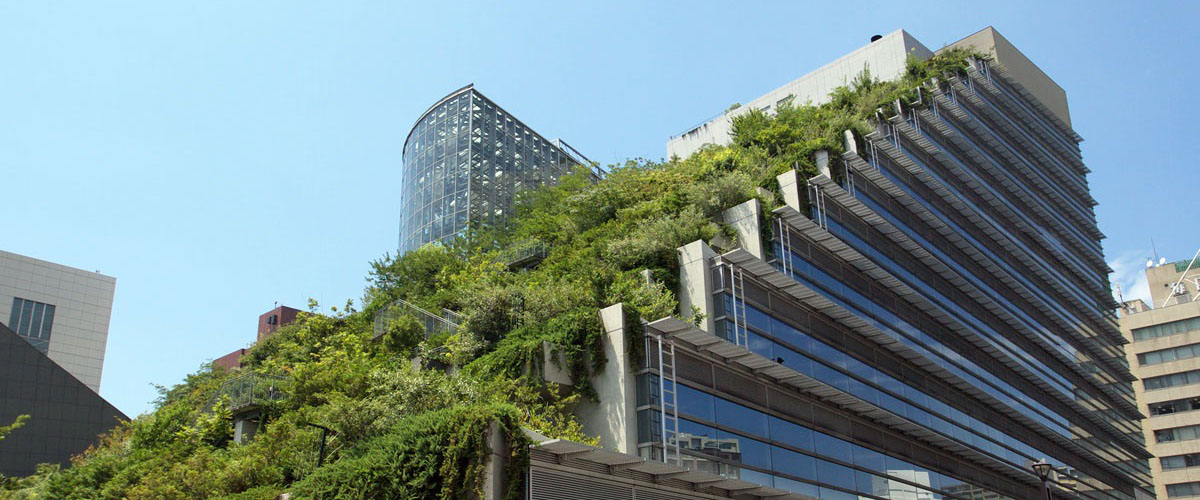
ACROS Fukuoka and the Asian pioneers of monumental green roofs
The world's most inspiring green roof projects demonstrate that integrating nature and architecture at a large scale is both technically feasible and environmentally transformative. The ACROS Fukuoka Prefectural International Hall (Japan, 1995), designed by Emilio Ambasz, represents the foundational paradigm: a 14-story building that integrates 35,000 m² of terraced green roofs across 15 levels on its south facade, connecting the 5,400 m² Tenjin Central Park to the rooftop via a continuous vegetated staircase. The project houses 76 plant varieties, including 37,000 plants and 120 tree species that have grown into a mature urban forest. Measurements taken by Kyushu University document a roof surface temperature reduction of 15 °C compared to the adjacent conventional roof, and a 30% decrease in the building's cooling demand. Annual maintenance costs amount to 12 EUR/m², offset by energy savings of 85,000 EUR/year and the documented appreciation of the surrounding urban environment, reflected in an 8% increase in the cadastral value of plots within a 500-meter radius.
In Southeast Asia, Jewel Changi Airport (Singapore, 2019), designed by Moshe Safdie, is the world's largest indoor garden under a glass and steel structure: 22,000 m² of vegetation distributed across 5 terrace levels surrounding the indoor Rain Vortex waterfall, standing 40 meters high as the world's tallest in an enclosed space. The project integrates more than 2,000 trees and 100,000 shrubs from 120 species, with a climate control system maintaining temperatures between 23 and 25 °C and relative humidity between 60% and 70% at an energy consumption rate of 150 kWh/m²·year, which is 35% lower than equivalent shopping centers without vegetation. The Parkroyal on Pickering (Singapore, 2013), by WOHA Architects, contributes 15,000 m² of green terraces and suspended gardens in a 16-story building, tripling the green area of the original 5,000 m² plot and reducing the local heat island effect by 3 °C according to measurements by the Building and Construction Authority of Singapore.
Bosco Verticale and the green roof revolution in Europe
Bosco Verticale (Milan, Italy, 2014), designed by Stefano Boeri Architects, revolutionized the green roof concept by extending vegetation across the entire envelope of two residential towers standing 80 and 112 meters tall. The project integrates 800 trees (3, 6 and 9 meters high), 4,500 shrubs and 15,000 perennial and ground-cover plants distributed across the perimeter terraces of 113 apartments. The plant biomass is equivalent to 30,000 m² of forest and meadow compressed into a 3,000 m² plot, absorbing 30 tonnes of CO₂ and generating 19 tonnes of oxygen annually according to data from the environmental study by Laura Gatti, the project's botanist. Each tree was subjected to wind tunnel testing at speeds of up to 160 km/h to verify the anchoring system's resistance, which consists of 8 mm stainless steel cables tensioned to the concrete structure. The additional cost of the vegetation represented 5% of the total construction budget, with annual maintenance of 90,000 EUR managed by a company specializing in work at height.
In northern Europe, the Vancouver Convention Centre (Canada, 2009) has one of the most extensive non-industrial green roofs in North America, with 24,000 m² of native grass meadow and 400,000 plants from 28 species native to British Columbia. The roof provides habitat for 240,000 bees managed in 4 hives producing 40 kg of honey annually, as well as seabirds such as gulls and terns that nest among the vegetation. The system retains 80% of annual precipitation (1,153 mm in Vancouver), reducing stormwater runoff to the sewer system by 22,000 m³/year. In Copenhagen, 8 House (BIG Architects, 2010) features 1,700 m² of terraced green roofs on a figure-eight structure housing 476 dwellings, while CopenHill (BIG, 2019) transforms the roof of a waste incineration plant into a 450-meter artificial ski slope with 10,000 m² of integrated green roof that filters airborne particles and absorbs 3.5 tonnes of CO₂/year.
Iconic green roofs in the Americas and the Middle East
In North America, the California Academy of Sciences (San Francisco, 2008), designed by Renzo Piano, features an undulating roof of 10,000 m² planted with 1.7 million native plants from 9 species of the Californian ecoregion. The seven artificial hills on the roof reach heights of 3 to 10 meters and house automated skylights that open when the indoor temperature exceeds 24 °C, reducing air conditioning demand by 35%. The substrate, 15 to 40 cm thick and composed of 50% recycled coconut fiber, retains 13 million liters of rainwater annually. In Chicago, Millennium Park (2004) includes the Lurie Garden spanning 10,000 m² atop the underground parking structure, with 240 perennial plant species and a 120 cm substrate layer that retains 20 million liters/year of runoff. The High Line in New York (2009-2014), although technically an elevated park on former railway infrastructure, functions as a linear green terrace stretching 2.33 km with 500 plant species planted in 210,000 m² of substrate, having catalyzed real estate investment of 5 billion USD in its surroundings.
In the Middle East, the Dubai Expo 2020 Sustainability Pavilion (designed by Grimshaw Architects) integrates 4,500 m² of green terraces with xerophytic species adapted to temperatures of up to 50 °C and subsurface drip irrigation that consumes 75% less water than conventional gardens in the region. The building generates a 50% energy surplus through photovoltaic panels integrated into the upper roof, while the vegetation reduces indoor temperature by 7 °C compared to the outdoor environment. In Latin America, the Consorcio Santiago Building (Chile, 2011, Enrique Browne and Borja Huidobro) was a pioneer with its 3,000 m² west-facing vegetated facade composed of ivy (Parthenocissus tricuspidata) that reduces solar heat gain by 40% during summer and allows sunlight through in winter when the leaves drop. The documented energy savings reach 48% in cooling, with a facade vegetation maintenance cost of 6 EUR/m²·year. The Bioclimatic Hospital of Puyo (Ecuador, 2020), designed by PMMT Arquitectura, incorporates 2,200 m² of tropical green terraces that regulate indoor temperature between 22 and 26 °C without mechanical climate control in an equatorial climate with an average temperature of 24 °C and annual precipitation of 4,500 mm.
Trends and global impact data of inspiring green roofs
Global data confirm the accelerating expansion of inspiring green roof projects. The worldwide green roof market reached 2.8 billion USD in 2023 and is projected to reach 4.5 billion by 2028, with a compound annual growth rate of 9.8% (Grand View Research, 2023). Germany leads with more than 120 million m² of installed green roofs, followed by Japan (28 million m²), the United States (15 million m²) and Switzerland (12 million m²). Public policies have been decisive: Hamburg subsidizes 60% of installation costs up to a maximum of 100 EUR/m²; Copenhagen has required green roofs on all new construction with slopes below 30% since 2010; Toronto has mandated green roofs on new buildings larger than 2,000 m² since 2009, covering a minimum of 20% to 60% of the roof area depending on building size. These regulations have generated more than 500,000 m² of new green roofs annually in Toronto alone.
The cumulative impact of these inspiring projects transcends individual buildings and transforms urban ecosystems. A study by the University of Melbourne (Williams et al., 2021) estimated that converting 30% of available rooftops in a city of 1 million inhabitants into green roofs would reduce the average urban temperature by 0.5 to 1.2 °C, decrease stormwater runoff by 15% to 25%, capture 5,000 to 12,000 tonnes of CO₂/year and create habitat supporting a 30% increase in urban pollinator biodiversity. Acoustic measurements taken at Bosco Verticale in Milan document a reduction of 8 to 12 dB in traffic noise in the vegetated terrace apartments, equivalent to a perceived reduction of 50% in sound level. The most advanced projects integrate productive rooftops: the 14,000 m² terrace of the Nature Urbaine building in Paris (2020) houses the largest rooftop urban farm in Europe, producing 1,000 kg of fruits and vegetables daily during peak season, supplying 3 restaurants and 400 neighborhood families.
References
- [1]A Vertical Forest: Instructions Booklet for the Prototype of a Forest CityCorraini Edizioni. ISBN: 978-88-7570-519-4
- [2]Ten Years of Green Roof Research: A Synthesis and RoadmapUrban Forestry & Urban Greening, 62, 127153.
- [3]Green Roof Market Size, Share & Trends Analysis Report, 2023-2028Grand View Research, Inc..
- [4]Green Roofs as Urban Ecosystems: Ecological Structures, Functions, and ServicesBioScience, 57(10), 823-833.
- [5]Green Roofs as a Means of Pollution AbatementEnvironmental Pollution, 159(8-9), 2100-2110.


Comments 0
No comments yet. Be the first!
Leave a comment