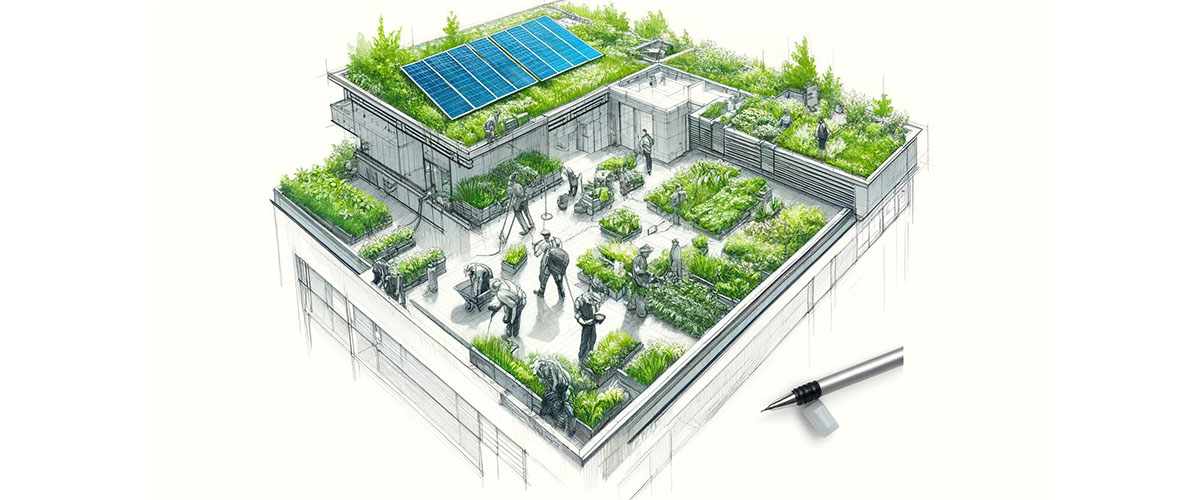
Structural assessment and preliminary planning for a green roof
Successfully implementing a green roof begins with a rigorous structural assessment to determine the load-bearing capacity of the existing or planned floor slab. Extensive green roofs (substrate depth of 6 to 20 cm) generate saturated loads of 60 to 150 kg/m², while intensive systems (substrate depth of 20 to 100 cm) reach 200 to 500 kg/m² according to the German FLL standard (Forschungsgesellschaft Landschaftsentwicklung Landschaftsbau, 2018 edition), an internationally adopted technical reference for green roof design. A conventional reinforced concrete slab with a depth of 25 cm supports imposed loads of 200 kg/m² under the Spanish Building Technical Code (CTE DB SE-AE), which is sufficient for extensive roofs but inadequate for intensive systems without reinforcement. Preliminary planning must include a geotechnical study of the building, calculation of additional surcharges from water accumulation (a 50 mm rainfall event instantly adds 50 kg/m²), and verification of punching shear resistance at support points for planters or trees, which can concentrate loads of 800 to 2,000 kg over areas of 1 m².
Planning also involves defining the perimeter drainage system and the minimum roof slope. Standard UNE 104416:2009 establishes minimum slopes of 1% for green roofs with bonded waterproofing membranes and 2% for unbonded membranes. Slopes below 1% cause permanent waterlogging that asphyxiates roots and accelerates substrate degradation, reducing the installation's service life from the expected 40 years to fewer than 10. The budget must account for the waterproofing phase (15-25 EUR/m²), root barrier layer (3-8 EUR/m²), drainage (8-15 EUR/m²), substrate (10-60 EUR/m²), vegetation (8-40 EUR/m²), irrigation system (5-20 EUR/m²) and specialized labor (15-50 EUR/m²), totaling a range of 60 to 250 EUR/m². The return on investment falls between 6 and 15 years when factoring in energy savings, extended waterproofing lifespan and a property value increase of 3% to 7% documented by studies from the National Research Council of Canada.
Waterproofing and layered system of a green roof
Waterproofing is the most critical layer of a green roof, as its failure compromises the building's structural integrity. The most widely used systems are plasticized PVC membranes (1.2-2.0 mm thick), TPO membranes (thermoplastic polyolefin, 1.5-2.0 mm) and EPDM membranes (ethylene propylene diene monomer rubber, 1.1-1.5 mm). PVC offers hot-air weldability with weld strength exceeding 8 N/mm per EN 12317-2, facilitating watertight joint execution. The root barrier, mandatory under EN 13948:2006, prevents roots from piercing the waterproofing: root resistance tests require 2-year exposure to roots of Quercus ilex and Cupressus sempervirens without perforation. The cost of repairing a leak in an installed green roof ranges from 500 to 5,000 EUR per intervention, as it requires removing vegetation, substrate and drainage layers to access the membrane, which underscores the need for flawless execution.
The layered system is organized from bottom to top in a sequence where each layer serves a distinct function: structural support, vapor barrier (200 µm polyethylene sheet with vapor permeability below 0.5 g/m²·day), thermal insulation (extruded polystyrene XPS, 60 to 120 mm thick with compressive strength of 300 kPa), waterproofing membrane, root barrier (if not integrated into the membrane), mechanical protection layer (geotextile of 300 to 500 g/m²), drainage layer (HDPE nodular sheet 20 to 60 mm high with drainage capacity of 3 to 9 liters/m²·min per EN ISO 12958), filter layer (geotextile of 100 to 150 g/m² retaining particles larger than 90 µm), substrate and vegetation. Each layer must overlap a minimum of 10 cm at its joints and extend 15 cm above the substrate level where it meets vertical surfaces. Omitting or under-sizing any layer causes systemic failures: without the filter layer, fine substrate particles clog the drainage within 2 to 5 years; without the vapor barrier, interstitial condensation degrades thermal insulation by 25% over 10 years.
Substrate and vegetation selection for a green roof
Green roof substrate differs radically from conventional topsoil: it must combine low density (800 to 1,200 kg/m³ at saturation versus 1,600-1,800 kg/m³ for natural soil), high drainage capacity (minimum permeability of 0.6 mm/min per the FLL standard), water retention of 35% to 65% by volume, and stability against organic decomposition. The typical composition includes 70-80% mineral components (expanded clay, volcanic pozzolana, recycled crushed brick with 2-16 mm particle size) and 20-30% organic components (mature compost with a C/N ratio above 25:1). The FLL standard limits organic matter to 65 g/l in extensive substrates and 90 g/l in intensive ones, since excess organic matter decomposes and reduces substrate thickness by 10% to 20% during the first 5 years, compromising planting stability. The optimal pH lies between 6.0 and 8.5, and salinity must remain below 3.5 g/l to avoid osmotic stress in the vegetation.
Plant selection is determined by substrate depth, climate zone, sun exposure and the anticipated maintenance level. For extensive roofs with substrates of 6 to 12 cm, species of the genus Sedum (S. album, S. acre, S. spurium, S. sexangulare) are the benchmark: they tolerate surface temperatures from -20 °C to +50 °C, withstand droughts lasting 60 days and cover 90% of the surface within 12 to 18 months from planting at densities of 16 to 25 units/m². Semi-intensive roofs (substrate depth of 12 to 25 cm) support grasses (Festuca ovina, Festuca glauca), aromatic herbs (Lavandula angustifolia, Thymus vulgaris) and perennials (Dianthus deltoides, Origanum vulgare), which increase arthropod biodiversity by 60% to 300% compared to Sedum monoculture roofs (Madre et al., 2013). Intensive roofs (substrate deeper than 25 cm) support shrubs and small trees (Olea europaea, Punica granatum, Cercis siliquastrum) with root systems confined in structural polypropylene containers with capacities of 200 to 1,000 liters and wind uplift anchoring designed for winds of 120 km/h.
Irrigation system, maintenance and monitoring of a green roof
The irrigation system is essential for ensuring plant survival during establishment periods and summer droughts. Subsurface drip irrigation embedded in the substrate, with self-compensating emitters delivering 2 to 4 liters/hour spaced 30-40 cm apart, is the most efficient system for green roofs, achieving distribution uniformity of 90% to 95% and application efficiency of 90% compared to 60-70% for sprinkler irrigation. Water requirements vary by typology: extensive Sedum roofs need 2 to 4 liters/m²·week during July and August in a Mediterranean climate, while intensive roofs with turf reach 8 to 15 liters/m²·week. Integrating volumetric substrate moisture sensors (FDR probes with a 0-100% range and ±2% accuracy) enables demand-based irrigation scheduling, reducing water consumption by 30% to 50% compared to fixed-schedule programming. Connecting the irrigation system to a rainwater collection tank of 50 to 100 liters per m² of catchment roof can cover 60% to 80% of annual irrigation needs in climates with precipitation exceeding 500 mm/year.
Maintenance of a successful green roof is structured across three intensity levels. Extensive roofs require 2 to 4 annual visits (cost of 1.5 to 4 EUR/m²·year) for weed control, perimeter drainage inspection, replacement of dead plants and slow-release fertilization (NPK 15-9-11, applied at 40 to 60 g/m² in spring). Intensive roofs demand 12 to 24 annual visits (cost of 8 to 25 EUR/m²·year) including pruning, mowing, phytosanitary treatments and planting renewal. Monitoring through IoT sensors (substrate moisture, leaf temperature, waterlogging detection) connected to cloud platforms enables early problem detection: a drop in volumetric moisture below 15% for more than 72 hours triggers water stress alerts that prevent plant mortality. Annual waterproofing inspection using infrared thermography (resolution of 0.05 °C) detects incipient moisture before it causes structural damage, at an inspection cost of 3 to 8 EUR/m² that avoids repairs costing up to 100 EUR/m². The service life of a properly maintained green roof reaches 40 to 50 years for the waterproofing (versus 20-25 years on exposed roofs) and is indefinite for the vegetation with periodic replacements.
References
- [1]Richtlinie für die Planung, Bau und Instandhaltung von DachbegrünungenFLL, Bonn. ISBN: 978-3-940122-63-7
- [2]A Survey of Green Roof Biodiversity: Flora and Arthropods Diversity on Parisian Green RoofsEcological Engineering, 57, 28-36.
- [3]State-of-the-Art Analysis of the Environmental Benefits of Green RoofsApplied Energy, 115, 411-428.
- [4]Green Roofs: A Critical Review on the Role of Components, Benefits, Limitations and TrendsRenewable and Sustainable Energy Reviews, 57, 740-752.
- [5]Performance of Green Roofs as a Stormwater Management TechniqueNRC Institute for Research in Construction, NRCC-47705.


Comments 0
No comments yet. Be the first!
Leave a comment