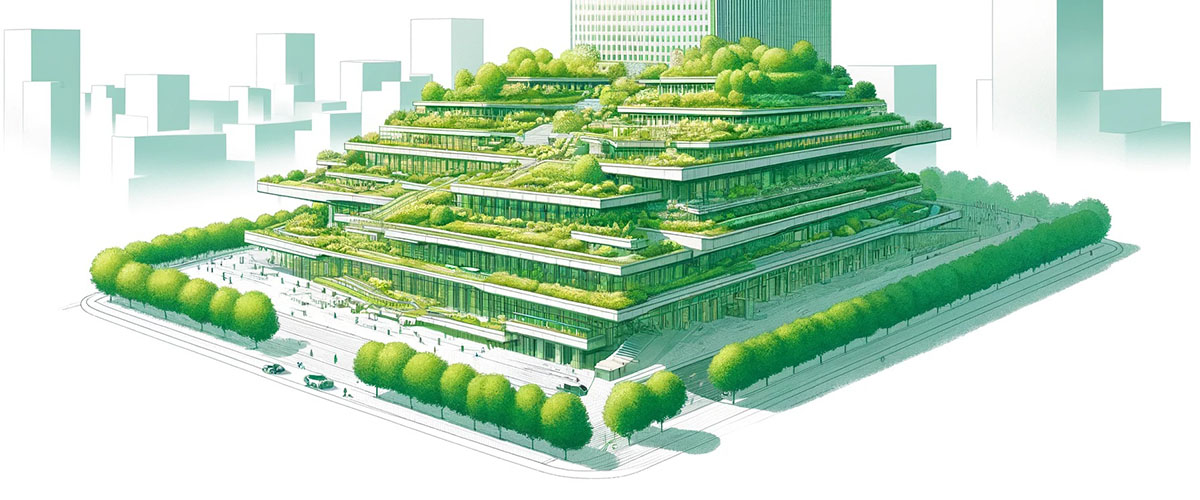
Vertical Gardening Systems: Technical Classification and Performance
Vertical gardening merging art, design and sustainability transforms inert surfaces into productive ecosystems. The systems are classified into 5 technical categories: (1) hydroponic green walls (Patrick Blanc system, 1988) — plants root in synthetic felt (polyamide/polyester) fixed to a waterproofed PVC panel, without substrate, irrigated by drip with nutrient solution (EC: 1.2-2.0 mS/cm, pH: 5.5-6.5); (2) substrate green walls — modular panels with lightweight substrate (perlite + peat + coconut fiber, density 200-400 kg/m³, thickness 80-150 mm); (3) box-type modular systems (GreenScreen, ANS Living Walls) — prefabricated modules of 400×600 mm or 600×600 mm with pre-vegetated substrate that are mechanically fixed to the facade; (4) cables and meshes for climbing plants — stainless steel structures (cables Ø 3-6 mm, mesh 200×200 mm) that guide climbing plants (Hedera, Parthenocissus, Wisteria); (5) hybrid systems that combine vegetated panels with artistic or functional elements.
The performance of a living wall varies according to the system and planting density (25-60 plants/m²): surface temperature reduction of the facade by 10-15°C in summer (Cameron et al., 2014), equivalent to additional insulation of R = 0.3-0.7 m²K/W; acoustic absorption of 5-10 dB (absorption coefficient α = 0.3-0.6 at frequencies of 500-2,000 Hz); CO₂ capture of 2-4 kgCO₂/m²·year through photosynthesis; particle filtration of PM10 and PM2.5 (10-30% retention in the immediate surroundings of the wall); and rainwater retention of 30-50% of intercepted precipitation. The weight of the water-saturated system ranges from 30-80 kg/m² (hydroponic/felt) to 80-200 kg/m² (thick substrate), requiring structural verification of the facade per Eurocode 1-1.
Botanical Design: Species Selection and Microclimatic Zoning
The botanical design of the vertical garden requires species selection adapted to 4 microclimatic factors that vary across the wall surface: (1) orientation — south (direct radiation 4-8 hours/day, substrate temperature up to 45-55°C), north (permanent shade, stable temperature 15-25°C), east/west (partial sun); (2) height — plants in the upper zone (>6 m) receive more wind and radiation, requiring xerophytic species; those in the lower zone (<2 m) are protected and accept shade species; (3) local climate — USDA hardiness zone (Spain: 8b-11a, minimum temperatures from -9°C to +4°C); (4) water availability — systems with automatic irrigation allow greater diversity than those with manual irrigation.
For a Mediterranean climate (USDA zone 9-10), recommended species include: direct sun — Rosmarinus officinalis, Lavandula angustifolia, Sedum spp., Helichrysum italicum, Festuca glauca (water consumption: 2-4 l/m²·day in summer); partial shade — Heuchera spp., Ajuga reptans, Liriope muscari, Carex spp. (consumption: 3-5 l/m²·day); full shade — Nephrolepis (fern), Asplenium, Tradescantia, Chlorophytum (consumption: 4-6 l/m²·day). Planting density is 25-40 plants/m² for felt systems and 15-25 plants/m² for modular substrate systems. The landscape architect Patrick Blanc has installed more than 300 living walls across 5 continents with his hydroponic felt system, using up to 250 different species on a single wall (Musée du Quai Branly, Paris, 2004: 800 m², 15,000 plants of 150 species).
Irrigation Engineering, Nutrition and Maintenance
The irrigation system of the vertical garden is the most critical component for its long-term survival. Drip irrigation with 16 mm polyethylene lines and pressure-compensating emitters (2-4 l/h, pressure range 0.5-4 bar) distributes water from the top of the wall, utilizing gravity. Irrigation frequency varies from 2-4 cycles/day in summer (duration 3-8 minutes per cycle) to 1-2 cycles/day in winter. Total water consumption is 3-8 l/m²·day in summer and 1-3 l/m²·day in winter for hydroponic systems; substrate systems retain more water and require 30-50% less irrigation.
Fertigation delivers nutrients dissolved in the irrigation water: NPK solution 3-1-2 (nitrogen-phosphorus-potassium) with micronutrients (Fe, Mn, Zn, B) at an electrical conductivity of 1.2-2.0 mS/cm. Irrigation water pH is maintained between 5.5-6.5 to optimize nutrient uptake. Capacitive moisture sensors installed at 3-5 points on the wall (upper, middle, lower zones and corners) automate irrigation based on substrate/felt moisture (activation threshold: 30-40% of field capacity). Annual maintenance includes: quarterly pruning (removal of dead plants, growth control: 4-6 hours/100 m² per session), plant replacement (replacement rate: 5-15%/year), irrigation system inspection (emitter cleaning, pump verification) and nutrient solution analysis. Maintenance cost is 25-60 EUR/m²·year for hydroponic systems and 15-35 EUR/m²·year for substrate systems.
Landmark Projects: From the Quai Branly to the Bosco Verticale
The Musée du Quai Branly (Paris, 2004, Jean Nouvel + Patrick Blanc) was the project that popularized vertical gardening at the architectural scale: 800 m² of hydroponic living wall with 15,000 plants of 150 species, irrigated by a closed-loop system with 90% water recirculation. After 20 years of operation, the wall maintains a vegetation coverage of 85-90% with a maintenance cost of 40-50 EUR/m²·year. The CaixaForum Madrid (2008, Herzog & de Meuron + Patrick Blanc) integrates 460 m² of vertical garden with 15,000 plants of 250 species on its 24 m high party wall, transforming a blank wall into an urban landmark and reducing surface temperature by 12-15°C in summer.
The Bosco Verticale (Milan, 2014, Stefano Boeri Architetti) took vertical gardening to the extreme: 900 trees (height 3-9 m), 5,000 shrubs and 11,000 ground-cover plants distributed across the balconies of two residential towers of 80 m and 112 m. The plant biomass is equivalent to 3 hectares of forest and absorbs 30 tonnes of CO₂/year. The additional cost of the vegetation system (structural reinforced concrete planters, waterproofing, automatic irrigation, rope-access arboricultural maintenance) was 5-8% of the total building cost. The One Central Park project (Sydney, 2014, Ateliers Jean Nouvel + Patrick Blanc) combines 1,120 m² of living walls with a motorized heliostat that reflects sunlight toward the shaded gardens on the podium, and a greywater recycling system that supplies 100% of irrigation water. These projects demonstrate that vertical gardening is technically and economically viable at the building scale, with a system service life of 15-25 years before full replacement of substrate or felt.
Environmental, Economic and Regulatory Impact of Vertical Gardening
The cost-benefit analysis of a 200 m² vertical garden in a Mediterranean climate shows: initial investment of 30,000-100,000 EUR (150-500 EUR/m² depending on the system), annual maintenance of 5,000-12,000 EUR (25-60 EUR/m²), energy savings from reduced cooling demand of 1,500-3,000 EUR/year (15-25% reduction on the treated facade), property value increase of 3-7% (Perini & Rosasco, 2013) and non-monetized benefits (biodiversity, air quality, occupant wellbeing). The direct payback is 15-25 years, but the social return (benefits for the urban community) reduces the effective payback to 8-15 years.
Urban planning regulations in cities such as Paris (Plan Biodiversité 2018: obligation to vegetate 30% of facades in new construction >1,000 m²), Singapore (LUSH 3.0: green ratio of 1:1 relative to plot area) and Milan (ordinance inspired by the Bosco Verticale) drive the adoption of living walls. In Spain, the ordinances of Vitoria-Gasteiz (European Green Capital 2012) and the Climate Plan of Barcelona incentivize green roofs and facades with property tax reductions of 10-30%. The LEED SS Sustainable Sites certification awards credits for heat island reduction (green roofs and facades with equivalent SRI >29), and BREEAM Hea 04 (health and wellbeing) recognizes the positive impact of vegetation visible from workstations on occupant wellbeing, with 2 additional credits.
References
- [1]The Vertical Garden: From Nature to the CityW.W. Norton & Company. ISBN: 978-0-393-73379-6
- [2]Cost–benefit analysis for green façades and living wall systemsBuilding and Environment, 70, 110-121.
- [3]The domestic garden — Its contribution to urban green infrastructureUrban Forestry & Urban Greening, 13(1), 129-137.
- [4]A Vertical Forest: Instructions Booklet for the Prototype of a Forest CityCorraini Edizioni. ISBN: 978-88-7570-519-4
- [5]Comparative life cycle analysis for green façades and living wall systemsEnergy and Buildings, 43(12), 3419-3429.

Comments 0
No comments yet. Be the first!
Leave a comment