Zero waste in construction: an ambitious goal with a defined roadmap
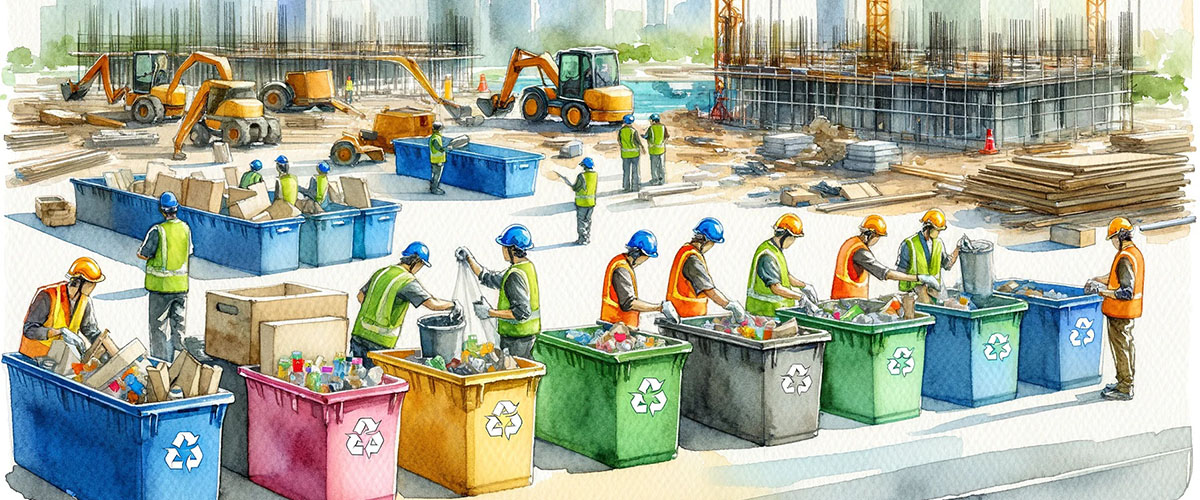
The path toward zero-waste construction entails a systemic transformation: from the linear model of "extract-manufacture-build-demolish-landfill" to a circular model where every material entering a building retains value upon leaving it. The concept of "zero waste" does not mean literally zero — thermodynamics prevents that — but rather a target of landfill diversion exceeding 95% through a combination of prevention (30-50%), reuse (10-20%), recycling (30-40%), and energy recovery (below 5%). According to the Zero Waste International Alliance, the goal is "to design and manage products and processes to systematically avoid and eliminate the volume and toxicity of waste, conserve and recover all resources, and not burn or bury them." This definition distinguishes zero waste from mere high-rate recycling: it prioritises prevention over end-of-pipe treatment and demands a fundamental rethinking of how buildings are designed, assembled and eventually decommissioned.
The gap between current practice and the zero-waste target is large but measurable. In the EU, 69% of CDW is recovered (2020, Eurostat), yet the vast majority is processed as downcycling — crushed concrete used as road sub-base, valued at 2-5 EUR/tonne compared to 15-30 EUR/tonne for the virgin natural aggregate it replaces. The rate of direct reuse of construction materials without reprocessing remains below 1% in most countries (EEA, 2020). In the United States, the EPA reports a CDW recycling rate of approximately 55%, with concrete and metals dominating recovered volumes while mixed fractions continue to be landfilled. The real challenge is not to recycle more but to reuse more and, above all, to generate less waste from the design stage. This requires architects, structural engineers and contractors to embed circular principles into their standard workflows rather than treating waste management as a post-construction administrative task.
Technical challenges: why construction generates so much waste
Construction generates waste for structural reasons that must be addressed systematically to approach zero waste. Non-modular design: buildings are routinely designed with irregular dimensions that force cuts in standardised materials (boards, panels, blocks); dimensional coordination to standard modules could reduce this waste by 20-30%. Irreversible connections: welding, adhesives, in-situ cast concrete, and cement mortar create permanent bonds that prevent material separation at end of life; reversible mechanical connections — bolting, screwing, interlocking — are technically viable and proven in steel and timber construction but remain underutilised in masonry and facade systems. Material mixing: composite systems such as sandwich panels, adhesive-bonded external insulation (ETICS), and wet-trade partitions make post-use separation and classification extremely difficult, often rendering entire assemblies unrecyclable.
Logistical challenges are equally significant. The lack of space on urban construction sites for sorting — containers for 6-8 fractions require 30-50 m2 of dedicated surface area — limits implementation in dense city contexts. Cultural resistance among site workers persists: sorting demands training and supervision, and a BRE (2018) study documented that 40% of nominally sorted waste was contaminated by incorrect mixing. Immature supply chains for reused materials present another barrier: few established platforms for material exchange exist, quality standardisation is lacking, and warranties are difficult to provide for second-hand components. Regulatory challenges compound the problem: structural codes in most countries do not recognise reused structural elements without original manufacturer CE marking, and specific fiscal incentives for reuse remain absent in the majority of jurisdictions, despite existing subsidies for recycling. Overcoming these barriers requires coordinated action across design, procurement, regulation and workforce development.
Opportunities: emerging technologies and business models
Technological opportunities for zero-waste construction are advancing rapidly across multiple fronts. BIM with circularity attributes creates digital models that document the composition, disassemblability, and residual value of every building element — forming the foundation for material passports on platforms such as Madaster. 3D printing (additive manufacturing) deposits material only where structurally required, generating waste below 2% compared to 10-15% in conventional construction. Robotic deconstruction — robots such as the ERO system developed at ETH Zurich — can disassemble concrete structures to controlled particle sizes without destructive demolition, enabling high-quality material recovery. IoT sensors in waste containers provide real-time monitoring of fill levels and composition, optimising collection logistics and reducing the number of partially loaded transport runs.
Emerging business models are reshaping the economics of material flows. Material-as-a-service arrangements, where manufacturers retain ownership of the material and recover it at building end-of-life, are being piloted through platforms such as Turntoo and the Excess Materials Exchange in the Netherlands. Material exchange platforms have achieved operational scale: Rotor DC processes 5,000 tonnes per year of reclaimed building materials in Brussels, Harvest Map operates in the Netherlands, and SalvoWEB serves the UK market. Urban material banks — publicly managed warehouses that inventory materials from forthcoming demolitions and make them available for new construction within the same city — are being developed in Copenhagen and Amsterdam as municipal infrastructure. The economic prize is enormous: the Ellen MacArthur Foundation (2021) estimates that the circular economy in construction could generate 360,000 million euros per year in Europe by 2040 and create 700,000 new jobs, predominantly in material recovery, quality assessment, logistics and digital platform management.
Real cases: projects achieving over 90% landfill diversion
The Circle House project (Aarhus, Denmark, 2020) — a development of 60 social housing units designed by Lendager Group with circularity criteria — achieved 90% landfill diversion through an integrated strategy: prefabricated concrete structure with bolted connections enabling future disassembly, brick facade assembled in pre-mounted recoverable panels, accessible building services installed in dedicated service zones rather than embedded in walls, and all materials documented in a digital passport. The cost premium was 3-5% above a conventional equivalent, but the residual value of materials at the end of the building's design life (50 years) is estimated at 20-25% of original construction cost. This residual value fundamentally alters the whole-life economic equation: the building functions as a long-term material investment rather than a depreciating asset destined for demolition waste.
The SuperLocal project (Kerkrade, Netherlands, 2022) — 5 dwellings constructed with 98% reused materials sourced from buildings demolished within a 15 km radius — demonstrated that zero waste is achievable at the scale of a complete building. The construction used prefabricated concrete elements cut and reconfigured from donor structures, adapted aluminium window frames, bricks carefully dismounted and re-laid, and recovered building services inspected and certified for continued use. The embodied carbon footprint was 90% lower than that of an equivalent new-build using virgin materials. These pilot projects confirm technical feasibility; the challenge now is scaling them to the mainstream market through regulatory reform that recognises reused materials in building codes, workforce training in deconstruction and reassembly techniques, and development of the circular supply chain infrastructure needed to match material supply from demolitions with demand from new construction projects across metropolitan regions.
References
- [1]Completing the Picture: How the Circular Economy Tackles Climate ChangeEllen MacArthur Foundation.
- [2]Circle House: Denmark's First Circular Social Housing Project — Design and Performance ReportLendager Group / Lejerbo.
- [3]Construction and Demolition Waste: Challenges and Opportunities in a Circular EconomyEEA Report No 14/2020.
- [4]Recovery rate of construction and demolition wasteEuropean Commission / Eurostat.
- [5]Buildings as Material Banks: Final Report — Horizon 2020 Project GA No. 642384European Commission.
- [6]Zero Waste Definition — Peer Reviewed, Internationally AcceptedZWIA.

Comments 0
No comments yet. Be the first!
Leave a comment