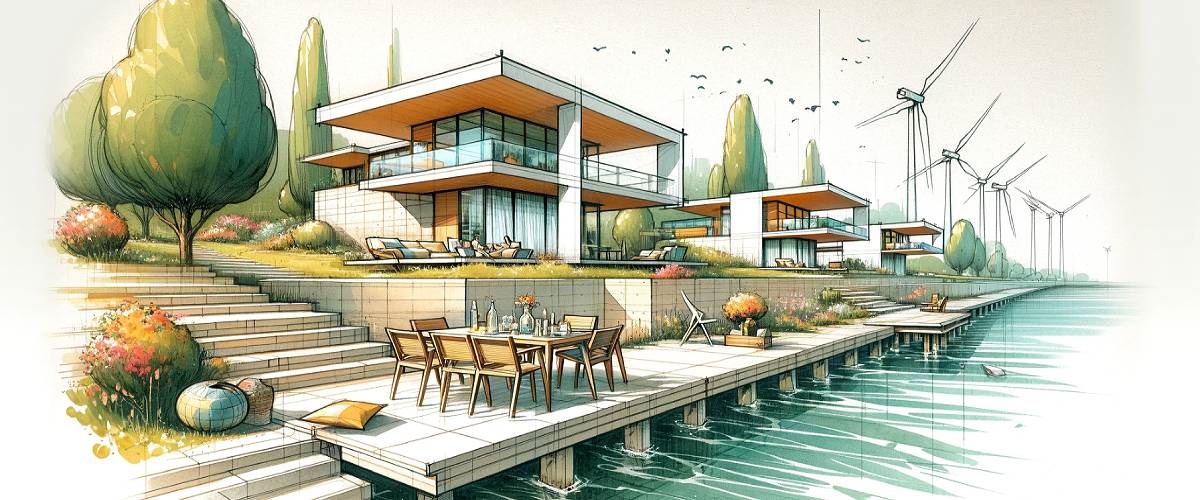
Design as the determinant of 70-80% of environmental impact
Understanding how design decisions impact the life cycle of a building requires quantifying the influence of each decision on LCA modules (EN 15978): material production (A1-A3), transport (A4), construction (A5), use and maintenance (B1-B5), operational energy (B6), operational water (B7), end of life (C1-C4) and benefits beyond the system boundary (D). An analysis by RIBA (2021) of 100 buildings in the United Kingdom concluded that decisions made during the concept design phase (RIBA Stage 2) determine 70-80% of the building's total life cycle emissions — while the optimization margin in later phases (construction, operation) is only 20-30%.
The highest-impact decisions fall into six groups: (1) building form and orientation (impact on B6: operational energy demand), (2) structural system and material selection (impact on A1-A5: embodied carbon), (3) envelope design (impact on B6: thermal losses and gains), (4) services specification (impact on B6: HVAC and lighting efficiency), (5) design for spatial flexibility (impact on B5: refurbishment frequency), (6) design for deconstruction (impact on C1-C4 and D: material recovery at end of life). The LETI Embodied Carbon Primer (London Energy Transformation Initiative, 2020) establishes targets for new buildings: <350 kgCO2eq/m2 of embodied carbon (A1-A5) for residential and <500 kgCO2eq/m2 for offices — figures achievable only if design decisions are optimized from the concept phase.
Orientation, form and envelope: energy demand as the legacy of design
Building orientation relative to the sun determines passive solar capture and climate control demand. A residential building with its main facade oriented south (latitudes 36-43 degrees N) has a heating demand 15-30% lower than one oriented north, with cooling demand controllable through overhangs and louvers. Building form — quantified by the surface-to-volume ratio (S/V) — directly affects thermal losses: a compact building (S/V = 0.3-0.4 m-1 for a 6-storey block) loses 30-50% less heat than a building with an extended geometry (S/V = 0.7-0.9 m-1 for a detached single-family house).
Envelope design determines the energy balance over 50-100 years of operation. An increase of 50 mm of insulation (from 100 to 150 mm of graphite EPS) reduces transmittance from 0.30 to 0.22 W/m2K and heating demand by 8-12 kWh/m2 per year, with an additional cost of 3-5 EUR/m2 and a payback of 3-5 years. The optimal window-to-wall ratio (WWR) varies by orientation: 30-50% south (maximize winter solar gain with summer solar protection), 15-25% north (minimize losses with diffuse light), 20-30% east/west. An excessive WWR (>60%) on the west facade increases cooling demand by 25-40% compared to the optimum. These decisions, made during the first weeks of design, lock in energy demand — and therefore operational emissions — for the entire service life of the building.
Material selection: embodied carbon as the first environmental mortgage
Embodied carbon (modules A1-A5) represents 30-50% of total life cycle emissions in efficient new buildings (NZEB) — and it is an irreversible impact: once the building is constructed, the embodied carbon has already been emitted. Structural system selection is the single highest-impact decision: conventional reinforced concrete generates 200-350 kgCO2eq/m2 (A1-A5), steel 150-300 kgCO2eq/m2, CLT (cross-laminated timber) -50 to +50 kgCO2eq/m2 (net biogenic capture in most analyses) and rammed earth/compressed earth block 5-20 kgCO2eq/m2.
Substituting a conventional reinforced concrete structure with CLT in a 6-storey residential building reduces embodied carbon by 60-80% (Churkina et al., 2020). At the individual material level, design decisions include: specifying concrete with 50-70% GGBS (ground granulated blast-furnace slag) which reduces concrete carbon by 40-60%, using steel with >80% recycled content (electric arc furnace steel: 0.4-0.8 kgCO2/kg vs 1.8-2.5 kgCO2/kg from BOF), choosing bio-based insulation (wood fibre, cork, straw: negative GWP) over petrochemical insulation (EPS, XPS: GWP 2-5 kgCO2/m3), and selecting low-footprint finishes (zero-VOC paint, locally sourced ceramic tiles, FSC-certified timber). The OneClick LCA or Tally tool (BIM plugin) enables calculation of embodied carbon for each alternative in real time during design, with a database of 80,000+ EPDs (Environmental Product Declarations) verified.
Design for flexibility and adaptability
Spatial flexibility determines how frequently a building requires refurbishment over its service life — and each refurbishment generates waste, energy consumption and emissions. A building with a column-and-slab structure (open plan, no internal load-bearing walls) allows space redistribution with demountable partitions (refurbishment cost: 50-100 EUR/m2) compared to a building with internal load-bearing walls (refurbishment cost: 200-500 EUR/m2 including structural reinforcement). Generous floor-to-ceiling heights (>= 3.0 m for offices, >= 2.7 m for residential) enable incorporation of future services (suspended ceiling, raised floor) without vertical extension work.
Accessible building services (exposed or routed through accessible technical galleries, rather than embedded in concrete walls) facilitate maintenance, repair and upgrading without demolition. The "Open Building" concept (John Habraken, 1972) separates the building into layers with different service lives: structure (50-100 years), envelope (30-50 years), services (15-25 years), interior finishes (7-15 years), furniture (3-7 years). Designing each layer with demountable connections allows independent replacement without affecting the others. The ISO 20887:2020 standard (Sustainability in buildings and civil engineering works — Design for disassembly and adaptability) provides the design principles for adaptability. The Triodos Bank HQ project (Zeist, Netherlands, 2019, RAU Architects) was designed as a "material bank": every component is catalogued in a digital material passport (Madaster) that records its composition, location and residual value, facilitating reuse at the end of the building's life.
Design for deconstruction: closing the material loop
Design for Deconstruction (DfD — Design for Disassembly) is the design decision with the greatest impact on modules C1-C4 (end of life) and D (reuse benefits). A building designed for conventional demolition recovers 30-50% of materials (primarily crushed concrete as recycled aggregate and steel for melting); a building designed for deconstruction recovers 80-95% with directly reusable components (steel beams, CLT panels, modular facades, prefabricated services). The difference in module D emissions is -50 to -150 kgCO2eq/m2 of benefit for the deconstructable building.
The principles of DfD include: (1) mechanical connections (bolted, pinned, clipped) instead of chemical bonds (welding, adhesive, mortar); (2) standardized components with modular dimensions allowing reuse in other projects; (3) compatible materials — avoid irreversible composites (example: concrete-insulation-concrete sandwich without demountable connectors); (4) documentation — assembly/disassembly drawings, material passport with composition, origin and certifications; (5) accessibility — connections must be accessible with standard tools, not concealed within layers. Bolted steel structures with composite floor decking and columns with endplate connections are the most favorable for DfD: direct reuse rate of 90-95% of structural steel (SCI, 2019). BREEAM Wst 06 (Design for disassembly and adaptability, 1 credit) and LEED MR Building Life-Cycle Impact Reduction (up to 5 points) certifications incentivize DfD with documentary evidence of the deconstruction plan.
References
- [1]RIBA 2030 Climate Challenge: Version 2 — Embodied and Operational Carbon TargetsRoyal Institute of British Architects.
- [2]LETI Embodied Carbon Primer: Supplementary guidance to the Climate Emergency Design GuideLondon Energy Transformation Initiative.
- [3]Buildings as a global carbon sinkNature Sustainability, 3, 269-276.
- [4]ISO 20887:2020 — Sustainability in buildings and civil engineering works: Design for disassembly and adaptability — Principles, requirements and guidanceInternational Organization for Standardization.
- [5]Steel Reuse: Assessment of Structural Steel Components — Technical ReportSteel Construction Institute.



Comments 0
No comments yet. Be the first!
Leave a comment