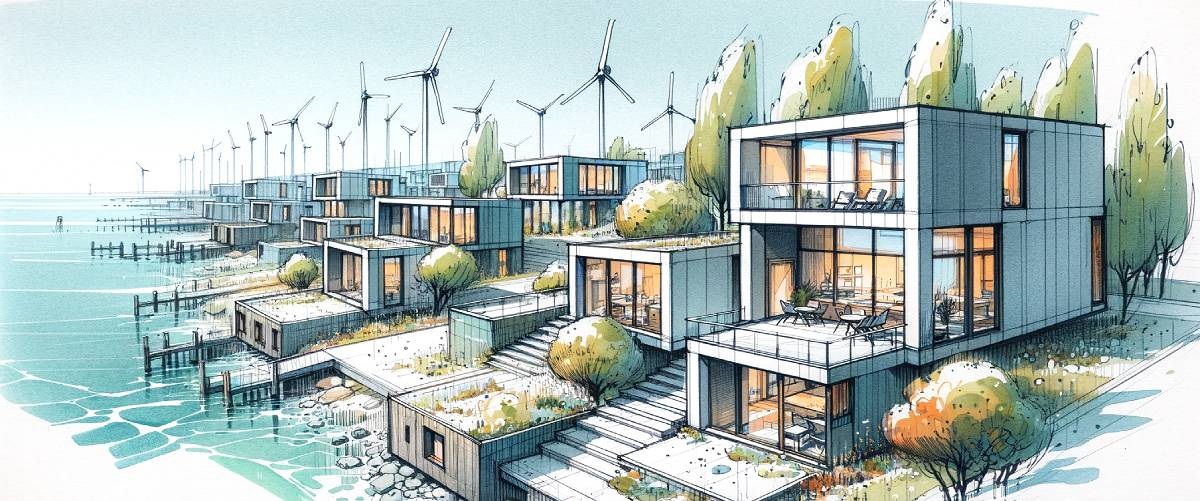
Life Cycle Phases According to EN 15978
Beyond construction, the life cycle of a building spans decades of operation, maintenance, and eventual demolition or deconstruction. The standard EN 15978:2011 (Sustainability of construction works — Assessment of environmental performance of buildings) structures this full life cycle into 4 major stages divided into modules: Product (A1-A3), covering raw material extraction, transport to factory, and manufacturing; Construction Process (A4-A5), including transport to site and construction; Use (B1-B7), covering operational energy, maintenance, repair, replacement, and refurbishment throughout the service life; and End of Life (C1-C4), comprising deconstruction, transport, waste processing, and final disposal. An additional module D accounts for benefits and loads beyond the system boundary (reuse, recycling, energy recovery).
The typical distribution of GHG emissions across the life cycle of an office building with a 50-year service life shows: modules A1-A3 represent 20-30% of total carbon (conventional building) or 40-60% (nearly zero-energy building, nZEB); modules B6-B7 (operational energy and water) represent 50-70% in conventional buildings but only 20-35% in nZEBs; and modules C1-C4 represent 3-5% of the total (RICS, 2017). This inversion of proportions in nZEBs is critical: as operational efficiency improves, embodied carbon (modules A+C) becomes the dominant component, already representing 50-70% of total impact in high-efficiency buildings.
Product and Construction Phase: Initial Embodied Carbon
Modules A1-A3 (product) concentrate the bulk of embodied carbon. Reinforced concrete contributes 200-400 kgCO2eq/m3 (of which Portland cement accounts for 90%), structural steel contributes 1,800-2,000 kgCO2eq/tonne (blast furnace route) or 400-600 kgCO2eq/t (electric arc furnace with scrap), facade aluminium contributes 8,000-12,000 kgCO2eq/t, and float glass contributes 1,200-1,500 kgCO2eq/t (data from the ICE Database v3.0, University of Bath, 2019). A typical 10,000 m2 office building with a reinforced concrete structure has an embodied carbon of 400-600 kgCO2eq/m2 in modules A1-A3.
Modules A4-A5 (construction) add an additional 5-10%: material transport (A4) depends on the weighted average distance (50-300 km in Spain, with an emission factor of 0.06-0.10 kgCO2eq/tkm for trucks), and the construction process (A5) includes equipment fuel consumption (cranes, concrete mixers, compressors), on-site waste generation (5-15% of purchased material becomes construction and demolition waste), and concrete pouring emissions. A study by Pomponi and Moncaster (2016) on 80 European office buildings quantified A4-A5 carbon at 30-60 kgCO2eq/m2, with significant variations depending on project location and the degree of industrialisation in the construction process.
Use Phase: Operation, Maintenance, and Refurbishment
Module B6 (operational energy) has historically been the dominant contributor: a conventional office building in Spain consumes 150-250 kWh/m2 per year (IDAE, 2020), generating 30-50 kgCO2eq/m2 per year with the 2023 Spanish electricity mix (0.12-0.15 kgCO2/kWh according to REE). Over 50 years, module B6 accumulates 1,500-2,500 kgCO2eq/m2, equivalent to 3-5 times the initial embodied carbon. An nZEB building consuming 30-50 kWh/m2 per year with rooftop photovoltaic self-consumption, however, reduces B6 to 300-500 kgCO2eq/m2 over 50 years, matching or falling below its embodied carbon.
Modules B2-B5 (maintenance, repair, replacement, refurbishment) accumulate 10-20% of the total life cycle impact. The elements with the highest replacement frequency are: roof waterproofing (every 15-25 years), HVAC equipment (every 15-20 years), external windows and frames (every 25-35 years), interior finishes (every 10-15 years), and lifts (modernisation every 20-25 years). The cumulative cost of maintenance and replacement over 50 years equals 60-100% of the initial construction cost (BCIS, 2019), demonstrating that the decision to invest in higher initial construction quality delivers a direct return during the use phase.
End of Life: Deconstruction, Recycling, and Circular Economy
Modules C1-C4 represent 3-5% of the total environmental impact but are of growing importance for the circular economy. Selective deconstruction (C1) allows materials to be separated for reuse or recycling, as opposed to conventional demolition which generates mixed waste with low recyclability. The cost of selective deconstruction is 15-30% higher than conventional demolition, but it yields materials with commercial value (steel: 250-350 EUR/t, aluminium: 1,200-1,800 EUR/t, clean timber: 30-60 EUR/t) and reduces waste management costs (10-25 EUR/t at a recycling plant vs 40-70 EUR/t at landfill under Spain's Law 7/2022 tax).
Module D (benefits beyond the system boundary) accounts for avoided impacts through recycling or reuse. According to data from Allwood et al. (2012), direct reuse of structural steel avoids 1.5-1.8 tCO2/t, recycling concrete as aggregate avoids 0.05-0.10 tCO2/t, and energy recovery from timber avoids 0.5-0.8 tCO2/t (displacing fossil fuel). Design for Disassembly (DfD) maximises module D: the ABN AMRO Circl building (Amsterdam, 2017, by de Architekten Cie.) was designed with 95% reusable materials, documented on the Madaster platform, and its module D offsets 30-40% of the embodied carbon from modules A.
Full Life Cycle Analysis: Reference Case Studies
The Bullitt Center (Seattle, 2013, Living Building Challenge certified) has a published full LCA: embodied carbon of 350 kgCO2eq/m2 (glued laminated timber structure), net-zero operational carbon (100% photovoltaic energy, 230 kWh/m2 per year generated vs 160 kWh/m2 per year consumed), and rainwater as the sole water source (95 m3/year captured, treated, and reused). Its 250-year life cycle (design service life) demonstrates an environmental impact 75% lower than an equivalent conventional office building (Miller Hull Partnership, 2013).
In Europe, The Edge (Amsterdam, 2015, PLP Architecture) with its BREEAM Outstanding rating (98.36%) consumes 70 kWh/m2 per year and generates more energy than it uses thanks to 4,100 m2 of photovoltaic panels on the roof and south facade. Its LCA shows a total carbon (A-C) of 800 kgCO2eq/m2 over 50 years, compared to 2,500-3,500 kgCO2eq/m2 for a conventional office building in the Netherlands. The difference of 1,700-2,700 kgCO2eq/m2 multiplied by its 40,000 m2 yields savings of 68,000-108,000 tCO2 over its service life. The systematic application of life cycle thinking, supported by tools such as One Click LCA (150,000+ EPDs) and regulatory frameworks like Level(s) from the European Commission (indicator 1.2: Life Cycle GWP), is transforming decision-making in the building sector.
References
- [1]EN 15978:2011 Sustainability of construction works — Assessment of environmental performance of buildings — Calculation methodEuropean Committee for Standardization.
- [2]Whole life carbon assessment for the built environmentRoyal Institution of Chartered Surveyors. ISBN: 978-1-78321-215-0
- [3]Inventory of Carbon and Energy (ICE) Database v3.0University of Bath.
- [4]Embodied carbon mitigation and reduction in the built environment — What does the evidence say?Journal of Environmental Management, 181, 687-700.
- [5]Sustainable Materials: With Both Eyes OpenUIT Cambridge. ISBN: 978-1-906860-05-9


Comments 0
No comments yet. Be the first!
Leave a comment