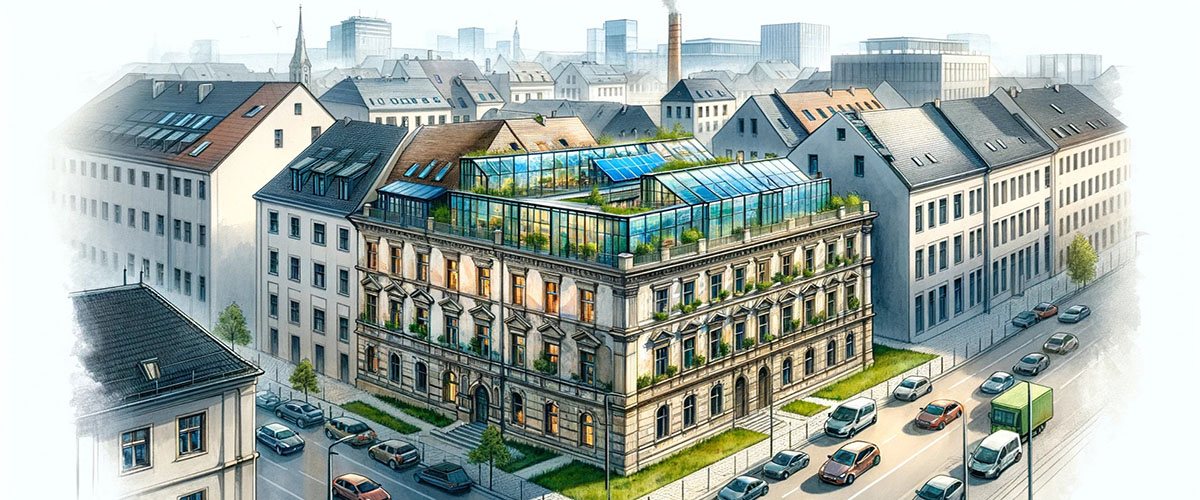
Restoration and sustainability: a natural convergence
Sustainable Materials in Building Restoration is not a contradiction but a natural convergence: historic building materials — lime, earth, stone, timber, plant fibres — are inherently sustainable because they are local, low in embodied energy, and biodegradable. Restoration with materials compatible with the original fabric is, by definition, sustainable restoration. According to ICOMOS (International Council on Monuments and Sites), the rehabilitation of existing buildings avoids the emission of 50-75% of the carbon that constructing an equivalent new building would generate (considering modules A1-A5 of EN 15978), since it reuses the existing structure, which stores 60-80% of the total embodied energy of the building. In the EU, 85% of the building stock was constructed before 1990, and 26% before 1945 (EU Building Stock Observatory, 2023), representing a massive patrimony that requires progressive restoration. This statistic underscores a fundamental point: the greenest building is often the one that already exists, and the materials used to restore it determine whether conservation practice aligns with or contradicts climate objectives.
The problem arises when modern materials incompatible with historic construction systems are used in restoration. Portland cement, introduced massively into restorations during the twentieth century, has caused well-documented damage to historic buildings: its rigidity (elastic modulus 20-30 GPa) compared with the flexibility of original lime mortars (2-8 GPa) generates stress concentrations that crack ashlar blocks; its low vapour permeability traps moisture within walls, accelerating degradation through salt crystallisation and freeze-thaw cycles; and its soluble salt content (alkalis) causes efflorescence and cryptoefflorescence that erodes stone surfaces. The Venice Charter (1964) and the Intervention Criteria of the IPCE (Institute of Cultural Heritage of Spain) establish the principle of material compatibility: restoration materials must be mechanically, physically, and chemically compatible with the originals, and must also be reversible. These principles are not merely theoretical: decades of empirical evidence from failed cement-based repairs across Europe's heritage stock have demonstrated that incompatible materials accelerate decay rather than arrest it, often at costs far exceeding the original repair budget.
Natural hydraulic lime: the quintessential sustainable restoration material
Natural hydraulic lime (NHL) — classified according to EN 459-1 as NHL 2, NHL 3.5, and NHL 5 by compressive strength — is the sustainable restoration material par excellence. Its production generates 0.4-0.6 kgCO2/kg compared with 0.8-0.9 kgCO2/kg for Portland cement, a reduction of 30-55%; furthermore, during the carbonation process (reabsorption of atmospheric CO2), lime reabsorbs 0.2-0.3 kgCO2/kg, reducing the net footprint to 0.1-0.4 kgCO2/kg. Its elastic modulus (2-8 GPa) is compatible with historic stone and brick walls, its vapour permeability (mu = 6-10) allows the wall to breathe, and its compressive strength (2-15 MPa depending on class) covers the requirements of the majority of restorations. The mechanical compatibility of NHL is critical: a mortar that is weaker than the masonry units it bonds ensures that any movement-induced cracking occurs in the joint rather than through the stone, preserving irreplaceable historic fabric at the expense of an easily replaceable pointing mortar.
Specialist manufacturers such as St. Astier (France), Singleton Birch (UK), and Socli (Spain) offer complete NHL ranges with detailed technical documentation. The cost of NHL (0.25-0.60 EUR/kg) is 2-4 times higher than Portland cement (0.08-0.15 EUR/kg), but the additional cost in the total restoration budget is marginal (< 2%) since mortar represents a small fraction of the total cost. Aged lime putty (slaked lime matured over months or years) remains the ideal material for repointing historic stone and brick masonry, with strengths of 0.5-2 MPa that guarantee the mortar is the sacrificial element (failing before the stone) in accordance with the principle of mechanical compatibility. In Spain, the IPCE has documented more than 500 exemplary restorations using lime mortars between 2000 and 2023. The accumulated evidence from these projects demonstrates that NHL mortars not only perform better over the long term than cement-based alternatives in heritage contexts but also require less frequent maintenance interventions, making them more cost-effective over the building's extended service life.
Ecological insulation in historic buildings: performance without altering character
Thermal insulation of historic buildings presents a specific challenge: external insulation (ETICS) alters the original facade, while internal insulation reduces usable space and can create interstitial condensation. Sustainable materials offer compatible solutions: hemp-lime mortar (hempcrete) applied as an internal lining (thicknesses of 50-100 mm) provides a thermal conductivity of lambda = 0.07-0.09 W/m-K with a vapour permeability of mu = 3-5 that prevents condensation. Natural expanded cork (lambda = 0.037-0.040 W/m-K, mu = 5-30) is another traditional Mediterranean material fully compatible with historic walls, with the additional advantages of resistance to moisture and insects. Both hempcrete and cork share a characteristic that distinguishes them from synthetic insulation products: they are hygroscopic, meaning they can absorb and release moisture without losing thermal performance, which is precisely the behaviour required in thick masonry walls that rely on vapour diffusion to manage internal humidity.
The 3ENCULT project (Horizon 2020, 2010-2014, budget 5.8 million euros) developed and validated energy efficiency solutions specifically for 8 historic buildings across 6 European countries, demonstrating energy demand reductions of 40-75% with compatible materials. Solutions included: aerogel in lime plaster (product Fixit 222: lambda = 0.028 W/m-K in thicknesses of 20-80 mm), calcium silicate panels (lambda = 0.05-0.06 W/m-K, capillary-active, absorbing and releasing moisture), and insulating glass with cavity adapted to historic joinery (U = 1.0-1.3 W/m2-K compared with U = 4.5-5.5 for the original single glazing). The EPBD Directive (2024, recast) explicitly recognises the possibility of exemptions for officially protected buildings when energy efficiency measures would unacceptably alter their character (Article 5.1), but encourages achieving standards through compatible materials and techniques. This regulatory nuance is important: it does not excuse historic buildings from energy performance improvement but rather demands that improvement be achieved through means that respect architectural significance rather than overriding it.
Timber, earth, and lime paint: traditional materials with modern certification
Timber is the most sustainable structural material for restoring buildings with original timber frames (representing 40% of the European building stock dating from before 1900). Restoration timber must meet two requirements: compatibility with the original (same species, similar cross-section, traditional jointing techniques such as carpentry joints) and certified sustainability (FSC or PEFC to guarantee responsible forest management). The cost of certified structural timber (400-800 EUR/m3 for oak, 250-500 EUR/m3 for pine) is 10-20% higher than non-certified timber, but the additional cost is negligible relative to the total restoration budget. In Spain, 2.8 million hectares of Scots pine and 0.6 million hectares of oak (MITERD, 2021) provide local raw material for restorations, with current harvesting below 40% of annual growth. This underutilisation of domestic timber resources represents both an ecological opportunity and an economic one: increased use of locally grown certified timber in restoration simultaneously supports rural employment, reduces transport emissions, and maintains forest health through sustainable management.
Raw earth — rammed earth, adobe, compressed earth blocks (CEB) — is the most sustainable material for restoring vernacular architecture buildings: embodied energy of 0.03-0.15 MJ/kg (compared with 3-5 MJ/kg for fired ceramic brick), emissions of 0.005-0.02 kgCO2/kg, and universal availability. CRAterre (Centre for Research on Earth Architecture, ENSAG Grenoble) has trained more than 2,000 professionals in earth restoration techniques since 1979. Lime paints (slaked lime diluted and applied in 3-5 coats) replace plastic paints on historic facades with advantages in permeability (mu = 6-8 compared with 200-500 for plastic paints), natural disinfectant properties (pH 12-13), and competitive cost (2-5 EUR/m2 per coat). Sustainable Materials in Building Restoration does not require disruptive innovations: it requires recovering the knowledge of traditional materials, certifying them to modern standards, and applying them with technical rigour and respect for heritage. The materials science is established, the certification frameworks exist, and the skilled workforce, though diminished, is being rebuilt through specialist training programmes at institutions like CRAterre, the Building Limes Forum, and the Society for the Protection of Ancient Buildings.
References
- [1]The Future of Our Pasts: Engaging Cultural Heritage in Climate ActionInternational Council on Monuments and Sites. ISBN: 978-2-918086-24-9
- [2]EN 459-1:2015 — Building lime. Part 1: Definitions, specifications and conformity criteriaEuropean Committee for Standardization.
- [3]Conservation of Earthen Architecture: A Guide for International PracticeCentre de Recherche sur l'Architecture en Terre / ENSAG.
- [4]3ENCULT: Efficient Energy for EU Cultural Heritage — Final Report, FP7 Project GA No. 260162European Commission.
- [5]EU Building Stock Database: Age Distribution, Renovation Rates and Energy PerformanceEuropean Commission, DG Energy.
- [6]Criterios de Intervención en el Patrimonio Arquitectónico: Materiales y Técnicas Compatibles — Guía TécnicaInstituto del Patrimonio Cultural de España, Ministerio de Cultura.

Comments 0
No comments yet. Be the first!
Leave a comment