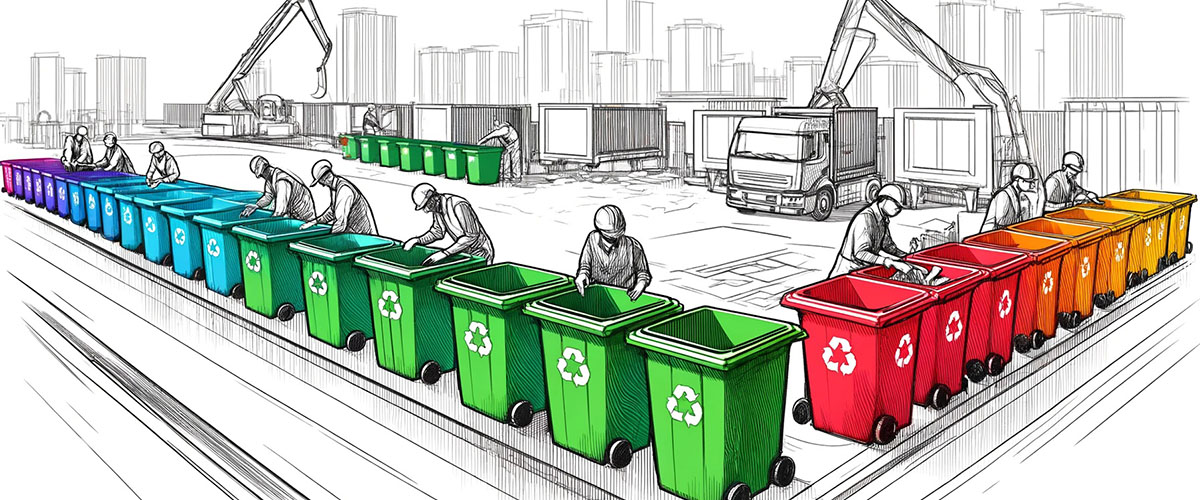
Technological convergence toward zero-waste construction
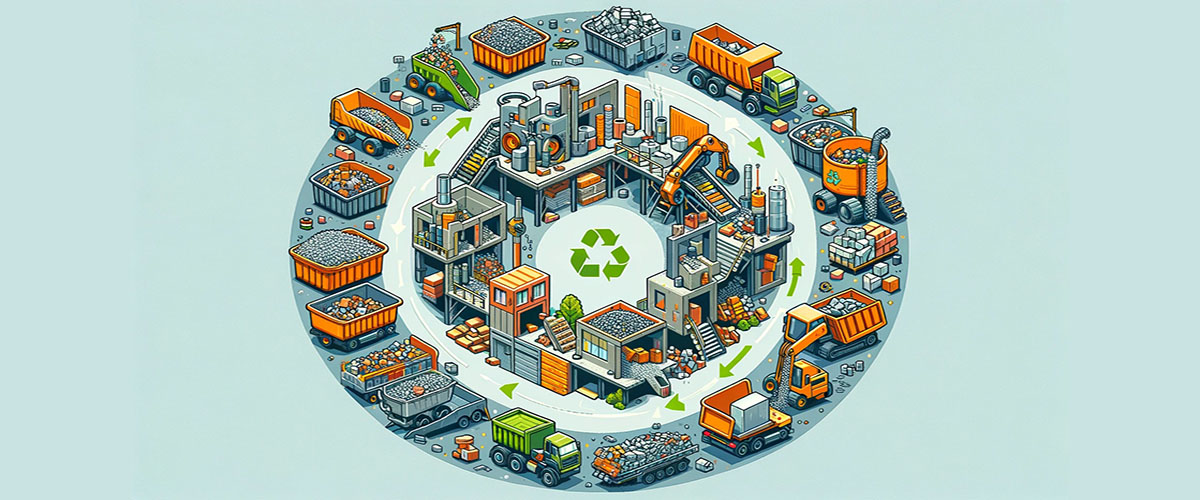
The trends shaping the future of zero-waste construction do not depend on a single disruptive technology but on the convergence of multiple innovations that, combined, make viable what was individually impractical. Digitalisation (BIM, digital twins, IoT, artificial intelligence), industrialisation (prefabrication, 3D printing, robotics), biology (biodegradable materials, renewable-origin building products), and circular business models (material-as-a-service, exchange platforms) are converging to redefine how buildings are designed, constructed, operated, and deconstructed. The World Economic Forum estimated in 2023 that the combined adoption of these trends could reduce construction waste by 75-90% and sector emissions by 50-60% by 2040, representing the most significant transformation opportunity in the industry since the mechanisation of earthworks in the mid-twentieth century.
The regulatory context is accelerating adoption. The European Green Deal (2019) designates construction circularity as a strategic priority. The Circular Economy Action Plan (2020) includes revision of the Construction Products Regulation to introduce requirements for recycled content and recyclability at product level. The EU Taxonomy for Sustainable Activities (2022) establishes circularity criteria that real estate projects must satisfy to access green financing at preferential rates. Investment in circular construction research and development exceeded 2,000 million euros in the EU between 2014 and 2024 through Horizon 2020 and Horizon Europe programmes, funding more than 200 projects across member states. This convergence of technological capability, regulatory pressure and financial incentive creates the conditions for rapid market adoption over the coming decade.
BIM 7D and digital twins: documenting for reuse
BIM 7D (Building Information Modelling with the sustainability and circularity dimension) extends the digital building model to include: the material composition of every element (type, mass, origin, linked Environmental Product Declaration), disassembly instructions (sequence, required tools, estimated time), residual value (market price of the material in reuse or recycling condition), and circularity potential (circularity index calculated using methodologies from Madaster or the Material Circularity Indicator developed by the Ellen MacArthur Foundation and Granta Design). Platforms such as One Click LCA and Madaster already integrate these data attributes with IFC models (ISO 16739), enabling the design team to visualise the "future value" of the building as a material bank alongside its conventional cost and performance metrics.
Digital twins add the temporal dimension that static BIM models lack. A digital twin is a BIM model updated in real time with data from IoT sensors that monitor the condition of materials throughout the building's operational life — measuring deformations, corrosion rates, insulation degradation, and structural loading patterns. When the building reaches end of life or a major refurbishment is planned, the digital twin provides an up-to-date inventory of materials available for reuse, with quality data verified by continuous monitoring rather than estimates based on the original design specification. The SPHERE project (Horizon Europe, 2022-2026) is developing digital twins with circularity attributes for 5 pilot buildings across 4 European countries, with a budget of 8 million euros. Early results indicate that sensor-verified material condition data increases the reuse potential of structural elements by 25-40% compared to assessments based on age-based degradation assumptions alone.
Prefabrication and industrialisation: from 15% waste to 2%
Off-site prefabrication is the trend with the greatest immediate impact on waste reduction. Manufacturing in a controlled factory environment reduces waste through five mechanisms: CNC-optimised cutting achieving material utilisation above 97%, reuse of offcuts within the same production line, quality control that prevents defective components reaching the site, elimination of disposable formwork (factory moulds are reusable for thousands of cycles), and optimised logistics (transport of complete modules rather than loose materials). The data is compelling: volumetric modular construction (complete 3D modules of 30-70 m2) generates 50-70% less waste than equivalent traditional construction (Jaillon et al., 2009), while panelised prefabrication (2D systems) achieves 30-50% less waste. These reductions apply consistently across residential, commercial and institutional building types.
Modular construction has been growing at 8-10% annually worldwide (McKinsey, 2019), led by manufacturers such as Volumetric Building Companies (VBC) in the United States and TopHat in the United Kingdom, which produce complete homes in factory conditions with waste rates below 3%. In continental Europe, developers including AEDAS Homes and Via Celere in Spain have begun incorporating prefabricated bathroom and kitchen pods (3D modules), reducing partition and finishing waste by 40-60%. The longer-term trend is industrial-scale additive manufacturing (3D printing), which deposits material only where it is structurally necessary: printing waste is below 2% of total material used, and AI-driven topological optimisation can reduce the mass of material required by an additional 30-50% compared to conventional design. When prefabrication and additive manufacturing are combined with Design for Disassembly principles, the construction industry moves from a linear consumption model to a closed-loop system where waste becomes a design failure rather than an inevitable by-product.
Biodegradable materials and biological cycles
Biodegradable materials eliminate the concept of "waste" at end of life by decomposing into nutrients that return to the biological cycle. The most advanced developments include: mycelium panels (fungi cultivated on agricultural residues that compost in 30-60 days at end of life, with decomposition emissions below 0.1 kgCO2/kg), hempcrete (hemp-lime concrete that biodegrades in 2-5 years after demolition, releasing calcium carbonate that improves soil quality), PHA bioplastics (produced by bacterial fermentation, achieving complete biodegradation in 3-6 months in soil), and sheep's wool and hemp fibre insulation (compostable without chemical treatment provided synthetic flame retardants are excluded from the formulation).
The Cradle to Cradle (C2C) framework developed by McDonough and Braungart (2002) provides the intellectual architecture for this approach, distinguishing between the technical cycle (materials designed for indefinite recycling: metals, glass, technical polymers) and the biological cycle (materials designed for biodegradation: timber, earth, natural fibres, bioplastics). A C2C building combines both cycles: a steel or CLT structure (technical cycle, recyclable), hemp insulation (biological cycle, compostable), copper installations (technical cycle, recyclable), and earth and lime finishes (biological cycle, returnable to soil). The Cradle to Cradle Certified programme (version 4.0, 2021) evaluates more than 5,000 products globally, of which over 800 are construction materials. The trends shaping the future of zero-waste construction converge on a single vision: buildings as temporary repositories of valuable materials, digitally documented, designed for disassembly, constructed with recyclable or biodegradable materials, and managed throughout their operational life with real-time data. This vision is technically achievable with current technologies; the barrier is the speed of adoption by a traditionally conservative industry and the regulatory framework that must shift from penalising landfill disposal to actively incentivising circularity.
References
- [1]Transforming the Built Environment: A Roadmap to Net Zero and CircularityWorld Economic Forum.
- [2]Quantifying the waste reduction potential of using prefabrication in building construction in Hong KongWaste Management, 29(1), 309-320.
- [3]Cradle to Cradle: Remaking the Way We Make ThingsNorth Point Press. ISBN: 978-0-86547-587-8
- [4]Modular Construction: From Projects to ProductsMcKinsey & Company.
- [5]A New Circular Economy Action Plan — For a Cleaner and More Competitive Europe, COM(2020) 98 finalEuropean Commission.
- [6]Madaster Platform: Material Passports and Circularity Index — Technical DocumentationMadaster Services BV.

Comments 0
No comments yet. Be the first!
Leave a comment