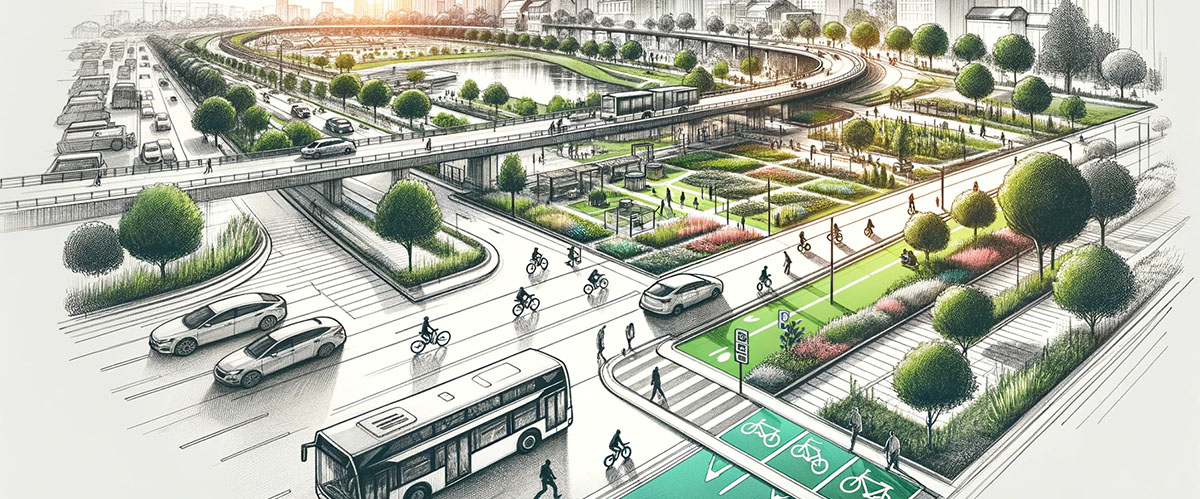
Thermal and climate benefits of urban green spaces
Green spaces are the most effective tool against the urban heat island effect in sustainable cities. According to a meta-analysis published in The Lancet Planetary Health (2021), urban parks with a minimum area of 3 hectares reduce the surrounding air temperature by between 2 and 5 °C within a radius of up to 400 metres, a phenomenon known as the Park Cool Island (PCI) effect. The city of Singapore, with tree canopy coverage of 47% of its total area, records urban temperatures 3.8 °C lower than cities of similar latitude and density but with less green cover. At the European scale, the European Environment Agency (2022) estimates that increasing urban green cover from 20% to 30% would reduce heat-wave deaths by 23%, which reached 61,672 people across Europe during the summer of 2022.
The water retention capacity of green spaces complements thermal regulation. One square metre of vegetated soil absorbs between 20 and 40 litres of rainfall per hour, compared with less than 2 litres for conventional asphalt. The Benthemplein water square in Rotterdam, designed with 1,800 m³ of retention capacity, prevents sewer overflows during storms with intensities of up to 60 mm/hour. In Copenhagen, the Cloudburst Management Plan (2012) allocated 1.1 billion euros to the creation of 300 green infrastructure projects that manage 30% of the city's stormwater, reducing flood damage estimated at 800 million euros per extreme event.
Impact on public health and well-being
The scientific evidence on the role of green spaces in human health has reached epidemiological levels of certainty. The longitudinal study by the Barcelona Institute for Global Health (ISGlobal, 2019), conducted with 3.6 million participants across 9 countries, demonstrated that living within 300 metres of a green space of at least 5,000 m² is associated with a 12% reduction in premature all-cause mortality. The mechanisms include the reduction of PM2.5 particulates (a mature tree filters between 20 and 50 kg of particulates per year), stress reduction (cortisol levels 21% lower after 20 minutes spent in a green area) and the promotion of physical activity.
The mental health benefits associated with green spaces in cities represent a quantifiable healthcare saving. The Green Prescriptions programme of the United Kingdom's National Health Service (NHS), which prescribes activities in natural spaces to patients with mild-to-moderate anxiety and depression, documented in 2023 that participants reduced their GP visits by 28% and anxiolytic consumption by 18% during the 12 months following enrolment. The WHO estimates that every euro invested in accessible urban green spaces yields a return of 4 to 10 euros in avoided healthcare costs, labour productivity and social cohesion, according to its Urban Green Spaces and Health (2016) report.
Urban biodiversity and ecosystem services
Well-designed green spaces function as biodiversity reservoirs in sustainable cities. The urban wildlife inventory of Berlin, published by the Senate Department for the Environment (2023), records more than 20,000 species of flora and fauna in the city, of which 65% depend directly on parks, gardens and green corridors for their survival. Urban ecological corridors — continuous green strips at least 50 metres wide — enable species migration between habitat fragments: Vitoria-Gasteiz, European Green Capital 2012, maintains a Green Belt of 613 hectares connecting 6 peri-urban parks and hosting more than 214 bird species, 40 mammal species and 800 vascular plant species.
The ecosystem services provided by urban vegetation have a quantified economic value. The i-Tree programme, developed by the United States Forest Service (USDA) and applied in over 130 cities worldwide, calculates that New York City's urban tree canopy delivers services valued at 122 million dollars annually: 52 million in pollutant removal, 36 million in runoff reduction, 28 million in energy savings from shade and 6 million in carbon sequestration. In Madrid, the 2022 municipal inventory records 1.7 million trees that sequester 17,600 tonnes of CO₂ annually and filter 1,850 tonnes of atmospheric pollutants, with an estimated ecosystem services value of 46 million euros per year.
Planning and standards for green cities
International per-capita green space standards guide the planning of sustainable cities. The WHO recommends a minimum of 9 m² of green space per inhabitant within 300 metres of the home, while the European Union sets a target of 15 m²/inhabitant in its Biodiversity Strategy 2030. Leading European cities far exceed these thresholds: Vienna has 120 m²/inhabitant, Gothenburg has 87 m²/inhabitant and Zurich has 79 m²/inhabitant. In contrast, southern European cities such as Athens (2.5 m²/inhabitant) and Istanbul (6.4 m²/inhabitant) fall below the recommended minimums, exposing them to greater climate and health risks.
Integrating green spaces into urban planning requires instruments such as green infrastructure plans, which are mandatory for cities with more than 20,000 inhabitants in several European countries. France has required since its Biodiversity Act of 2016 that urban planning schemes include a minimum biotope area factor, set between 0.30 and 0.60 depending on the zone, which obliges each plot to dedicate a proportion of its area to permeable or vegetated surface. Berlin pioneered this with its Biotope Area Factor (BAF), introduced in 1994, which requires a minimum of 0.30 in residential areas and 0.45 in new developments. The result has been the creation of more than 1,300 green roofs and 850 green facades in the German capital, adding 4.2 million m² of additional green surface compared to the area that existed before the standard was implemented.
References
- [1]Green spaces and mortality: a systematic review and meta-analysis of cohort studiesThe Lancet Planetary Health.
- [2]Who Benefits from Nature in Cities? Social Inequalities in Access to Urban Green and Blue Spaces across EuropeEEA. ISBN: 978-92-9480-534-0
- [3]Urban Green Spaces and Health: A Review of EvidenceWHO Regional Office for Europe. ISBN: 978-92-890-5215-3
- [4]i-Tree: Tools for Assessing and Managing Community ForestsUSDA.
- [5]EU Biodiversity Strategy for 2030 — Bringing Nature Back into Our LivesEuropean Commission.
Comments 0
No comments yet. Be the first!
Leave a comment