The BEE Indicator and CASBEE Framework
CASBEE (Comprehensive Assessment System for Built Environment Efficiency), Japan's sustainability assessment system, employs a fundamentally different evaluation methodology than its Western counterparts. Developed in 2001 under the leadership of Professor Shuzo Murakami and commissioned by the Ministry of Land, Infrastructure, Transport and Tourism (MLIT), CASBEE uses the Building Environmental Efficiency (BEE) indicator, calculated as the ratio of environmental quality (Q) to environmental load (L). This Q/L formulation elegantly captures the dual objective of maximizing indoor quality while minimizing external environmental impact, and it produces results that can be plotted on a two-dimensional chart rather than collapsed into a single score.
The BEE ratio determines five rating levels: C (poor, BEE < 0.5), B⁻ (slightly poor, 0.5-1.0), B⁺ (good, 1.0-1.5), A (very good, 1.5-3.0), and S (excellent, BEE > 3.0). As of 2024, more than 47,000 buildings have been evaluated under CASBEE across Japan. The system offers four primary assessment tools: CASBEE for Building Design (BD), New Construction (NC), Existing Building (EB), and Renovation (RN). Specialized variants address urban-scale assessment (CASBEE Urban), heat island effects (CASBEE Heat Island), and workplace wellness (CASBEE Wellness Office), reflecting Japan's characteristic thoroughness in developing tools for specific use cases.
Quality Categories and Indoor Environment Standards
The Q (Quality) side of the BEE equation evaluates three categories. Q1 addresses indoor environmental quality, with benchmarks that include CO₂ concentrations below 1,000 ppm, formaldehyde levels under 0.08 ppm, and illuminance standards differentiated by space function. Japan's historical experience with "sick building syndrome" in the tightly sealed, mechanically ventilated buildings of the 1980s and 1990s drove particularly stringent indoor air quality requirements in CASBEE, including specific provisions for volatile organic compounds beyond formaldehyde.
Q2 evaluates service quality, encompassing structural durability (with design lifespans of 60 to 100 years for highest ratings), functional flexibility, and maintenance accessibility. Q3 assesses the building's contribution to outdoor environmental quality, including landscape design, townscape harmony, and contribution to local biodiversity. The L (Load) categories mirror this structure: L1 covers energy consumption using Japan's PAL* (Perimeter Annual Load) and ERR (Energy Reduction Ratio) metrics, L2 addresses resource consumption with targets including 95% construction and demolition waste recycling rates, and L3 evaluates off-site environmental impacts including transportation emissions and regional ecological effects.
Seismic Resilience Integration
CASBEE is unique among major green building rating systems in its explicit integration of seismic resilience as a sustainability criterion. Japan's location on the Pacific Ring of Fire, where four tectonic plates converge, produces approximately 1,500 perceptible earthquakes annually. The Building Standard Law (BSL) requires structures to withstand ground accelerations of 300 to 400 gal without collapse, and the seismic index Is must equal or exceed 0.6 for a building to be deemed adequately earthquake-resistant. CASBEE awards credits for exceeding these code minimums, recognizing that a building destroyed by an earthquake represents the ultimate sustainability failure.
Base isolation technology, which decouples a building from ground motion using elastomeric bearings or sliding systems, has been installed in over 5,000 buildings across Japan. CASBEE credits base-isolated structures for their superior occupant safety and reduced post-earthquake repair costs. The 2011 Tohoku earthquake and tsunami reinforced the importance of this integration: buildings with base isolation systems in the affected region experienced dramatically less structural and non-structural damage, maintaining functionality as emergency shelters while conventionally founded structures required extensive repairs. This experience validated CASBEE's approach of treating resilience and sustainability as inseparable rather than competing objectives.
ZEB Targets and Energy Performance
Japan's Zero Energy Building (ZEB) roadmap, established by MLIT in conjunction with the Energy Conservation Law revisions, sets a target of making all new buildings ZEB Ready by 2030. The ZEB designation requires a minimum 50% reduction in primary energy consumption compared to the reference building standard, with the remaining energy demand offset by on-site renewable generation. By 2023, approximately 1,200 buildings had achieved ZEB Ready status, with the highest concentration in commercial office and educational facility typologies where roof area relative to floor area favors photovoltaic installation.
CASBEE's L1 energy assessment integrates directly with the PAL*/ERR framework established by the Energy Conservation Law. PAL* measures the thermal load on the building perimeter per unit floor area, while ERR quantifies the efficiency of mechanical systems in meeting that load. Together, these metrics provide a granular picture of both passive design quality and active system performance. The Japanese approach differs from Western energy modeling practices by separating envelope performance from systems efficiency, allowing designers and regulators to identify specific improvement opportunities rather than relying on a single composite energy metric.
Adoption Patterns, Iconic Buildings, and International Influence
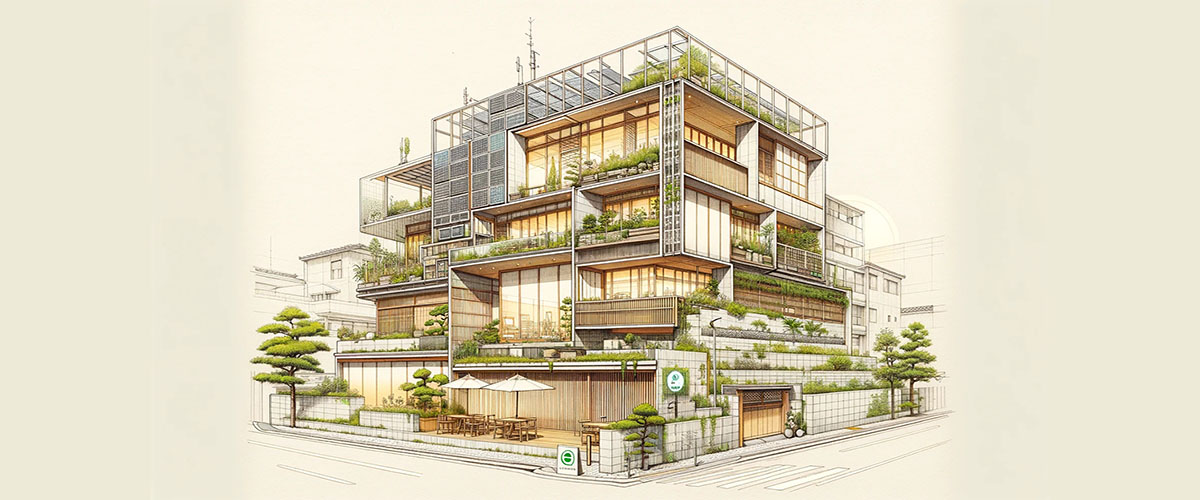
The distribution of CASBEE ratings across evaluated buildings reveals a system calibrated for differentiation rather than broad certification: approximately 5% achieve the S (excellent) rating, 25% earn A (very good), 45% receive B⁺ (good), and the remainder score B⁻ or C. Twenty-four local governments have made CASBEE assessment mandatory for buildings exceeding 2,000 m², creating a substantial database of building performance data that informs both policy development and design practice. Notable CASBEE-rated buildings include ACROS Fukuoka, whose stepped green terraces integrate 35,000 plants into a 97,000 m² commercial complex, and Tokyo Skytree, which achieved a 48% CO₂ reduction compared to a conventional broadcast tower through heat pump systems and natural ventilation strategies.
CASBEE's methodological influence extends well beyond Japan. Singapore's Green Mark, Hong Kong's BEAM Plus, and Thailand's TREES systems all incorporated elements of the BEE indicator approach or adapted CASBEE assessment categories for their regional contexts. Research by Cole and Valdebenito (2013) identified the Q/L ratio as a more intuitive representation of building sustainability than single-score systems for communicating with non-technical stakeholders. Looking forward, CASBEE's 2030 revision roadmap includes the integration of embodied carbon accounting, climate adaptation metrics, and enhanced connections to the UN Sustainable Development Goals, ensuring the system remains aligned with the evolving priorities of international sustainable construction practice.
Comments 0
No comments yet. Be the first!
Leave a comment