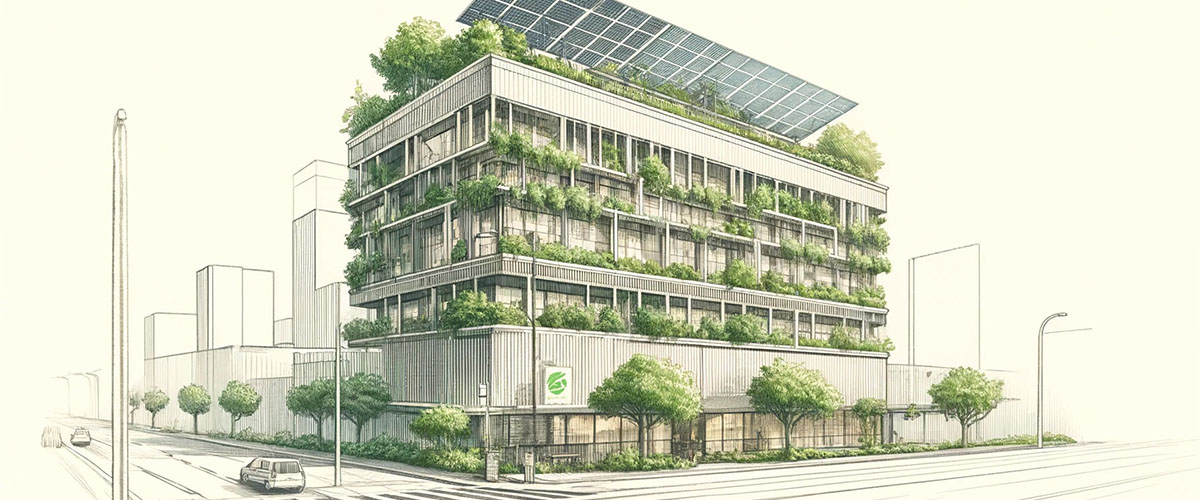
Origin and Structure: The 7 Petals of the Living Building Challenge
The Living Building Challenge (LBC), created by Jason F. McLennan in 2006 under the umbrella of the International Living Future Institute (ILFI), is the most demanding sustainable building certification system in the world. Unlike LEED (which operates with a cumulative points system and allows trade-offs between categories) or BREEAM (which weights percentages by category), the LBC functions as an imperative-based system: each of its 20 imperatives grouped into 7 petals must be fully met, with no exceptions or trade-offs. Version LBC 4.0 (2019) structures the petals as follows: (1) Place (2 imperatives: urban growth boundaries, habitat conservation), (2) Water (1 imperative: 100% water self-sufficiency), (3) Energy (1 imperative: net positive energy self-sufficiency), (4) Health + Happiness (3 imperatives), (5) Materials (5 imperatives), (6) Equity (3 imperatives), and (7) Beauty (5 imperatives).
LBC certification requires 12 consecutive months of verified actual operation before the seal is awarded, unlike LEED (which certifies based on design and construction) or BREEAM (which verifies design and an optional post-occupancy review). This requirement for measured — not modeled — performance makes the LBC the only certification system that guarantees the building performs as designed. Through December 2024, only 39 projects worldwide have obtained full LBC certification (Full Certification), and more than 600 are registered at various stages of the process. The geographic distribution is concentrated in North America (28 projects), with growing presence in Europe (5 projects) and Asia-Pacific (6 projects). The scale of certified projects ranges from single-family homes of 90 m2 to office buildings of 4,800 m2, demonstrating the standard's applicability across multiple typologies.
Energy and Water Petals: Self-Sufficiency Verified Over 12 Months
The Energy petal (Imperative 06: Net Positive Energy) requires the building to produce, through renewable sources located on-site, 105% or more of the energy consumed during the 12-month operational verification period, including all end uses without exception: HVAC, lighting, plug loads, elevators, servers, and electric vehicle charging. The surplus (minimum 5%) is fed to the grid as a net positive contribution to the community. The Bullitt Center (Seattle, 2013, 4,830 m2, 6 stories, designed by Miller Hull Partnership) — the first office building with full LBC certification — produces 230,000 kWh/year through a photovoltaic roof system of 242 kWp (575 panels), compared to a measured consumption of 171,000 kWh/year (equivalent to 35.4 kWh/m2 per year), 60% lower than the average office consumption in Washington State (92 kWh/m2 per year, CBECS 2018).
The Water petal (Imperative 05: Net Positive Water) requires the building to cover 100% of its water demand from rainwater harvesting, greywater reuse, or local regenerative sources, and to treat 100% of its wastewater on-site before infiltrating it or returning it to the hydrological cycle. The Bullitt Center captures 570 m3/year of rainwater from its 960 m2 roof, filters and purifies it through an ultrafiltration + UV + contact chlorination system approved by the Washington State Department of Health, and treats wastewater through a composting system (Phoenix composting toilets) that eliminates the need for a sanitary sewer connection. The Kendeda Building (Georgia Tech, Atlanta, 2019, 3,700 m2, full LBC certification) implemented a rainwater harvesting system of 760 m3/year in a region with annual rainfall of 1,270 mm/year, demonstrating that water self-sufficiency is viable even in humid subtropical climates with irregular rainfall distribution.
Materials Petal: Red List, Transparency, and Embodied Carbon
The Materials petal comprises 5 imperatives that radically transform the construction supply chain. Imperative 10 (Red List) prohibits the use of more than 800 chemical substances grouped into 22 categories, including: added formaldehyde, PVC (polyvinyl chloride), phthalates, halogenated flame retardants (HBCD, TCEP, TDCP), isocyanates (MDI, TDI in polyurethane foams), lead, cadmium, mercury, and perfluorinated compounds (PFAS). The practical difficulty of this imperative is substantial: a study by Magwood and Bowden (2021) documented that the Kendeda Building team evaluated more than 6,000 products during the design process, of which 30% were rejected for containing Red List substances, requiring an alternative search that extended the specification timeline by 4-6 months and increased materials costs by 3-8%.
Imperative 12 (Responsible Sourcing) requires that 100% of timber come from FSC-certified (Forest Stewardship Council) sources or reclaimed wood, and that stone materials do not originate from quarries in protected areas. Imperative 13 (Living Economy Sourcing) establishes minimum percentages for local and regional procurement: at least 20% of the materials budget must come from manufacturers located within 500 km, and at least 30% within 1,000 km of the site. Imperative 14 (Net Positive Waste) requires a construction waste diversion rate of at least 90% (compared to the typical 50-75% in LEED) and a materials management plan for the building's end of life. The Frick Environmental Center (Pittsburgh, 2016, 2,230 m2, full LBC certification) achieved a diversion rate of 97%, with a materials budget featuring 42% regional sourcing (800 km radius) and 100% FSC-certified timber.
Costs, Barriers, and the Horizon of Regenerative Building
The cost premium of an LBC building compared to a conventional building that meets local building code ranges from 10-25% according to aggregated data by ILFI (2023), versus 2-7% for a LEED Platinum building. However, a life cycle cost (LCC) analysis over 30 years demonstrates that LBC buildings generate net operational savings: the Bullitt Center documents energy costs of 0 EUR/year (net positive production fed to grid with compensation), water costs of 0 EUR/year (rainwater harvesting), and maintenance costs reduced by 20% due to the absence of conventional boilers, chillers, and sewer systems. The payback period for the investment premium stands at 12-18 years, considering exclusively direct operational savings, without accounting for brand value, the rental premium (documented at 10-15% higher in buildings with high-performance certifications, according to McGraw-Hill Construction, 2014), or the health and productivity benefits for occupants.
The main barriers to LBC adoption are: (1) local regulations that prohibit rainwater harvesting for human consumption (in effect in several US states and in most EU countries, where Directive 98/83/EC requires connection to a potable water network), (2) limited availability of products free from Red List substances (although the ILFI's Declare database has grown from 500 products in 2015 to more than 4,500 in 2024), (3) complexity of the verification process (12 months of monitoring + third-party audit), and (4) developer resistance to the initial cost premium without specific tax incentives. Nevertheless, the LBC's influence on conventional regulation is measurable: the LEED Zero program (2018) adopted the net positive energy concept; the revised EPBD (Energy Performance of Buildings Directive, 2024) incorporates the zero-emission building (ZEB) concept; and the European Commission's Level(s) framework integrates indicators for water use, materials, and indoor air quality that reflect the LBC philosophy, signaling that the most demanding standard of the present becomes the mandatory regulation of the near future.
References
- [1]Living Building Challenge 4.0 StandardInternational Living Future Institute, Seattle.
- [2]The Philosophy of Sustainable DesignEcotone LLC, Kansas City. ISBN: 978-0-9749033-0-3
- [3]The Kendeda Building for Innovative Sustainable Design: Performance Case StudyGeorgia Institute of Technology / ILFI.
- [4]Bullitt Center: Seven-Year Performance Report 2013-2020Bullitt Foundation, Seattle.
- [5]The Drive Toward Healthier Buildings: The Market Imperative for Green Building Design, Construction and OperationsMcGraw-Hill Construction, New York. ISBN: 978-0-07-183285-0
Comments 0
No comments yet. Be the first!
Leave a comment