Definition and physical principles
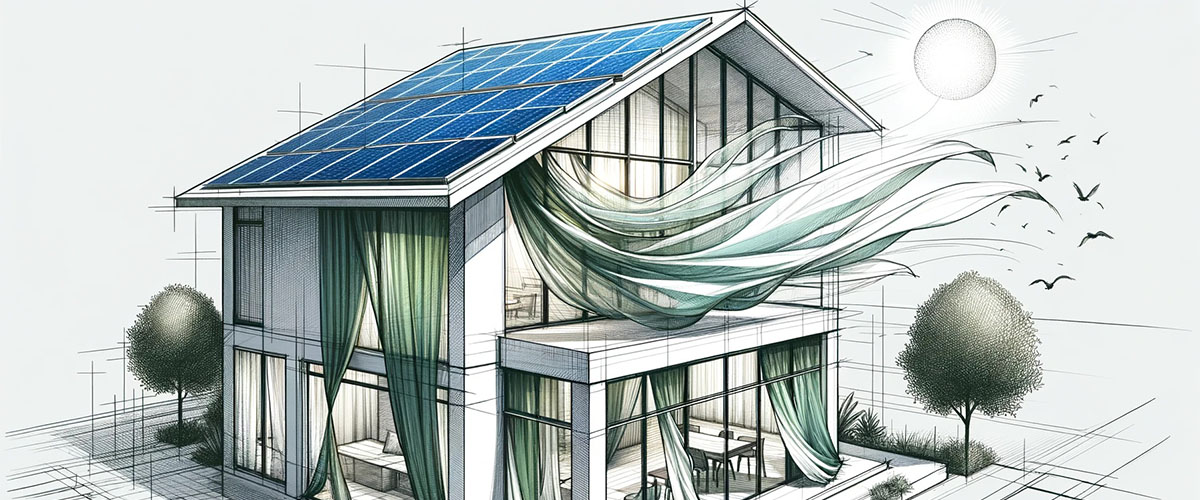
Natural ventilation systems are indoor air renewal strategies that rely exclusively on natural forces — wind pressure and air density differences due to temperature — to move air through a building without mechanical fans. What are natural ventilation systems is answered from physics: they are direct applications of two phenomena: wind pressure (pressure difference between windward and leeward sides of a building) and the stack effect, where warmer, less dense indoor air rises and is replaced by cooler outdoor air entering through lower openings.
Wind-driven pressure is calculated as ΔP_wind = 0.5·ρ·v²·ΔCp, where ρ is air density (1.2 kg/m³), v is wind speed, and ΔCp is the pressure coefficient difference between openings (typically 0.8-1.2 for cross-ventilation). Stack-effect pressure is ΔP_stack = ρ·g·H·(T_int - T_ext)/T_ext, where H is the height between openings (m) and T the absolute temperatures (K). For a 12 m tall building with 5 °C difference, ΔP_stack ≈ 2.0 Pa, sufficient to generate airflow rates of 2-5 m³/s with openings of 1.5-2.0 m².
Types of natural ventilation configurations
Cross-ventilation requires openings on at least two opposite or perpendicular facades. It is the most effective configuration per unit opening area, generating airflow rates proportional to wind speed. Its main limitation is maximum space depth: CIBSE AM10 recommends that the distance between opposite facades with openings should not exceed 5 times the ceiling height (5H). For a 3 m ceiling, maximum depth is 15 m. For single-sided ventilation (openings on one facade only), depth reduces to 2-2.5H (6-7.5 m with 3 m ceilings).
Single-sided ventilation has openings on only one facade. It is less effective: useful airflow penetration is limited to 2-2.5 times ceiling height. Stack-driven ventilation uses a vertical duct (atrium, solar chimney, wind tower) to generate upward draft independent of wind. Solar chimneys amplify the effect by heating air in the duct with solar radiation absorbed by a dark surface, generating temperature differences of 10-20 °C and pressures of 3-8 Pa in 6-15 m ducts. Monitor roof ventilation combines roof-level extraction with lateral admission, ideal for industrial halls and large-span spaces.
Design airflow rates: standards and requirements
EN 16798-1:2019 establishes minimum ventilation rates by category: category I (high quality), 10 l/s per person + 2.0 l/s·m² for building emissions; category II (normal), 7 l/s per person + 1.4 l/s·m²; category III (moderate), 4 l/s per person + 0.8 l/s·m². ASHRAE 62.1-2022 requires similar rates: 2.5 l/s per person + 0.3-0.9 l/s·m² by space type for offices. Spain's CTE DB-HS3 regulates residential ventilation with rates based on bedroom count: 8 l/s for a master bedroom and 4 l/s per additional bedroom.
The reference indicator for air quality is CO₂ concentration: outdoor level is 420 ppm (2024), and EN 16798-1 sets maximum increments of 550 ppm (category I), 800 ppm (II), and 1,350 ppm (III) above outdoor level. An adult at rest generates 18-20 l/h of CO₂; in an office, 20-25 l/h. To maintain CO₂ below 1,000 ppm (category II) with 25 people in a 75 m² classroom, a minimum airflow of 200-250 l/s is needed, equivalent to 8-10 air changes per hour with 3 m ceiling height.
Quantifiable advantages over mechanical ventilation
Mechanical ventilation with heat recovery (MVHR) typically consumes 0.5-2.0 W/(l/s) of Specific Fan Power (SFP). For a 2,000 m² office building with airflow of 3,000 l/s, this represents continuous consumption of 1.5-6.0 kW during occupied hours (2,500 h/year), or 3,750-15,000 kWh/year of electricity. Natural ventilation eliminates this consumption entirely, saving 1.9-7.5 kWh/m²·year in fan energy alone.
Additionally, mechanical systems require ductwork (occupying 5-8% of building volume), air handling units (AHU), filters replaced every 6-12 months, and periodic maintenance of fans and heat recovery units. CIBSE Guide A estimates annual maintenance cost for a mechanical ventilation system at €8-15/m², compared to €1-3/m² for natural ventilation (actuator and sensor maintenance). Natural ventilation also eliminates the risk of duct contamination (Legionella, dust accumulation, biofilm) documented in buildings with poor maintenance.
Limitations and when mechanical ventilation is necessary
Natural ventilation is not applicable in all situations. Exclusion criteria include: areas with facade noise exceeding 65 dB(A) without attenuation options, outdoor pollutant concentrations exceeding Directive 2008/50/EC limits (NO₂ > 40 μg/m³ annual, PM2.5 > 25 μg/m³ annual), buildings requiring air filtration (hospitals, cleanrooms, laboratories per ISO 14644), and climates with prolonged extreme temperatures (> 35 °C or < -10 °C for more than 1,000 hours/year).
In these cases, the optimal solution is mixed-mode (hybrid) ventilation, automatically alternating between natural mode (when outdoor conditions are favourable) and mechanical mode (when thresholds are exceeded). CIBSE Application Manual AM13 classifies three mixed-mode types: complementary (natural + mechanical simultaneous), alternating (one or the other based on sensors), and zonal (natural at facade, mechanical on ground floor or interior zones). Mixed-mode buildings consume 30-60% less HVAC energy than fully mechanical ones, according to UCL Energy Institute data on 200 monitored buildings in the UK.
References
- [1]EN 16798-1:2019 Energy performance of buildings — Ventilation for buildings — Part 1: Indoor environmental input parametersEuropean Committee for Standardization.
- [2]ANSI/ASHRAE Standard 62.1-2022: Ventilation and Acceptable Indoor Air QualityASHRAE.
- [3]AM10: Natural ventilation in non-domestic buildingsChartered Institution of Building Services Engineers. ISBN: 978-1-903287-56-5
- [4]Natural Ventilation of Buildings: Theory, Measurement and DesignJohn Wiley & Sons. ISBN: 978-0-470-66035-5
- [5]CarbonBuzz: Closing the gap between design and operational energy performanceUniversity College London.



Comments 0
No comments yet. Be the first!
Leave a comment