The water cycle in buildings: six stages from intake to return
Understanding what is water management in the built environment requires tracing water through six distinct stages: abstraction from the source, treatment to potable standards, distribution to the building, on-site use across fixtures and appliances, wastewater collection and conveyance, and finally treatment-and-discharge or reuse. Each stage consumes energy, generates emissions, and incurs cost. In Spain, average domestic consumption stands at 132 litres per person per day (INE, 2022), broken down roughly as 35% bathing and showering, 30% toilet flushing, 15% laundry, 10% kitchen, and 10% other uses. Effective water management targets every stage, reducing demand at the fixture, recovering flows for reuse, and attenuating runoff before it reaches the sewer.
At the municipal scale, non-revenue water—losses through leaks, metering inaccuracies, and unauthorised connections—averages 23% in Spanish networks according to AEAS benchmarking data. Building-level management cannot address network losses directly, but sub-metering and leak-detection systems within the property boundary can cut internal waste by 5-10%. The six-stage model provides a structured framework for identifying intervention points, quantifying savings, and allocating investment where marginal returns are highest.
Low-flow devices and the EU water label
Fixture-level efficiency delivers the fastest payback in water management. Aerators fitted to taps reduce flow from 12-15 L/min to 5-6 L/min, achieving 50-60% savings with minimal user perception of reduced comfort. Thermostatic shower valves maintain stable temperature, eliminating the 5-15 litres typically wasted while adjusting manual mixers. Dual-flush cisterns (3/4.5 L) cut toilet-flushing volumes by approximately 60% compared with legacy 9-litre single-flush models, and pressure-assisted 4-litre cisterns push savings further.
The European Commission introduced the EU Water Label through Delegated Regulation 2024/1785, scheduled for mandatory display from 2026, rating taps and showers on an A-to-G scale analogous to the energy label. Products rated A deliver below 6 L/min for taps and below 8 L/min for showers. This labelling scheme is expected to shift the market toward high-efficiency products, much as the energy label drove appliance improvements. Specifiers designing for BREEAM or LEED should target A-rated products to maximise certification credits while future-proofing installations against tightening benchmarks.
Spanish and European regulatory framework
CTE DB-HS4 (Supply) governs potable-water system design, mandating minimum pressures (100 kPa at the most unfavourable point), maximum velocities (2 m/s in interior pipework), and backflow prevention. CTE DB-HS5 (Drainage) sets requirements for wastewater and rainwater drainage sizing, including the obligation to separate networks in new developments where the municipal system is separate. The RITE (Regulation of Thermal Installations in Buildings) addresses water quality in HVAC circuits, requiring conductivity and biocide control in cooling towers to prevent Legionella (RD 865/2003). RD 140/2003 establishes drinking-water quality parameters, directly constraining any non-potable reuse connection within the building.
At the European level, Directive (EU) 2020/2184 (recast Drinking Water Directive) introduces risk-based approaches to water safety, mandates lead reduction below 5 µg/L by 2036, and promotes access-to-water provisions. Regulation (EU) 2020/741 sets minimum quality requirements for treated urban wastewater reuse in agricultural irrigation, signalling the EU’s commitment to circular water economy. Spanish autonomous communities, notably Catalonia and the Balearic Islands, have layered additional requirements for greywater and rainwater reuse in buildings exceeding defined thresholds, creating a multi-tier compliance landscape that designers must navigate project by project.
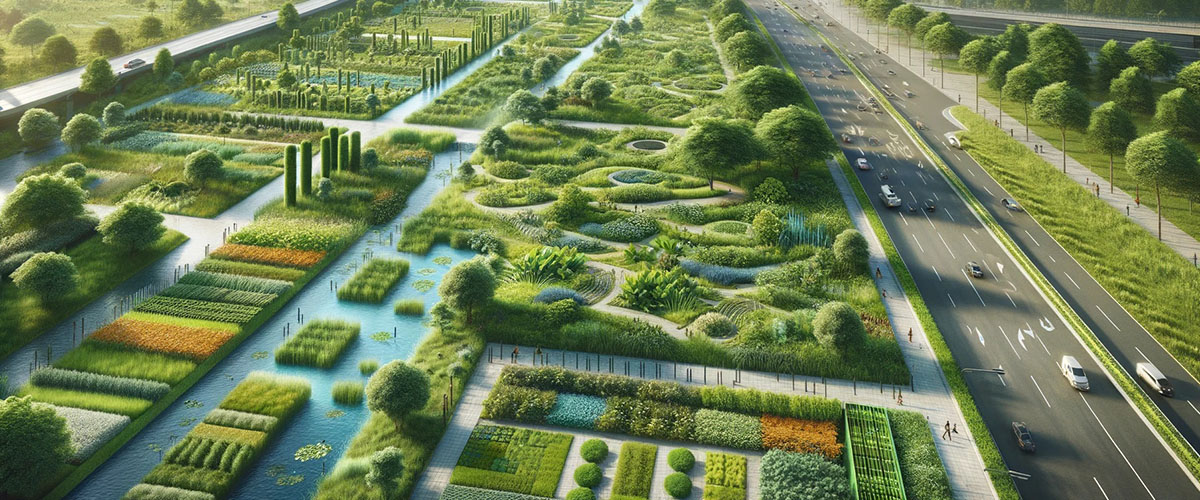
Sustainable drainage systems (SUDS) and urban-scale management
Sustainable drainage systems (SUDS) manage stormwater at source, mimicking natural hydrology to reduce peak flows, improve water quality, and enhance amenity. Green roofs retain 40-80% of annual rainfall depending on substrate depth (extensive 40-60%, intensive 60-80%), delaying peak runoff by 15-45 minutes. Permeable pavements with void ratios above 20% achieve runoff coefficients below 0.10, compared with 0.85-0.95 for conventional asphalt, virtually eliminating surface runoff for events up to 30 mm/h. The CIRIA C753 SUDS Manual (Woods Ballard et al., 2015) provides the reference design methodology, widely adopted in the UK and increasingly referenced in Spanish municipal ordinances.
Bioretention cells, swales, and detention basins form the conveyance and storage layers of the SUDS treatment train, each contributing pollutant removal through sedimentation, filtration, and biological uptake. Typical SUDS treatment trains remove 70-90% of total suspended solids, 50-70% of total phosphorus, and 20-40% of total nitrogen. For the building designer, integrating SUDS at the plot level—rain gardens adjacent to downpipes, permeable parking surfaces, and attenuation tanks beneath landscaped areas—reduces the required connection diameter to the municipal sewer, lowers infrastructure levies in some jurisdictions, and contributes to BREEAM Pol 03 (Surface Water Run-off) credits.
Water footprint and certification pathways
The water footprint of a building, assessed per ISO 14046:2014, quantifies both direct (operational) and indirect (embodied) water consumption and degradation. Operational water footprints in commercial offices range from 0.5 to 1.5 m³/m²/year; residential buildings typically fall between 1.0 and 2.5 m³/m²/year. Embodied water—consumed during material extraction, manufacturing, and transport—can equal 10-20 years of operational consumption for concrete-intensive structures, highlighting the importance of material-selection decisions in whole-life water accounting.
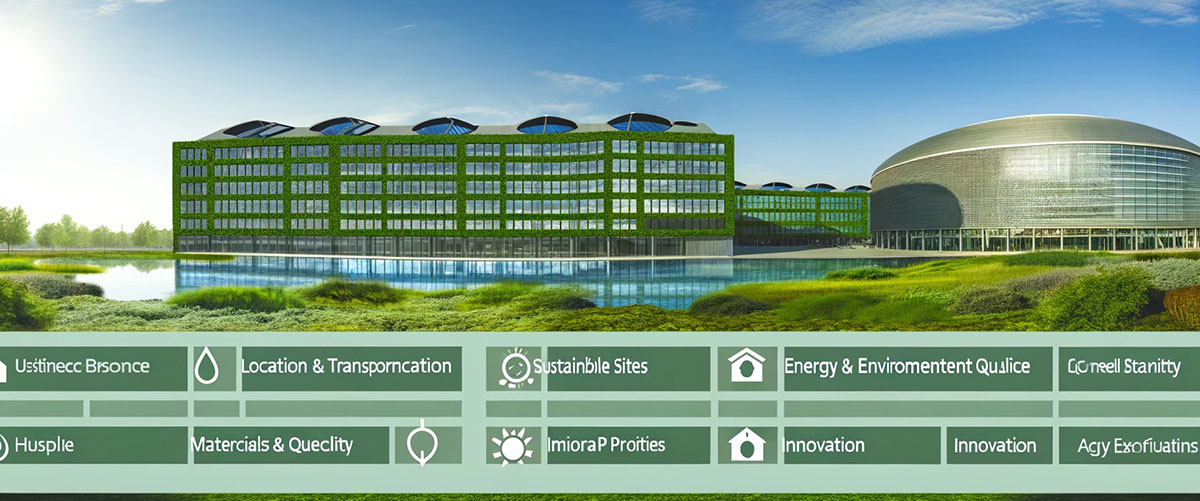
LEED v4.1 addresses water through the WE (Water Efficiency) category, awarding up to 11 points across Indoor Water Use Reduction (up to 6 points for 50% reduction), Outdoor Water Use Reduction (up to 2 points), and Water Metering (1 point). BREEAM International 2016 allocates credits under Wat 01 (Water Consumption, up to 5 credits), Wat 02 (Water Monitoring, 1 credit), and Wat 04 (Water-Efficient Equipment, 1 credit). The WELL Building Standard v2 includes eight water features (W01-W08) covering fundamental water quality, inorganic and organic contaminants, Legionella management, and moisture management. Pursuing multiple certifications simultaneously requires early coordination of water-strategy targets, fixture specifications, metering architecture, and reuse-system design to avoid costly retrofits.
References
- [1]Estadística sobre el suministro y saneamiento del agua — Año 2020INE.
- [2]Directive (EU) 2020/2184 on the quality of water intended for human consumptionOfficial Journal of the European Union.
- [3]The SUDS Manual (CIRIA C753)CIRIA. ISBN: 978-0-86017-760-9
- [4]ISO 14046:2014 Environmental management — Water footprintInternational Organization for Standardization.
- [5]CTE DB-HS4: Suministro de agua / CTE DB-HS5: Evacuación de aguasGobierno de España.
Comments 0
No comments yet. Be the first!
Leave a comment