From linear economy to construction circularity: context and scope
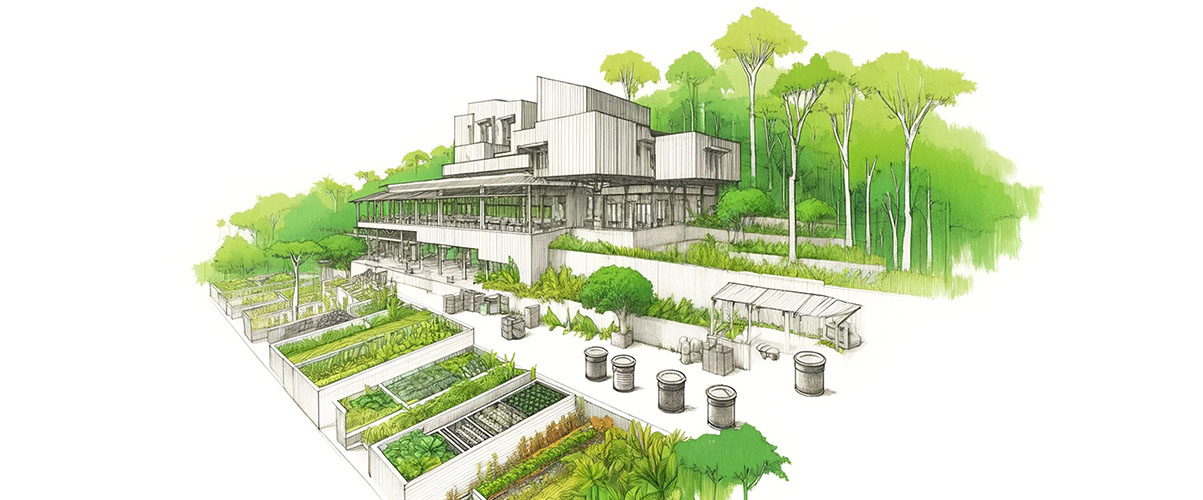
Projects that turned waste into resources represent the built evidence that the transition from a linear model (extract, manufacture, use, discard) to a circular model (reduce, reuse, recycle, regenerate) is technically viable in the construction sector. This sector generates 35% of the European Union's solid waste (374 million tonnes annually according to Eurostat, 2022) and consumes 50% of globally extracted materials (UNEP, Global Resources Outlook, 2019). The gap between waste generation and its utilization as construction resources is enormous: only 9% of the global economy is circular (Circularity Gap Report, 2023), and in the construction sector the circularity rate is even lower, estimated at between 5% and 12% depending on the region. However, a group of pioneering projects has demonstrated that it is possible to construct functional, aesthetically sound and code-compliant buildings using 50% to 100% of materials sourced from waste streams, at competitive costs and with documented environmental performance.
Transforming waste into construction resources operates at three levels of complexity. The first level is direct reuse: employing a material without industrial modification (dismantled bricks, reclaimed timber beams, second-hand joinery). The second level is recycling: transforming a waste product into a secondary raw material (crushed concrete converted into aggregate, ground glass converted into insulation, melted plastic converted into panels). The third level is upcycling: transforming a low-value waste product into a higher-value product (PET bottles converted into structural panels, tires converted into safety pavements, fly ash converted into geopolymers). According to the Ellen MacArthur Foundation, each tonne of reused material avoids the emission of 0.5 to 3 tonnes of CO₂ equivalent compared to virgin material production, depending on the material type. The projects documented below illustrate each of these levels with quantitative data on materials, costs and verifiable environmental performance.
EcoArk in Taipei and the Brighton Waste House: building from waste
The EcoArk (Taipei, Taiwan, 2010, Arthur Huang / MINIWIZ) is an exhibition pavilion 130 m long and 26 m tall built with 1.5 million recycled PET bottles, transformed into translucent modular panels called Polli-Bricks. Each Polli-Brick is manufactured from PET waste through a blow-molding process that produces a hollow hexagonal block with thermal insulation properties (conductivity: 0.06 W/m·K, comparable to double glazing), structural resistance (withstands wind loads of 130 km/h, verified during Typhoon Morakot in 2009), light transmittance of 70% and weight of only 4 kg per 0.5 m² panel. The building weighs 50% less than an equivalent glass and steel structure, which reduced the foundations by 40%. The facade's carbon footprint was 60% lower than that of a conventional curtain wall facade. The EcoArk was one of the projects that turned waste into resources with the greatest media visibility, receiving more than 8 million visitors in its first 3 years and winning the Wall Street Journal Technology Innovation Award.
The Brighton Waste House (Brighton, United Kingdom, 2014, BBM Architects / University of Brighton) is a functional 2-story, 85 m² dwelling built with 90% materials sourced from waste streams. The structure is reclaimed timber from demolition sites, insulated with 2 tonnes of recycled denim (from discarded jeans: thermal conductivity of 0.039 W/m·K, no additional fire retardant treatment needed as it is protected within the wall cavity), complemented with compressed carpet pieces and shredded VHS tapes. The walls incorporate 20,000 reused toothbrushes as filler between studs (density: 120 kg/m³, improving acoustic insulation by 3 dB compared to the empty wall), 4,000 floppy disks as an improvised vapor barrier, and particleboard manufactured from furniture factory waste. The total cost was 112,000 GBP (1,318 GBP/m²), comparable to a conventional social housing unit in southern England. Measured energy consumption during the first year was 60% lower than the average dwelling in Brighton's existing housing stock, demonstrating that waste transformed into resources can match or exceed the thermal performance of conventional materials.
Nolla Cabin, Loblolly House and other constructive circularity projects
The Nolla Cabin (Helsinki, Finland, 2018, Robin Falck) is a 15 m² micro-dwelling designed to generate zero operational emissions and maximum material circularity. The structure is FSC-certified timber with bolted connections (100% demountable), the insulation is recycled cellulose (density: 45 kg/m³, conductivity: 0.038 W/m·K, 85% recycled newsprint), the exterior facade consists of composite panels manufactured from thermo-pressed textile waste, and the roof incorporates 2.5 kWp of solar panels covering 100% of annual electricity demand (consumption: 1,800 kWh/year, production: 2,100 kWh/year at latitude 60°N). Heating is provided by a high-efficiency wood stove (efficiency 82%, particle emissions below 20 mg/m³) and the recycled cellulose insulation delivers a wall U-value of 0.15 W/m²·K. The total construction carbon footprint was 2.8 tCO₂eq, 75% lower than an equivalent cabin built with conventional materials. Nolla has become a benchmark among projects that turned waste into resources at the minimum dwelling scale.
The Loblolly House (Chesapeake Bay, Maryland, USA, 2006, Kieran Timberlake) demonstrated that design for disassembly is compatible with high-quality architecture. This 185 m² dwelling was built with a bolted aluminum chassis system, prefabricated facade panels with recycled cardboard insulation (R-value of 40, equivalent to 7 m²·K/W), and modular components connected through reversible mechanical joints (without adhesives or welds). 80% of the materials are recoverable at end of life with purity exceeding 95%. On-site assembly time was 6 weeks (compared to 12-16 weeks for an equivalent conventional dwelling), with 40% less construction waste generated compared to the sector average (45 kg/m² versus 75 kg/m²). Other notable projects include the People's Pavilion (Eindhoven, 2017, bureau SLA), built with 100% borrowed materials that were returned to their owners after the event, and the ICEhouse (New York, 2016, William McDonough), a 650 m² temporary structure fabricated from translucent recycled PET panels with a light transmittance of 40% and weight 60% less than equivalent glass.
Impact metrics and replicability of documented projects
Quantifying the impact of projects that turned waste into resources establishes benchmark ranges for future developments. In terms of carbon footprint, the documented projects demonstrate embodied carbon reductions of between 50% and 90% compared to equivalent constructions with virgin materials: EcoArk (-60%), Brighton Waste House (-65%), Nolla Cabin (-75%), Loblolly House (-55%), People's Pavilion (-95%). In terms of landfill diversion, the percentages range from 80% to 100% by material weight. In terms of cost, the average premium for circular solutions was 0% to 15% compared to conventional alternatives, with a convergence trend as recycled material supply chains mature. The comparative life cycle analysis conducted by Arup for 12 European circular projects (Circular Buildings Toolkit, 2022) demonstrated that the total cost of ownership over 30 years (construction + operation + end of life) of circular buildings is 5% to 20% lower than that of conventional buildings.
The replicability of these projects depends on three critical factors. The first is the availability of predictable and quality-controlled waste streams: material exchange platforms such as Harvest Map (Netherlands), Rotor DC (Belgium) and Backacia (France) connect demolitions with new construction projects and document the properties of available materials. The second factor is the regulatory framework: CE certification of recycled materials (CE marking under the Construction Products Regulation 305/2011) is essential for their acceptance in projects with structural or fire safety requirements. The third is the technical capacity of the design team: integrating recycled materials demands deep knowledge of their variable properties and compensation strategies (selective over-sizing, supplementary testing, monitoring systems). The proliferation of these projects confirms that turning waste into resources is not an experimental eccentricity but a construction practice with measurable, replicable and scalable results for housing programs, public facilities and renovation of the existing building stock.
References
- [1]EcoArk: The World's First Building Made from Recycled Plastic Bottles — Technical DocumentationMINIWIZ Sustainable Energy Development.
- [2]The Brighton Waste House: Constructing a House from Waste Materials — Project ReportUniversity of Brighton.
- [3]Loblolly House: Elements of a New ArchitecturePrinceton Architectural Press. ISBN: 978-1-56898-779-8
- [4]Circular Buildings Toolkit: Practical Strategies for Design TeamsArup / Ellen MacArthur Foundation.
- [5]The Circularity Gap Report 2023Circle Economy Foundation.
- [6]Global Resources Outlook 2019: Natural Resources for the Future We WantUnited Nations Environment Programme. ISBN: 978-92-807-3741-7
Comments 0
No comments yet. Be the first!
Leave a comment