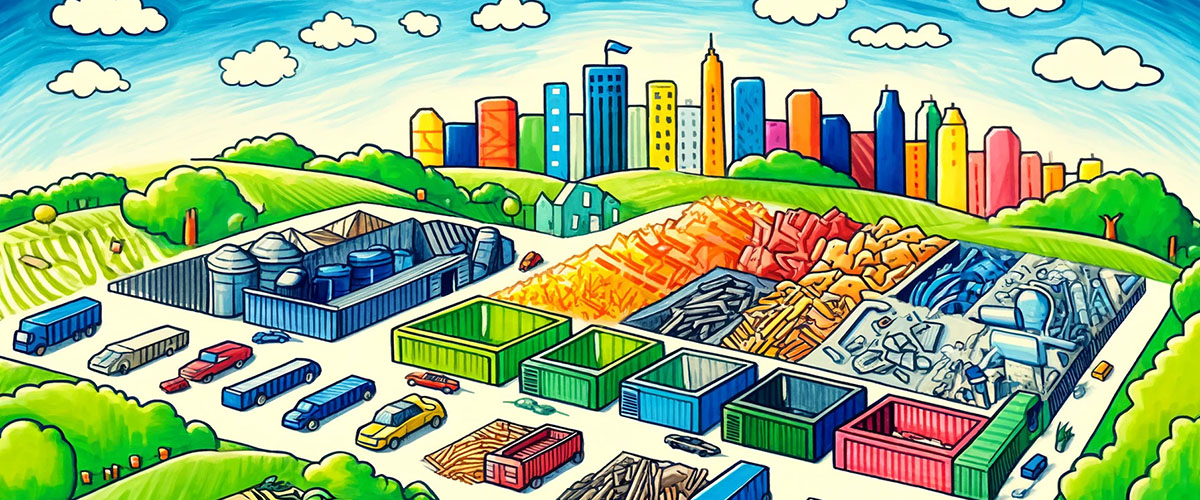
Scale of the problem: waste generation in conventional construction
The construction and demolition sector generates 374 million tonnes of waste per year in the EU-27, representing 37.5% of all waste generated in the Union (Eurostat, 2023). In Spain, the figure reaches 38.9 million tonnes annually according to the National Statistics Institute (2022), of which only 40% is managed in authorized recycling or recovery facilities, compared to the 70% target set by Directive 2008/98/EC for 2020, which Spain failed to meet. The typical composition of construction and demolition waste (CDW) in Europe is: concrete and stony materials 60-70%, bricks and ceramics 10-15%, wood 5-10%, metals 3-5%, plastics 1-3%, glass 0.5-1%, and hazardous waste (asbestos, paints, solvents) 1-3%. In new construction, the material wastage rate ranges between 10% and 15% of total materials purchased, representing a direct cost of 15,000-40,000 EUR for a 150 m2 single-family home and 1-3 million EUR for a 10,000 m2 office building (WRAP, 2018).
The environmental impact of this waste goes beyond the volume sent to landfill. The embodied energy in discarded materials amounts to 500-800 kWh/tonne of CDW, representing an energy waste of 187-299 TWh/year in the EU alone, comparable to the total electricity consumption of the Netherlands (BPIE, 2021). Emissions associated with the extraction, manufacture, and transport of materials that end up as waste amount to 120-180 million tCO2/year in Europe. CDW landfills occupy 3,200 hectares of land annually in the EU and generate leachates with a pH of 11-13 (from concrete) and heavy metal concentrations (chromium 50-200 microg/L, lead 10-80 microg/L) that contaminate aquifers if waterproofing is deficient. The zero-waste construction concept proposes a systemic shift: designing, building, and operating buildings so that no material ends up in landfill, redirecting 100% of flows toward reuse, high-value recycling, or composting in the case of bio-based materials.
Prevention strategies: design for disassembly and lean construction
Design for Disassembly (DfD) is the most effective strategy for preventing future waste. It involves designing buildings with reversible connections (bolted, interlocking, clipped) instead of irreversible ones (welded, glued, cast in situ), facilitating component separation at the end of their useful life. A DfD building reduces selective demolition costs by 50-70% and increases the material recovery rate from the typical 30-50% to 85-95% (Akinade et al., 2017). The Circl building of ABN AMRO bank in Amsterdam (2017) was designed entirely using DfD principles: bolted steel structure, demountable facade, accessible building services, and a materials passport on the Madaster platform documenting 170,000 elements with their location, composition, weight, and estimated residual value. The building uses 2,500 m2 of wood reclaimed from other projects and 5,000 panels of recycled jeans as acoustic insulation.
Lean construction (an adaptation of the Toyota production system to the construction sector) reduces waste during the execution phase through just-in-time planning, process standardization, and continuous improvement. A study by Koskela et al. (2013) covering 58 projects in Finland, Brazil, and Chile documented reductions of 30-50% in construction waste, 15-25% in execution timelines, and 8-12% in total costs compared to conventionally managed projects. Prefabrication amplifies these results: factory-controlled manufacturing reduces waste by 52% to 70% compared to on-site construction, because it allows CNC-optimized cuts (waste < 2% versus 8-12% for manual cutting), reuse of offcuts and formwork, and returnable packaging. The Dutch firm Brink Bouw has implemented a factory sorting system with 12 waste fractions and achieves a factory recycling rate of 97%, with only 3% sent to landfill (non-recoverable fraction composed mainly of inseparable composite materials).
Advanced on-site management: segregation, recovery, and digital traceability
Source segregation is the basic requirement for effective CDW management. Best practices demand a minimum of 8-12 separation fractions on site: clean concrete, ceramic material, untreated wood, treated wood, ferrous metals, non-ferrous metals, plastics, cardboard/paper, glass, gypsum, hazardous waste, and non-recoverable residue. In Spain, Royal Decree 105/2008 requires separation into fractions when individual thresholds are exceeded (80 t of concrete, 40 t of bricks, 1 t of metals, 0.5 t of glass), but does not set landfill diversion targets. Countries such as Belgium (Flanders) and Denmark have required diversion rates of 95% since 2016, and they achieve them: Flanders recycles 97% of its CDW, compared to 40% in Spain (OVAM, 2023). The difference is explained by the combination of deterrent landfill taxes (60-100 EUR/tonne in Flanders versus 10-30 EUR/tonne in Spain), effective inspection, and mandatory pre-demolition audits.
Digital traceability of waste using technologies such as BIM, blockchain, and RFID tagging makes it possible to document every material flow from its origin on site to its final destination. The European HISER project (2015-2018) developed a traceability system that assigns QR codes to each waste container and records weights, transports, and destinations on a cloud platform, reducing discrepancies between declared and actually managed CDW from the usual 25-40% to less than 5%. The city of Amsterdam has required a materials passport for all new construction works exceeding 1,000 m2 since 2020, linked to the Madaster platform, which registers 12,000 buildings across Europe. In the most ambitious horizon, the Bamb project (Buildings as Material Banks, 2016-2019), funded by the EU with 10 million EUR, demonstrated in 6 pilot buildings across 5 countries that the combination of DfD + materials passport + exchange platforms achieves recovery rates of 90-99% by weight, relegating to landfill only sealants, mastics, and inseparable composite materials that represent less than 1-2% of the total building weight.
Reference cases and roadmap toward the zero target
Several projects demonstrate that zero-waste construction is technically feasible. Bloomberg's headquarters in London (Foster + Partners, 2017) managed 12,000 tonnes of construction waste with a landfill diversion rate of 99.1%, documented and verified by an independent third party. The keys were: hiring a dedicated waste manager from the design stage, 16 segregation fractions on site, active sourcing of receivers for difficult materials (contaminated gypsum, used mineral wool, concrete slurry), and weekly tracking of indicators. London's 2012 Olympic Park achieved 98.5% diversion on 1.3 million tonnes of CDW over 4 years of construction, reusing 800,000 tonnes of excavated soil and recycling 200,000 tonnes of demolished concrete as aggregate for new road bases. In Spain, the renovation of the Mercat dels Encants in Barcelona (2013) reused 92% of the steel from the original structure and achieved a diversion rate of 94%.
The roadmap toward zero-waste construction requires coordinated action along four axes. In regulation, establishing minimum landfill taxes of 50-80 EUR/tonne (the most effective economic incentive according to Nordic and Benelux experience) and mandatory diversion targets of 95% by 2030. In design, incorporating DfD as a requirement in certification systems (LEED v5 already awards 4 credits for DfD documented with a materials passport). In technology, scaling up robotic sorting plants that achieve purities of 95-98% per fraction and throughputs of 80-120 t/hour, compared to manual sorting with purities of 70-85% and throughputs of 5-15 t/hour (ZenRobotics, 2023). In markets, developing quality standards for secondary materials that equalize their acceptance with that of virgin materials: standard EN 13242 already permits the use of recycled aggregates in roads, but equivalent standards are lacking for reused components such as beams, columns, window frames, and cladding. Zero-waste construction is not a utopia; it is a documented strategy that demands political will, investment in management infrastructure, and a cultural shift from the linear model toward circularity.
References
- [1]Generation of Waste by Economic Activity — ConstructionEuropean Commission.
- [2]Cutting Embodied Carbon in Construction ProjectsWRAP.
- [3]Design for Deconstruction (DfD): Critical Success Factors for Diverting End-of-Life Waste from LandfillsWaste Management, 60, 3-13.
- [4]Which Are the Wastes of Construction?Proceedings IGLC-21, Fortaleza, Brazil.
- [5]Afvalcijfers Vlaanderen: Bouw- en SloopafvalOVAM.


Comments 0
No comments yet. Be the first!
Leave a comment