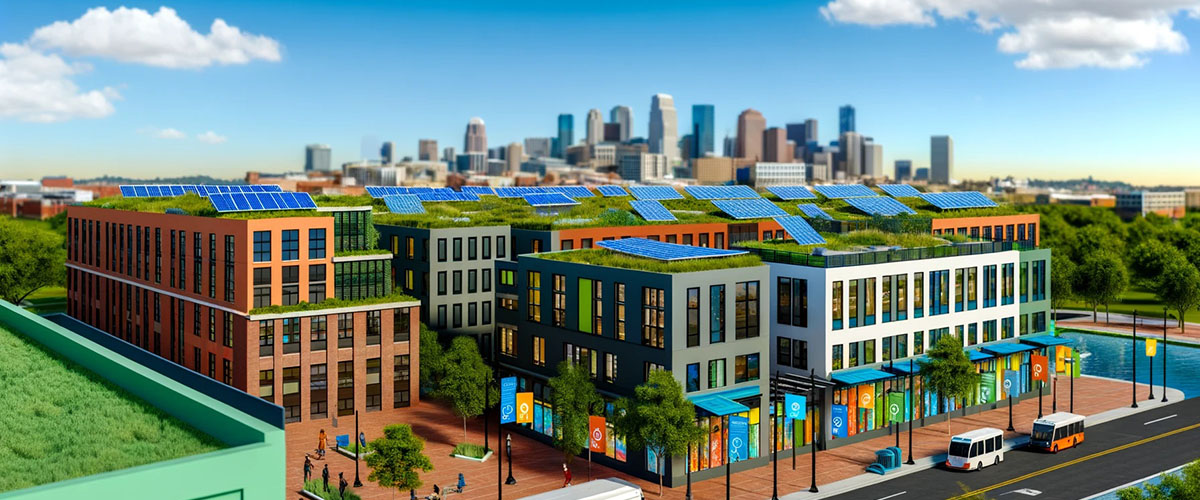
The LEED system and high-performance certification levels
The LEED system (Leadership in Energy and Environmental Design), developed by the US Green Building Council (USGBC) since 1998, structures the assessment of sustainable buildings through a scoring scale with a maximum of 110 points distributed across 9 categories: Integrative Process (1 point), Location and Transportation (16), Sustainable Sites (10), Water Efficiency (11), Energy and Atmosphere (33), Materials and Resources (13), Indoor Environmental Quality (16), Innovation (6), and Regional Priority (4). Certification levels are assigned based on the score achieved: Certified (40-49 points), Silver (50-59), Gold (60-79), and Platinum (80+). As of March 2024, LEED has certified more than 110,000 projects in 185 countries, with a total certified area exceeding 1.3 billion m². Platinum projects account for approximately 4% of the total certified, and Gold for 35%, reflecting the technical rigour demanded by the upper levels.
The current version, LEED v4.1 (published in 2022), tightens energy performance requirements compared to previous versions: the energy prerequisite (EAp2) demands a minimum improvement of 5% over ASHRAE 90.1-2019, while achieving the 18 points of energy optimisation (EAc2) needed for the Platinum pathway requires improvements of 46-50% in new buildings. The Materials and Resources category incorporates the assessment of embodied carbon (credit MR: Building Life-Cycle Impact Reduction), requiring a demonstrated reduction of at least 10% in global warming potential (GWP) compared to a reference building, evaluated through a complete life cycle assessment (LCA) in accordance with ISO 14044. The cost of managing LEED certification ranges between 30,000 and 80,000 EUR for a building of 5,000-10,000 m², representing 0.3-0.8% of the material execution budget (Kats, 2010).
Bullitt Center and Torre Reforma: two Platinum benchmarks
The Bullitt Center (Seattle, USA, 2013, designed by Miller Hull Partnership) is considered the most sustainable office building in the world. With 4,830 m² of floor area across 6 storeys, it achieved LEED Platinum certification with 82 points and simultaneously the Living Building Challenge (LBC) certification, the most demanding in the sector. The building generates 230,000 kWh/year of electricity through 575 photovoltaic panels installed on a rooftop canopy of 980 m², producing 60% more energy than it consumes annually (Energy Use Intensity of 86.4 MJ/m²·year, equivalent to 24 kWh/m²·year, compared to the 290 kWh/m²·year average for offices in Seattle). The rainwater harvesting system collects 580,000 litres/year from a 900 m² roof, treated on-site through biofiltration to potable quality, eliminating dependence on the municipal network. Composting toilets process 100% of human organic waste without connection to the sewer system.
Torre Reforma (Mexico City, 2016, designed by LBR&A Arquitectos) achieved LEED Platinum certification with 91 points, the highest score recorded for a skyscraper in Latin America. With 57 storeys and 246 metres in height, the tower incorporates a ventilated double facade that reduces solar heat gain by 30% and allows natural ventilation in 75% of occupied spaces. The chilled beam air conditioning system consumes 40% less energy than a conventional variable air volume (VAV) system. Integrated water management includes rainwater harvesting (2,500 m³/year), greywater recycling, and low-consumption sanitary fixtures, achieving a 60% reduction in potable water consumption relative to the LEED baseline standard. The mixed steel and high-strength concrete structure (80 MPa) with 30% fly ash reduced embodied carbon by 4,200 tCO₂ compared to a conventional design, according to the project's LCA documented with OneClick LCA.
Reference LEED Gold projects in Europe and Spain
In Europe, the Bloomberg headquarters in London (2017, designed by Foster + Partners, 102,200 m²) received the BREEAM Outstanding rating with the highest score ever recorded (98.5%) and simultaneously LEED Gold. The building consumes 73% less water than a standard London office building, thanks to a vacuum toilet system (consumption of 0.5 litres/flush compared to the conventional 6 litres) and a greywater recycling plant. The ventilation system with a micro-perforated bronze ceiling combines radiant cooling and displacement ventilation, maintaining CO₂ levels below 800 ppm with an energy consumption of 128 kWh/m²·year (DEC: A+). In Spain, Torre Puig (Barcelona, 2015, GCA Architects, 25,000 m²) was the first office building in Spain to obtain LEED Platinum, with 83 points. Its double-skin glass facade with integrated solar shading and its 400 m² rooftop photovoltaic array contribute to an energy consumption of 95 kWh/m²·year.
The Repsol corporate campus at Mendez Alvaro (Madrid, 2012, Rafael de La-Hoz Arquitectos, 123,000 m²) received LEED Gold certification as one of the first major certified corporate headquarters in Spain. The complex of 4 buildings connected by a central atrium 160 m long incorporates 3,700 m² of rooftop photovoltaic panels, facades with a solar factor g ≤ 0.28, and a geothermal system with 400 boreholes at 100 m depth that provides 46% of the HVAC energy. Water consumption is reduced by 42% through electronic taps, dual-flush toilets (3/6 litres), and irrigation with recycled water. The Acciona headquarters in Alcobendas (Madrid, 2008, LEED Gold rehabilitation in 2015) demonstrated that retrofitting existing buildings can achieve high certification levels: following an investment of 4.2 million euros in envelope improvements, LED lighting with DALI controls, and a centralised energy management system, the building reduced its energy consumption by 38% and its CO₂ emissions by 42%, with an investment payback period of 6.5 years.
Profitability and lessons from high-level LEED projects
The evidence accumulated over more than two decades of LEED certification demonstrates that high-level projects generate quantifiable returns. A meta-analysis of 200 LEED Platinum and Gold buildings conducted by the Pacific Northwest National Laboratory (Fowler et al., 2011) determined that these buildings consume 25-30% less energy than the average US commercial building stock (measured by Energy Star Portfolio Manager). The CoStar Group study (2019) on 20,000 real estate transactions revealed that LEED Gold buildings command rental premiums of 8-12% and sale premiums of 9-16% compared to equivalent uncertified buildings. Vacancy rates are 3-4% lower. Average operating costs are reduced by 1.20 USD/m²·year (12 USD/m² over a 10-year horizon), which for a 10,000 m² building represents cumulative savings of 120,000 USD in the first decade.
The common lessons from high-level LEED projects can be summarised in five success factors: (1) early definition of the certification target (before the schematic design phase), which reduces the cost premium to 2-5% versus 8-15% when decided at advanced stages (Kats, 2010); (2) an integrated design process (IDP) with multidisciplinary workshops from week 1; (3) energy simulation from the concept phase, using tools such as DesignBuilder or Sefaira to evaluate form, orientation, and envelope alternatives; (4) commissioning of all MEP systems, required as a LEED prerequisite (EAp1), which reduces installation defects by 60-70% and improves actual performance by 10-15% over the theoretical; and (5) post-occupancy monitoring for at least 12 months, comparing actual consumption with the model. Projects that have achieved high-level LEED certifications demonstrate that measurable sustainability and real estate profitability are convergent objectives.
Comments 0
No comments yet. Be the first!
Leave a comment