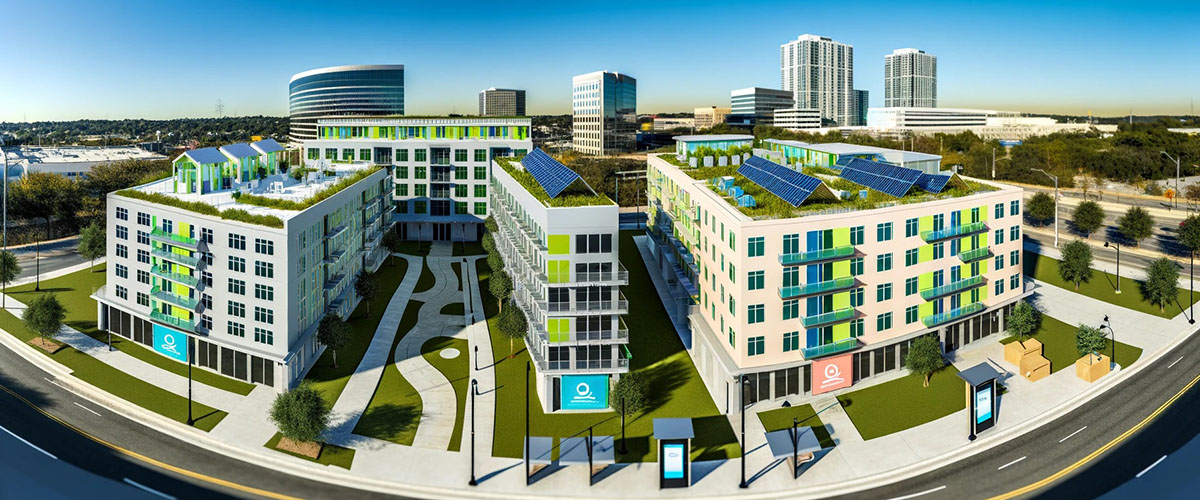
The 5 LEED Rating Systems: Structure and Scope
How many types of LEED certificates exist? The USGBC offers 5 main rating systems, each engineered for a specific project typology. LEED BD+C (Building Design and Construction) is the most widely used, accounting for over 70% of all global certifications: it covers new buildings and major renovations, with 9 sector-specific adaptations (New Construction, Core and Shell, Schools, Retail, Hospitality, Data Centers, Warehouses and Distribution Centers, Healthcare, and Multifamily Midrise). LEED ID+C (Interior Design and Construction) evaluates interior fit-outs within existing buildings, with 3 adaptations (Commercial Interiors, Retail, and Hospitality). As of 2024, more than 100,000 projects across 185 countries have achieved one of these certificates.
LEED O+M (Operations and Maintenance) certifies the sustainable operation of existing buildings by measuring actual performance (not design-stage predictions) over 12 months: real energy consumed, water utilized, and waste generated. LEED ND (Neighborhood Development) evaluates sustainability at the district or master-plan scale: connectivity to transit, mixed-use diversity, public open space, stormwater management, and urban heat island mitigation. LEED Homes certifies single-family and low-rise multifamily residences (up to 3 stories), with credits adapted to the residential scale. Additionally, LEED Cities and Communities (pilot program) assesses city-wide sustainability through the Arc monitoring platform. All 5 systems share a common structure of 110 available points and 4 certification levels (Certified: 40+, Silver: 50+, Gold: 60+, Platinum: 80+).
LEED BD+C: The Most Widely Used Certificate and Its 9 Adaptations
LEED BD+C v4.1 dominates the certification market because it addresses the phase with the greatest environmental impact: the design and construction of new buildings. The New Construction version is the general-purpose system for offices, institutional buildings, and mixed-use developments. Core and Shell (CS) certifies only the structure, envelope, and central systems when the developer does not control the interior fit-out (speculative office buildings): it covers only 40-60% of the building, awarding up to 110 points through adapted credits that exclude interior finishes. Tenants can subsequently certify their spaces under LEED ID+C.
The sector-specific adaptations include credits tailored to unique operational demands: LEED Schools adds EQ Acoustic Performance as a prerequisite (STC of 50 or higher, NC of 35 or lower in classrooms), mandates a minimum of 300 lux in classroom areas, and establishes Joint Use requirements for sharing facilities with the surrounding community. LEED Healthcare incorporates credits for operating room air quality (15 air changes per hour, HEPA H14 filtration) and requires Infection Control Risk Assessment (ICRA) documentation. LEED Data Centers adds IT equipment energy efficiency credits (PUE target of 1.4 or lower) that do not exist in the generic version. LEED Retail adjusts lighting credits (LPD below 12 W/m2 for retail versus 6 W/m2 for offices) and transportation accessibility thresholds.
LEED ID+C and O+M: Interior Fit-Outs and Operational Performance
LEED ID+C v4.1 (Interior Design and Construction) evaluates fit-outs of commercial, office, and retail spaces within existing building shells. Its key difference from BD+C is the exclusion of site-related credits (LT and SS categories) and envelope performance, focusing instead on: interior materials (MR, 7 points), indoor environmental quality (EQ, 17 points — the highest-weighted category in ID+C), indoor water efficiency (WE, 12 points), lighting and plug load energy (EA, 12 points), and innovation (IN, 6 points). The certification cost for ID+C is 30-50% lower than BD+C because it excludes the full energy simulation and site credits.
LEED O+M v4.1 (Operations and Maintenance) is unique because it evaluates actual measured performance over 12 months of operation, not design-intent predictions. The required data includes: energy invoices (actual kWh consumed), water bills (actual m3 used), waste records (kg sorted by waste stream), and occupant satisfaction surveys. LEED O+M serves as the most rigorous tool for verifying whether a building delivers on its design promises: a landmark study by Turner and Frankel (2008, NBI) demonstrated that 25-30% of LEED BD+C buildings fail to achieve their predicted energy savings during actual operation, underscoring the critical importance of O+M certification. O+M recertification every 3-5 years costs $3,500-15,000 USD and maintains the validity of the certificate.
LEED ND and Homes: Urban-Scale and Residential Certification
LEED ND (Neighborhood Development) operates at the district scale (minimum of 2 habitable buildings) and evaluates 3 unique credit categories: Smart Location and Linkage (SLL, 27 points) — proximity to existing infrastructure, public transit access, and brownfield remediation; Neighborhood Pattern and Design (NPD, 44 points) — mixed uses, density (target of 25 or more dwellings per hectare), pedestrian-oriented design, and cycling infrastructure; and Green Infrastructure and Buildings (GIB, 29 points) — energy and water efficiency of individual buildings and stormwater management. LEED ND has certified more than 500 projects globally, with flagship examples including Dockside Green (Victoria, Canada, LEED ND Platinum) and Via Verde (Bronx, New York, LEED ND Gold).
LEED Homes v4.1 adapts credit requirements to the residential scale: energy simulation uses RESNET HERS (Home Energy Rating System) rather than ASHRAE 90.1, with a target HERS Index of 50 or below (meaning 50% more efficient than the reference dwelling). Water credits include appliance-specific thresholds for washing machines (26 litres per cycle or less) and dishwashers (11 litres per cycle or less). The Awareness and Education (AE) category, exclusive to LEED Homes, awards up to 2 points for providing homeowners with a sustainable operation manual covering maintenance schedules, system controls, and resource conservation. The certification cost for LEED Homes is $3,500-8,000 USD for a single-family dwelling (including HERS verification), significantly below the cost of BD+C for commercial buildings.
The 4 Certification Levels and Comparative Cost Analysis
The 4 certification levels apply uniformly across all LEED types: Certified (40-49 points) represents baseline compliance with all prerequisites and performance exceeding code minimums. Silver (50-59 points) demands additional effort in 2-3 key credit categories. Gold (60-79 points) requires excellence in energy and water plus at least one additional category — it is the most common level in corporate projects, representing over 40% of all certifications. Platinum (80+ points) demands exceptional performance across nearly every category: only 8% of LEED projects worldwide achieve Platinum.
A comparative cost analysis across LEED certificate types for a representative 10,000 m2 project yields the following ranges: BD+C New Construction: USGBC fees $7,500-22,500, consultancy 30,000-60,000 EUR, testing and documentation 15,000-30,000 EUR, construction cost premium 2-8% (total: 80,000-200,000 EUR). ID+C Commercial Interiors: USGBC fees $4,500-15,000, consultancy 15,000-30,000 EUR, construction cost premium 1-5% (total: 40,000-100,000 EUR). O+M Existing Buildings: USGBC fees $3,500-15,000, consultancy 10,000-25,000 EUR, no construction cost premium (total: 15,000-45,000 EUR). The global distribution of certificates by level is: Certified 20%, Silver 32%, Gold 40%, and Platinum 8% (USGBC, 2024). The choice among types of LEED certificates depends on project typology, intervention phase, and available budget.
References
- [1]LEED Rating System — All Rating Systems and AdaptationsU.S. Green Building Council.
- [2]Energy Performance of LEED for New Construction BuildingsNew Buildings Institute (NBI).
- [3]LEED v4.1 Neighborhood Development Rating SystemU.S. Green Building Council.
- [4]RESNET/ICC 301-2019: Standard for the Calculation and Labeling of the Energy Performance of Dwelling and Sleeping Units using an Energy Rating IndexRESNET/ICC.
- [5]Sustainable Construction: Green Building Design and DeliveryJohn Wiley & Sons, 4th ed.. ISBN: 978-1-119-05517-4
Comments 0
No comments yet. Be the first!
Leave a comment