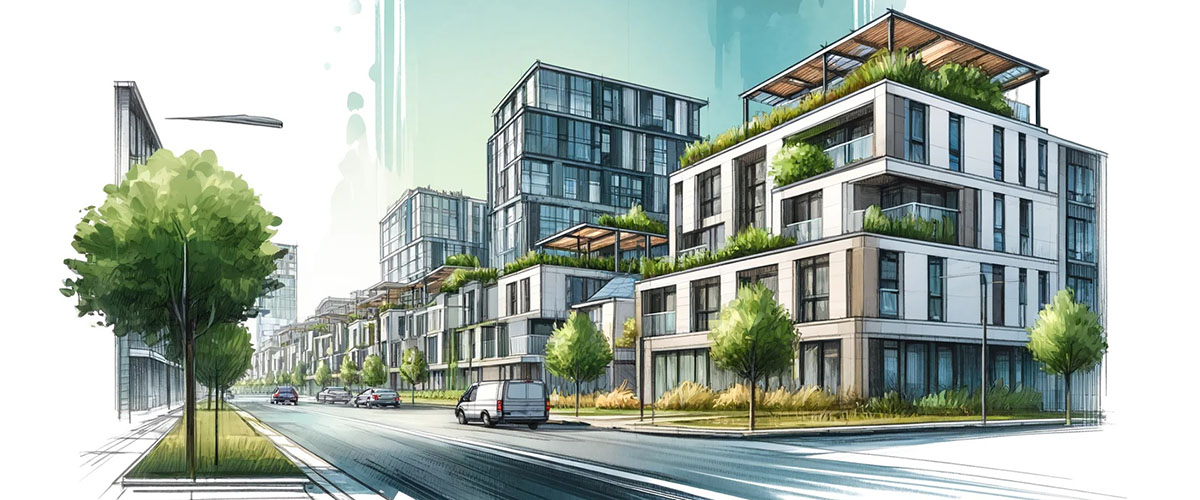
From reactive to sustainable maintenance: a paradigm shift
Sustainable maintenance protocols transform building management from a reactive model (repair when it fails: repair cost 3-5x higher than prevention) to a preventive-predictive model that extends component service life by 30-50%, reduces operational energy consumption by 10-20%, minimizes maintenance waste by 40-60% and uses low environmental impact products and materials. The cost of maintenance over the service life of a building represents 60-80% of the total cost of ownership (TCO) — three times more than the construction cost. Optimizing maintenance therefore has a greater economic and environmental impact than most design decisions, and sustainable protocols maximize their long-term value.
The ISO 41001:2018 standard (Facility Management — Management Systems) establishes the framework for a maintenance management system with sustainability objectives: documented maintenance policy, planning based on asset criticality, execution with standardized procedures, monitoring of key performance indicators (KPI) and continuous improvement. KPIs for sustainable maintenance include: MTBF (Mean Time Between Failures) for main systems (target: >2,000 hours for HVAC, >5,000 hours for LED lighting), preventive/corrective ratio (target: >80% preventive), water and chemical consumption for cleaning (target: 30-50% reduction versus conventional practices), and maintenance waste diversion rate from landfill (target: >75%). LEED O+M (Operations + Maintenance) certification incentivizes these protocols with up to 40 points for verified operational performance.
Envelope: inspection, sealing and airtightness maintenance
The building envelope (facades, roofs, windows, joints) is the first barrier against deterioration and energy losses. The maintenance protocol includes: biannual visual inspection (spring and autumn) of mortar/render cracks (>0.3 mm width: infiltration risk), EIFS insulation detachment, degradation of expansion joint sealants (structural silicone service life: 15-25 years, polyurethane: 10-15 years) and roof waterproofing condition (bituminous membrane service life: 15-20 years, TPO/EPDM: 25-40 years).
Annual infrared thermography (IR camera with resolution >= 320x240 pixels, sensitivity <0.05 degrees C) detects hidden thermal bridges, water infiltration and insulation defects not visible to the naked eye. Periodic Blower Door testing (every 5-10 years or after envelope interventions) verifies that airtightness remains within target (n50 <= 0.6 ACH for Passivhaus, <= 3.0 ACH for standard code compliance). A degradation in airtightness of 0.5 ACH increases heating demand by 5-8 kWh/m2 per year. Preventive envelope maintenance costs 2-5 EUR/m2 per year and avoids corrective rehabilitation of 50-150 EUR/m2 every 15-20 years. Next-generation sealants (MS Polymer hybrid silicone) have a service life of 25-35 years, reducing replacement frequency by 40-60% compared to conventional acrylic sealants.
HVAC: preventive and predictive maintenance of climate control systems
HVAC systems account for 40-60% of building energy consumption and are the most sensitive to poor maintenance. A dirty air filter (pressure drop >250 Pa vs 100-150 Pa nominal) increases fan energy consumption by 15-30% and reduces airflow by 10-20%. The preventive protocol includes: filter replacement every 3-6 months (MERV-13/F7 filters: cost 5-15 EUR/filter), heat exchanger coil cleaning every 6-12 months (recovering 5-10% of efficiency), heat pump COP verification every 12 months (deviation >15% indicates need for refrigerant recharge or heat exchanger cleaning), and temperature/humidity/CO2 sensor calibration every 12-24 months (typical drift: +/-0.5 degrees C/year for NTC thermistors).
Predictive maintenance uses BMS data (consumption trends, supply/return temperatures, refrigerant pressures) and machine learning algorithms to anticipate failures before they occur. The AFDD (Automated Fault Detection and Diagnostics) technique — implemented in platforms such as SkySpark, CopperTree and BuildingIQ — detects 80-90% of faults 2-4 weeks before breakdown, reducing unplanned downtime by 50-70%. The cost of preventive + predictive HVAC maintenance is 5-10 EUR/m2 per year (versus 10-25 EUR/m2 per year for reactive), with associated energy savings of 10-20%. Refrigerants must be managed in accordance with the F-Gas Regulation (EU 517/2014): high-GWP HFCs (R-410A: GWP 2,088) are being replaced by R-32 (GWP 675) and R-290 propane (GWP 3), with mandatory leak detectors for systems containing >3 kgCO2eq of refrigerant.
Lighting, water and renewable systems: specific protocols
LED lighting requires minimal maintenance thanks to its service life of 50,000-100,000 hours (L70), but the LED driver (electronic power supply) is the first component to fail: service life of 30,000-60,000 hours at 25 degrees C (every 10 degrees C increase halves the lifespan). The protocol includes: diffuser cleaning every 6-12 months (dust accumulation reduces luminous flux by 10-20%), luminous maintenance factor (LMF) verification every 2-3 years with calibrated luxmeter, and preventive driver replacement at 40,000 hours (before failure, to avoid blackouts in critical zones).
Sustainable water maintenance includes: faucet and cistern mechanism inspection every 6 months (leaks account for 10-20% of consumption in poorly maintained buildings), rainwater filter cleaning every 3 months (or after rainfall >20 mm), microbiological analysis of recycled water every 3-6 months (E. coli < 0 CFU/100 ml for cisterns per RD 1620/2007), and UV disinfection lamp replacement every 8,000-12,000 hours. Photovoltaic panels lose 0.3-0.5%/year in efficiency from natural degradation (LID + PID), but accumulated soiling can add losses of 5-15%: cleaning with deionized water and soft brush every 6-12 months recovers production. Inverters have a service life of 10-15 years (versus 25-30 years for the panel), requiring at least one replacement during the installation's lifetime. The total sustainable maintenance cost for a 5,000 m2 office building with green technology (efficient HVAC, LED, photovoltaics, green roof, recycled water) is 15-30 EUR/m2 per year — 10-20% lower than a conventional building with reactive maintenance (20-40 EUR/m2 per year), thanks to greater component durability and reduced breakdowns.
Ecological cleaning products and maintenance waste management
Conventional cleaning products (chlorinated detergents, solvent-based degreasers, VOC-emitting air fresheners) contribute 5-10% of indoor VOC emissions and generate hazardous waste. Sustainable maintenance protocols replace these products with alternatives certified under Ecolabel (EU) or Green Seal (GS-37/GS-42): plant-based biodegradable detergents (pH 6-8, phosphate-free, chlorine-free), disinfectants using peracetic acid or hydrogen peroxide (biodegradation >99% within 7 days), and ozonated water cleaning systems (dissolved O3 at 0.5-2 ppm: bactericidal efficacy equivalent to chlorine without chemical residues). The cost of ecological products is 10-30% higher than conventional ones, offset by reduced worker toxicity (30-50% reduction in respiratory irritation sick leave) and elimination of hazardous waste.
Maintenance waste management includes: selective separation of used air filters (non-recyclable fraction: incineration with energy recovery), LED luminaire recycling (metal content: aluminum, copper — recycling rate >95%), management of retired refrigerants under the F-Gas Regulation (mandatory recovery by certified technician), and composting of green roof and vertical garden pruning waste (yield: 0.5-2 kg/m2 per year of compost). LEED O+M v4.1 certification awards credits for: green cleaning program (EQ Green Cleaning: 1-2 points), operational waste management (MR Waste Management: 1-2 points), and measured energy performance (EA: up to 20 points). A comprehensive sustainable maintenance protocol — preventive + predictive + ecological products + waste management — extends building service life from 40-50 years (without optimized maintenance) to 60-80 years, reducing the environmental impact of the complete life cycle by 15-25%.
References
- [1]ISO 41001:2018 — Facility management: Management systems — Requirements with guidance for useInternational Organization for Standardization.
- [2]ASHRAE Guideline 36-2018: High-Performance Sequences of Operation for HVAC SystemsAmerican Society of Heating, Refrigerating and Air-Conditioning Engineers. ISBN: 978-1-947192-30-8
- [3]Operations & Maintenance Best Practices: A Guide to Achieving Operational Efficiency (Release 3.0)Pacific Northwest National Laboratory / U.S. DOE FEMP.
- [4]Regulation (EU) No 517/2014 on fluorinated greenhouse gases (F-Gas Regulation)Official Journal of the European Union, L 150/195.
- [5]GS-37: Cleaning Products for Industrial and Institutional Use — Standard for Environmental LeadershipGreen Seal Inc..


Comments 0
No comments yet. Be the first!
Leave a comment