The developer as green positioning strategist
The property developer occupies the central position in the green marketing value chain because it controls the investment decisions that determine the sustainability level of the final product and the communication strategy to the market. In Spain, the 5 leading listed developers (Neinor Homes, AEDAS Homes, Metrovacesa, Vía Célere, and Habitat Inmobiliaria) have integrated sustainability as a strategic pillar with quantified commitments: Neinor Homes certifies 100% of its new developments with BREEAM since 2019 (12,000 dwellings in portfolio assessed); AEDAS Homes has certified more than 6,000 dwellings with BREEAM and allocates 0.5% of the construction budget to sustainability measures beyond CTE requirements; Metrovacesa has achieved an A or B rating on more than 85% of its developments launched since 2021. The cost of a green marketing strategy for a mid-sized developer (200-500 dwellings/year) breaks down as: certification (0.2-0.5% of the construction budget), sustainability consultancy (0.1-0.3%), green communication materials (0.05-0.15%), and sales team training (0.02-0.05%), totalling 0.4-1.0% of the overall construction budget.
The developer's role in green marketing goes beyond communication: it involves defining the sustainability brief for the project team, selecting the target certification, and integrating green criteria into the financial feasibility study. A developer that decides to incorporate BREEAM Very Good certification and an A rating from the project conception phase (before schematic design) incurs a premium of 3-5% on the construction budget, whereas the same decision taken during the construction phase can raise the premium to 8-15% due to design modifications and delays (GBCE, 2023). Developers leading green marketing maintain a Sustainability Committee with representatives from technical management, commercial management, and financial management, which evaluates sustainability KPIs quarterly (% of certified dwellings, average energy rating, average BREEAM score, price premium achieved) and adjusts the strategy based on market response. The OFISO report (Observatory of Socially Responsible Investment, 2023) documents that 68% of IBEX 35 companies with real estate assets include verifiable ESG commitments in their corporate reporting, compared to 41% in 2019.
The builder as guarantor of as-built quality
The builder transforms the project's sustainability specifications into constructed reality, and its role in green marketing lies in verifying the quality of execution. The gap between projected and actual performance (known as the performance gap) is the primary risk of green marketing: a study by Innovate UK (2016, "Building Performance Evaluation Programme") of 68 new buildings documented that actual energy consumption exceeds projected values by 150% to 400% in the absence of rigorous construction quality control. The critical factors are: thermal bridges caused by insulation defects (increasing heating demand by 10-30%), air infiltration through poor sealing (air change rate n50 of 4-8 air changes/hour versus the 0.6-3 projected), and deficiencies in mechanical ventilation installation (reduction of 20-40% in effective airflow compared to the design specification).
Builders that add value to green marketing implement specific quality control protocols for sustainability: intermediate Blower Door airtightness testing (during the enclosure phase, before finishes are applied) and final testing (in accordance with EN ISO 9972:2015), with acceptance thresholds of n50 ≤ 3 air changes/hour for CTE or ≤ 0.6 for Passivhaus; infrared thermography of the envelope to detect thermal bridges and insulation defects (in accordance with EN 13187:1998); and commissioning of all HVAC, ventilation, and lighting systems in accordance with the ASHRAE Standard 202-2018 protocol. Spanish builders such as Acciona Construcción (with certified ISO 14001 and ISO 50001 management systems), Sacyr, and FCC Construcción publish sustainability reports with on-site environmental performance indicators: waste generated per m² constructed (sector average: 120-180 kg/m²; best practice target: < 80 kg/m²), on-site water consumption (400-600 litres/m²; target: < 300 litres/m²), and CO₂ emissions during construction (50-100 kg CO₂/m²; target: < 40 kg CO₂/m²). These execution data feed the development's green communication with evidence of process, not just design.
The architect as technical prescriber and design brand
The architect makes a dual contribution to green marketing: technical prescription (material selection, bioclimatic design, energy simulation) and authorial brand (the studio's prestige as a guarantee of architectural and sustainable quality). Architecture studios specialising in sustainability act as prescribers who influence the end user's purchasing decisions: 31% of upper-segment home buyers identify the architect as a relevant decision factor (Engel & Völkers survey, 2023). Spanish studios with an established green positioning include: GCA Architects (design of Torre Puig, the first LEED Platinum building in Spain), B720 Fermín Vázquez Arquitectos (Mediapro building, LEED Gold), ACXT-IDOM (Bilbao Exhibition Centre, BREEAM Excellent), and Ruiz-Larrea & Asociados (pioneers in residential Passivhaus in Madrid, with more than 200 certified dwellings).
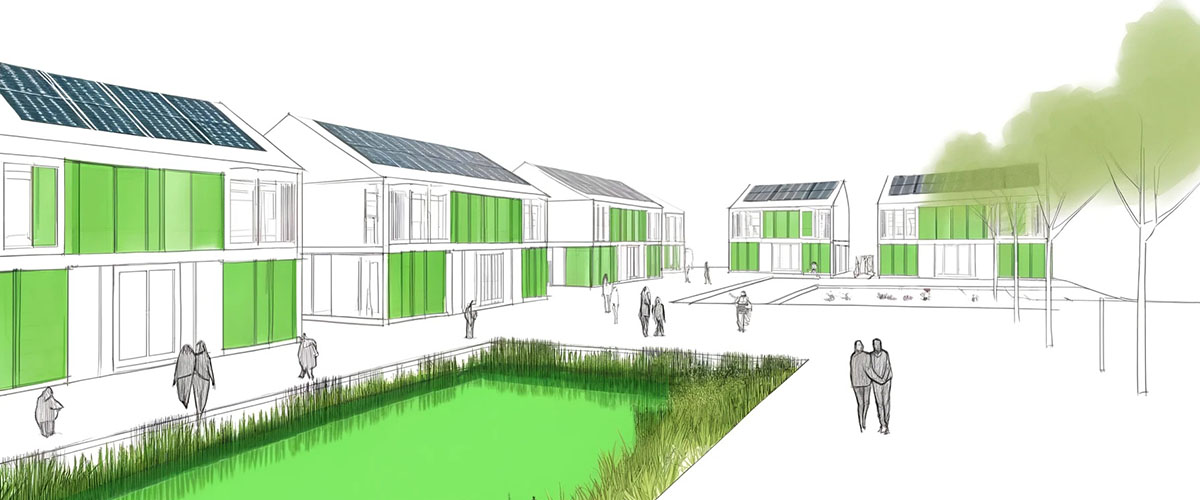
The architect's role in green marketing materialises in four marketable deliverables: (1) the project sustainability report, a technical document detailing bioclimatic strategies, selected materials with their EPDs, energy simulation results, and the carbon footprint calculated in accordance with EN 15978; (2) visualisations and renders that communicate sustainable attributes (integrated solar panels, green roofs, natural ventilation, biophilic spaces) with photorealistic quality; (3) construction detail drawings of the envelope, which the sales team can use to demonstrate insulation quality, the elimination of thermal bridges, and airtightness; and (4) participation in commercial events (project presentations, webinars, open days) where the architect explains the design decisions to the end buyer. The architect's remuneration for sustainability services (energy simulation, certification advisory, sustainability report) represents between 15% and 25% of project fees, estimated at 4-8% of the construction budget for residential development (CSCAE, Indicative Fee Schedule 2023), which equates to 0.6-2.0% of the construction budget dedicated to the sustainability component of architectural design.
Synergies between stakeholders and the integrated collaboration model
The maximum effectiveness of green marketing is achieved when developer, builder, and architect operate as an Integrated Project Delivery (IPD) team with shared sustainability objectives. The IPD model, formalised by the AIA (American Institute of Architects) in 2007 and increasingly adopted in Spain, establishes a multi-party contract with risk and benefit sharing linked to project KPIs, including sustainability indicators. A study by Stanford University (Fischer et al., 2017) of 35 IPD projects documented average reductions of 2.5% in construction cost, 10% in construction time, and 15% in energy consumption compared to projects procured traditionally (design-bid-build). The key is that sustainability decisions are made in the early phases (concept and schematic design), when the cost of change is low and the impact on final performance is greatest.
In Spanish practice, the integrated collaboration model is implemented through integrative design sessions (IPD workshops) at the start of the project, where developer, architect, MEP engineer, certification consultant, and builder participate in defining the sustainability objectives and their economic feasibility. BREEAM formalises this collaboration through the Man 01 credit (Project Briefing and Design), which requires evidence of at least 2 integrative design meetings with all stakeholders. Passivhaus requires the participation of a Certified European Passive House Designer (CEPH) from the concept phase. Marketing communication benefits from this collaboration: commercial materials can present the complete project team (developer + architect + builder + certification consultant) as a guarantee of comprehensive quality. Developers that communicate the identity of all project team members achieve a trust index 22% higher than those that mention only the developer's brand (Sigma Dos / ASPRIMA study, 2023), reinforcing the credibility of sustainability arguments among increasingly informed and demanding buyers.
References
- [1]Building Performance Evaluation Programme: Findings from Non-Domestic ProjectsInnovate UK / UK Government.
- [2]Integrating Project DeliveryJohn Wiley & Sons. ISBN: 978-0-470-58735-5
- [3]Informe anual: La inversión socialmente responsable en España 2023OFISO / Spainsif.
- [4]Baremo Orientativo de Honorarios del Arquitecto 2023CSCAE.
- [5]ASHRAE Standard 202-2018: Commissioning Process for Buildings and SystemsASHRAE.



Comments 0
No comments yet. Be the first!
Leave a comment