Conceptual framework: why certify cities and not just buildings
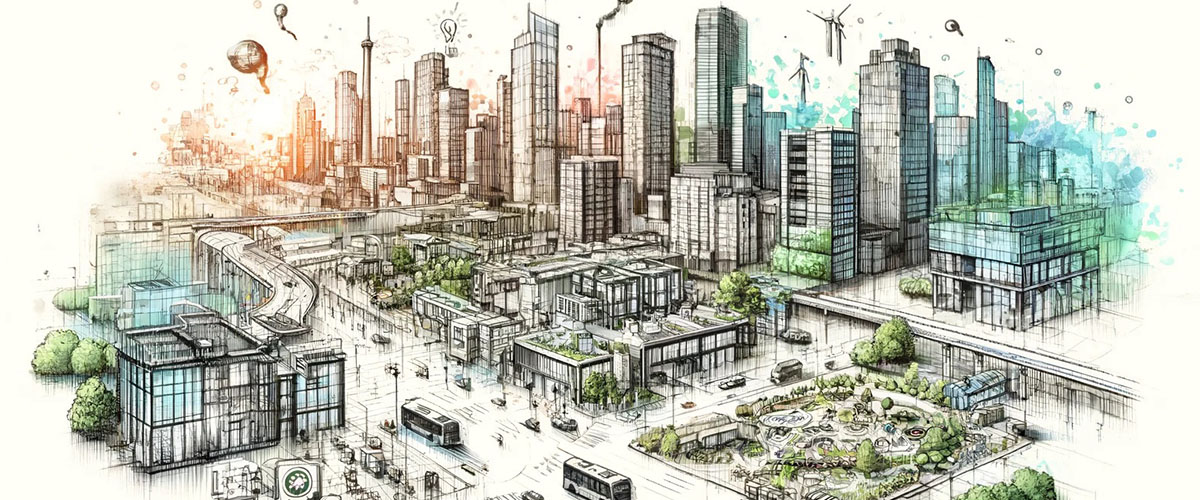
The assessment and certification of sustainable cities extends the scale of sustainability from the individual building to the complete urban fabric. A LEED Platinum building may be surrounded by highways, lack public transport and be connected to a coal-based electricity grid — its individual certification does not guarantee systemic sustainability. Urban certification systems evaluate the interaction between buildings, infrastructure, mobility, public spaces and governance, capturing synergies (compact density reduces transport demand, green infrastructure reduces runoff and the urban heat island effect) that building-level certifications do not address.
The urban certification market has grown from 5 active systems in 2010 to more than 15 in 2024. The main ones are: LEED for Cities and Communities (USGBC, since 2016: >140 cities in 50 countries certified or in progress), BREEAM Communities (BRE, since 2012: >50 developments in Europe), CASBEE-UD (Urban Development) (Japan, since 2007), Green Star Communities (GBCA, Australia, since 2012), ISO 37120 (indicators for urban services, since 2014: >100 member cities) and ISO 37122 (smart city indicators, since 2019). Certification provides: comparative benchmarking between cities, a planning framework with measurable objectives, investment attraction (certified cities receive 15-25% more ESG investment according to Bloomberg, 2022) and accountability to citizens.
LEED for Cities and Communities: the global reference standard
LEED for Cities and Communities (v4.1, 2019) evaluates entire cities or districts through 5 categories: (1) Energy — GHG emissions per capita, energy consumption per capita, % of renewables in the electricity mix (target: <4 tCO₂eq/inhabitant·year for Platinum); (2) Water — potable water consumption per capita, % of treated wastewater (target: >90%); (3) Waste — recycling rate, kg of waste to landfill per capita (target: <200 kg/inhabitant·year); (4) Transportation — % of trips by public transport/bicycle/walking, VMT (Vehicle Miles Traveled) per capita; (5) Human Experience — education, health, safety, equity, air quality.
The certification levels are: Certified, Silver, Gold and Platinum. The city of Washington D.C. was the first to obtain LEED for Cities Platinum (2017) with emissions of 6.1 tCO₂eq/inhabitant·year (target <4 by 2032), 90% treated wastewater and 40% of trips by public transport. Phoenix (Arizona) obtained Gold with its plan to reduce water consumption by 33% compared to 2000 despite a 28% population growth. The cost of LEED for Cities certification is 15,000-150,000 USD depending on the size of the city (population from 50,000 to >5,000,000 inhabitants). The Arc platform (USGBC digital platform) allows cities to monitor their indicators in real time and compare themselves with other certified cities, creating a dynamic benchmark with data updated monthly.
BREEAM Communities and ISO 37120: Europe and international standards
BREEAM Communities (BRE, 2017 update) evaluates new-build or regeneration urban developments through 6 categories and 40+ indicators: (1) Governance (GO 01-03: consultation, participation, monitoring), (2) Social and Economic Wellbeing (SE 01-17: housing, employment, health, education, accessibility, safety), (3) Resources and Energy (RE 01-07: energy, water, waste, materials), (4) Land Use and Ecology (LE 01-06: land use, biodiversity, remediation), (5) Transport and Movement (TM 01-06: public transport, cycling, pedestrian, parking management) and (6) Innovation. The levels are: Pass, Good, Very Good, Excellent and Outstanding (≥85% of credits).
The North West Cambridge development (University of Cambridge, 150 ha, 3,000 dwellings + 2,000 student residences, BREEAM Communities Outstanding) achieved the highest score with: 40% affordable housing, a district heating network with biomass CHP, 100% selective waste collection, 10 m² of green space/inhabitant and cycling connectivity with central Cambridge. The standard ISO 37120:2018 (Sustainable cities and communities — Indicators for city services and quality of life) defines 104 indicators across 19 themes: economy, education, energy, environment, finance, governance, health, recreation, safety, waste, water, transport, telecommunications, etc. The indicators are verified by the World Council on City Data (WCCD), which has certified 100+ cities across 5 continents with audited and comparable data. ISO 37122 (2019) supplements with smart city indicators: % of intelligent traffic lights, IoT network coverage, municipal open data.
CASBEE-UD, Green Star Communities and regional systems
CASBEE for Urban Development (CASBEE-UD) (Japan, Japan Sustainable Building Consortium, 2014 update) evaluates the environmental impact of urban development through the BEE (Building Environmental Efficiency) ratio = Q (indoor environmental quality) / L (external environmental load). Indicators include: urban microclimate (urban heat island effect, measured with mean radiant temperature), stormwater management, biodiversity, district energy efficiency and public space quality. The levels are: C (poor), B−, B+, A and S (superior, BEE ≥ 3.0). CASBEE-UD has been applied in 50+ developments in Japan, including the Kashiwa-no-ha Smart City project (AEON/Mitsui, 273 ha: CASBEE-UD class S).
Green Star Communities (Green Building Council of Australia, since 2012) evaluates 5 categories: Governance, Liveability, Economic Prosperity, Environment, Innovation — with a maximum of 6 stars (World Leadership). The Barangaroo South development (Sydney, 22 ha, 3 office towers + residential + public space) obtained 6 stars with: net zero carbon emissions, 100% renewable electricity, recycling of 98% of construction waste and recovery of 1 hectare of waterfront for public space. In Spain, the VERDE NE Urbanismo certification (GBCe, since 2015) evaluates plots and developments with indicators aligned with Level(s) from the European Commission: energy, water, materials, waste, mobility, biodiversity and quality of life. Pioneering Spanish cities in urban certification include Vitoria-Gasteiz (European Green Capital 2012) and Valencia (European Green Capital 2024), which have implemented ISO 37120 indicators in their strategic planning.
Comparison, trends and the city of 2030
The comparison between systems reveals differences in approach: LEED for Cities prioritizes outcome indicators (emissions, consumption, air quality) measured annually; BREEAM Communities evaluates the planning process and design decisions before construction; ISO 37120 provides comparative data without a certification level (verification only). Certification costs vary: LEED for Cities 15,000-150,000 USD, BREEAM Communities 50,000-250,000 GBP (including consultancy), ISO 37120 10,000-50,000 USD (WCCD verification), Green Star Communities 30,000-100,000 AUD.
The trends for 2025-2030 include: (1) SDG integration — LEED for Cities already maps its credits against the 17 SDGs; BREEAM and Green Star incorporate social equity metrics; (2) continuous monitoring — platforms such as Arc (USGBC), GRESB (real estate investment) and CDP Cities (climate disclosure) enable real-time assessment with IoT data, replacing one-off auditing; (3) zero carbon — new certification levels (LEED Zero, BREEAM Net Zero) require 0 operational emissions from the city or district; (4) resilience — the LEED for Cities: Resilience certification (pilot 2023) evaluates the city's capacity to withstand and recover from extreme climate events, pandemics and supply disruptions. The convergence of these trends points to a future where every city will need to report its sustainability indicators with the same transparency as it currently reports its economic indicators — urban certification will become a necessary condition for international climate finance (green funds, municipal green bonds: market of 500 billion USD in 2023).
References
- [1]LEED for Cities and Communities v4.1 — Rating SystemU.S. Green Building Council.
- [2]BREEAM Communities Technical Manual SD202 — 2017 UpdateBuilding Research Establishment.
- [3]ISO 37120:2018 — Sustainable cities and communities: Indicators for city services and quality of lifeInternational Organization for Standardization.
- [4]World Council on City Data — Open City Data Portal and Certification ReportsWorld Council on City Data.
- [5]Sustainable Debt: Global State of the Market 2022Bloomberg LP.

Comments 0
No comments yet. Be the first!
Leave a comment