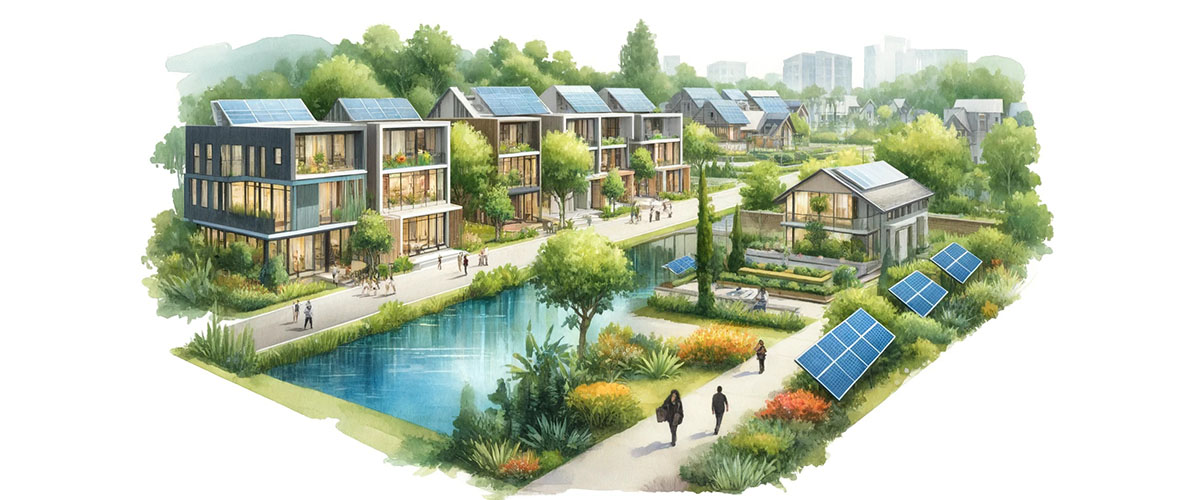
Demographics and socioeconomic profile of the green buyer
The characterisation of the sustainable housing buyer in Spain has been refined through large-sample sectoral surveys. The ASPRIMA-CGATE 2023 study (Association of Property Developers of Madrid and General Council of Technical Architecture), conducted with 3,200 new-build home buyers, identifies a segment of active green buyers representing 28% of the total, distinguished by: average age of 35-45 years (upper millennials and young Generation X), gross household income above 45,000 EUR/year (60th percentile of the household income distribution, INE 2023), university-level education in 74% of cases, and prior residence predominantly in rental properties or owner-occupied dwellings with a low energy rating (E, F, or G). This segment declares willingness to pay an average premium of 8.3% for a dwelling with an A or B energy rating, compared to the 3.1% premium accepted by the average buyer.
Generation Z (born between 1997 and 2012) represents the emerging segment with the greatest potential. According to the Deloitte Global Millennial and Gen Z Survey 2024 (survey of 22,800 people in 44 countries), 62% of Generation Z consider climate change their primary social concern (compared to 49% of millennials and 37% of Generation X). In the Spanish property market, this group accesses their first home at an average age of 31-33 years (Banco de España, 2024), with a preference for 60-80 m² dwellings in dense urban settings with access to public transport and sustainable mobility. Eurobarometer 501 (2023) on environmental attitudes reveals that 64% of Spanish respondents (compared to 58% EU average) consider at least one environmental criterion when making major purchasing decisions, including housing. These demographic data enable the construction of buyer personas with quantified variables to guide the segmentation of both digital and in-person marketing campaigns.
Purchase motivations and decision criteria hierarchy
The motivations for purchasing sustainable housing are not limited to environmental awareness: economic savings on operating costs is the primary motivation. The ASPRIMA-CGATE 2023 survey establishes the following hierarchy of decision criteria for buyers who chose a dwelling rated A or B: (1) savings on energy bills — cited by 67% as a decisive factor; (2) thermal and acoustic comfort — 53%; (3) indoor air quality and health — 41%; (4) property value appreciation — 38%; (5) environmental contribution — 34%; (6) access to green finance (green mortgage with a better spread) — 22%. The environmental motivation, while present, ranks fifth, indicating that the most effective green marketing prioritises the buyer's personal and economic benefits over altruistic arguments.
A study by the Universidad Politécnica de Madrid (Encinas et al., 2018, Energy Policy, DOI: 10.1016/j.enpol.2018.02.036) analysed willingness to pay (WTP) for energy efficiency attributes among 1,120 potential buyers using choice experiments. The results indicate an average WTP of 32 EUR/m² per letter step in the energy rating (equivalent to 2,880 EUR for a 90 m² dwelling), a WTP of 18 EUR/m² for a heating system with an air-source heat pump (versus a gas boiler), and a WTP of 12 EUR/m² for the presence of a photovoltaic self-consumption installation. The combined WTP for the three attributes (62 EUR/m²) exceeds the typical sustainable construction premium in climate zone D3 (40-80 EUR/m² to move from rating D to A), indicating that the market is willing to absorb the sustainability premium when the attributes are communicated effectively. The commercial key lies in presenting each attribute with its associated monetary benefit, not as an abstract technical feature.
Market segmentation and buyer personas in green construction
The sustainable housing market can be segmented into four operational buyer personas, defined by the combination of primary motivation and economic capacity. The Conscious Saver (35-50 years old, income 35,000-50,000 EUR/year, family with children) prioritises bill reduction and seeks A- or B-rated dwellings in mid-priced developments; their information channel is the property portal with energy efficiency filters (Idealista and Fotocasa have allowed filtering by rating since 2022). The ESG Investor (40-60 years old, income > 80,000 EUR/year, diversified property portfolio) seeks assets with BREEAM or LEED certification to meet green taxonomy requirements and access sustainable finance; their channels are market reports from consultancies (CBRE, JLL, Savills) and specialist brokers.
The Eco-native Millennial (28-38 years old, income 30,000-45,000 EUR/year, first-time buyer, high digital engagement) values sustainability as part of their identity and consumes content on social media and specialist blogs; they respond to content marketing strategies with technical data presented in visual formats (infographics, construction videos, 360° virtual tours). The Active Senior (55-70 years old, income > 50,000 EUR/year, downsizing or second home) prioritises thermal comfort, acoustic insulation, and indoor air quality for health reasons; they respond to well-being arguments backed by indoor environmental quality data and WELL certification. Each buyer persona requires a differentiated communication strategy: the Conscious Saver needs savings calculators and comparisons with their current bills; the ESG Investor needs profitability reports and taxonomy compliance documentation; the Eco-native Millennial needs visual storytelling with technical data; and the Active Senior needs comfort testimonials and health data. Marketing budget allocation should reflect the weight of each segment within the development's catchment area.
Communication channels and effective digital strategies
The digitalisation of the home search process has transformed real estate marketing channels. 95% of Spanish buyers begin their search online (Fotocasa, 2023), with an average of 4.2 months of digital research before the first in-person visit. Property portals (Idealista: 32 million visits/month; Fotocasa: 18 million) are the initial point of contact for 78% of buyers. Since 2022, both portals allow filtering by energy rating, which turns building efficiency into an active search criterion. Developments rated A receive 34% more online visits than those rated D in the same area and price range (Idealista Analytics data, 2023). Photographs of sustainable features (solar panels, triple-glazed windows, home automation systems) among the first 5 images of the listing increase the CTR (Click Through Rate) by 18% compared to listings without these images.
Social media and content marketing complement property portals with educational content that builds trust. Instagram and TikTok have become relevant channels for the millennial and Gen Z segment: construction videos showing ETICS insulation installation, high-performance window fitting, or Blower Door test results generate engagement rates of 3.2-5.8%, compared to 0.8-1.5% for conventional real estate content (HubSpot, State of Marketing Report, 2024). The most effective content marketing strategy combines: (1) a technical blog with articles on energy savings, certifications, and sustainable materials (long-tail SEO, organic traffic acquisition); (2) monthly newsletters with construction progress data and project sustainability metrics; (3) webinars with the architects and certification consultants; and (4) an experiential sales suite with a 1:1 scale envelope mock-up, a real-time thermal comparison between a conventional window and triple glazing, and a demonstration of the heat recovery ventilation system. Developers implementing this omnichannel strategy report visit-to-reservation conversion rates of 12-18%, compared to 5-8% for conventional real estate marketing (CBRE Spain internal data, 2023).
References
- [1]Willingness to pay for energy efficiency in housing: Evidence from a choice experiment in Santiago, ChileEnergy Policy, 118, 459-471.
- [2]2024 Gen Z and Millennial Survey: Living and Working with Purpose in a Transforming WorldDeloitte Global.
- [3]Special Eurobarometer 501: Attitudes of European Citizens towards the EnvironmentDirectorate-General for Communication.
- [4]Informe Anual 2023: Capítulo 4 — El mercado de la vivienda en EspañaBanco de España.
- [5]The State of Marketing Report 2024HubSpot Research.


Comments 0
No comments yet. Be the first!
Leave a comment