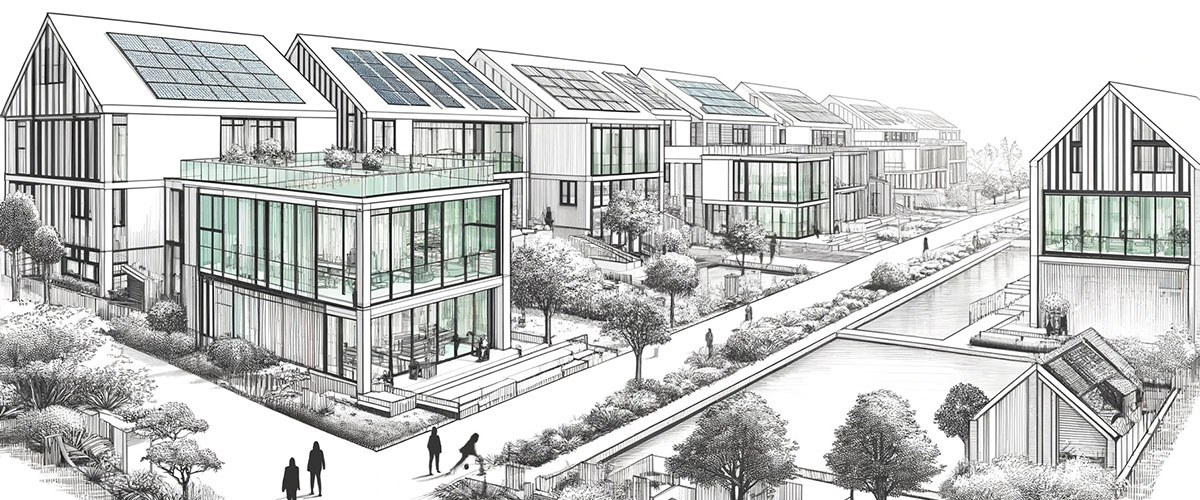
Overview of green certifications in the property market
Sustainable building certifications act as independent quality seals that translate environmental and comfort performance into a rating recognisable by buyers, investors, and tenants. Worldwide, the four certifications with the greatest market penetration are LEED (more than 110,000 certified projects in 185 countries, USGBC 2024), BREEAM (more than 600,000 assessed buildings in 89 countries, BRE 2024), Passivhaus (more than 65,000 certified units globally, PHI 2024), and DGNB (more than 10,000 projects in 30 countries, DGNB 2024). In Spain, the certification landscape is shared among BREEAM ES (market leader with 390 projects and 72,000 assessed dwellings), LEED (310 registered projects), Passivhaus (368 certified buildings, PEP 2024), and VERDE by GBCe (185 assessed projects). The combined total of all schemes covers less than 2% of new buildings constructed annually in Spain, highlighting the growth potential of the certified segment.
The marketing value of a green certification rests on three quantifiable pillars: credibility (independent verification by an accredited third party, eliminating the risk of greenwashing), differentiation (only 2-5% of the building stock holds a recognised certification), and market premium (documented increase in transaction value). A meta-analysis of 42 studies on the economic impact of green certifications (Chegut et al., 2014, Journal of Real Estate Finance and Economics) found rental premiums of 3-26% and sale premiums of 5-35%, with a weighted average of 8% for rent and 13% for sales at high certification levels (LEED Gold/Platinum, BREEAM Excellent/Outstanding). The variation reflects differences in market, building typology, and certification level, but the direction of the effect is consistent across all studies analysed.
LEED and BREEAM: differentiated marketing strategies
LEED certification offers specific marketing advantages for projects with international reach: its global recognition, the USGBC brand, and the physical certification plaque (visible at the building entrance) serve as corporate identity elements. The cost of LEED v4.1 certification for a 5,000-10,000 m² building ranges from 30,000 to 80,000 EUR (including registration, documentation, and review fees), with a processing period of 6-12 months following construction completion. The LEED credits with the greatest commercial impact are: Energy and Atmosphere (demonstrating savings of 25-50% in energy consumption), Indoor Environmental Quality (guaranteeing verified clean air, natural light, and acoustic comfort), and Location and Transport (rewarding proximity to public transport and services). Corporate headquarters with LEED certification attract ESG-committed tenants: 72% of Fortune 500 companies with sustainability targets require green certification for their new offices (JLL, 2023).
BREEAM leads the Spanish market thanks to its local adaptation (the BREEAM ES Vivienda scheme, developed by ITec under BRE licence) and its focus on the residential sector. The BREEAM assessment process covers 10 categories: Management (12%), Health and Wellbeing (15%), Energy (19%), Transport (8%), Water (6%), Materials (12.5%), Waste (7.5%), Land Use and Ecology (10%), Pollution (10%), and Innovation (10%). Spanish developers using BREEAM as a marketing tool include Neinor Homes (100% of new developments with BREEAM since 2019), AEDAS Homes (more than 6,000 assessed dwellings), and Metrovacesa. The cost of a BREEAM ES Vivienda assessment for a development of 80-120 dwellings stands at 15,000 to 35,000 EUR, representing 125-440 EUR/dwelling or less than 0.2% of the average sale price. The BREEAM assessment report provides the marketing department with category-specific data that translate directly into sales arguments tailored to each buyer profile.
Passivhaus and VERDE: highly specialised niches
Passivhaus certification has positioned itself in Spain as the benchmark for peak energy performance, with stringent requirements that guarantee verifiable results: heating demand ≤ 15 kWh/m²·year, cooling demand ≤ 15 kWh/m²·year (or cooling load ≤ 10 W/m²), renewable primary energy demand ≤ 60 kWh/m²·year (Classic class), and airtightness n50 ≤ 0.6 air changes/hour (verified by Blower Door test). The Passivhaus Building Platform (PEP) records 368 certified buildings in Spain as of December 2024, concentrated in the Basque Country (23%), Catalonia (18%), Madrid (16%), and Navarre (12%). The additional cost of a Passivhaus dwelling compared to one that strictly complies with CTE DB-HE 2019 is estimated at 5% to 12% (average of 8%, PEP data 2023), offset by energy savings of 75-90% and a payback period of 10-14 years.
The VERDE certification (Valoración de Eficiencia de Referencia de Edificios), developed by Green Building Council España (GBCe), is the only natively Spanish certification scheme, tailored to local regulations and construction practices. VERDE assesses 42 criteria grouped into 6 areas: Site and setting, Energy and atmosphere, Natural resources, Indoor environmental quality, Quality of service, and Social and economic aspects. Scores are expressed in leaves (from 0 to 5, where 5 represents best available practice). VERDE offers marketing advantages for the domestic market: its assessment cost is 30-40% lower than LEED or BREEAM (8,000 to 20,000 EUR for a residential building of 50-100 dwellings), its accredited assessors operate from Spanish offices, and the process is conducted in Spanish. GBCe has assessed 185 projects using VERDE through 2024, including landmark buildings such as the Repsol Technology Lab headquarters in Móstoles (5-leaf VERDE) and the Residencial Nereidas housing complex in Valladolid (4-leaf VERDE). For developers focused exclusively on the domestic market, VERDE offers a rigorous certification at lower cost with full regulatory validity in green public procurement (RD 1058/2017).
Certification selection and communication strategy
Choosing the optimal green certification for a development depends on four strategic factors: target audience (domestic buyer versus international investor), building typology (residential, offices, industrial), available certification budget, and the developer's communication objectives. For mid-to-high-end residential developments aimed at the domestic market, BREEAM ES offers the best cost-to-commercial-impact ratio: a cost of 125-440 EUR/dwelling generates documented sale premiums of 5-10% in the Spanish market (CBRE-BREEAM ES study, 2022). For offices with international corporate tenants, LEED Gold or Platinum maximises brand recognition and attracts companies with ESG commitments. For single-family homes and small developments seeking extreme technical differentiation, Passivhaus offers the argument of "maximum comfort with minimum consumption," verifiable with a single figure: ≤ 15 kWh/m²·year.
Communicating the certification in marketing materials should follow five principles to maximise effectiveness and avoid penalties under the anti-greenwashing Directive 2024/825: (1) name the specific certification and its level ("BREEAM Excellent", not "green certified building"); (2) cite key performance indicators (energy consumption, CO₂ emissions, water savings, acoustic comfort) with numerical values; (3) compare against the existing stock ("consumes 65% less than the average dwelling in the municipality"); (4) translate into economic savings ("1,400 EUR/year less on energy and water bills"); and (5) verify post-construction by delivering the official certificate and the full assessment report to the buyer. Developers applying these five rules report post-handover customer satisfaction 18% above the sector average and a Net Promoter Score (NPS) 22 points above the national average for residential development (Sigma Dos / ASPRIMA, 2023). Green certification, deployed with rigour in the commercial strategy, shifts from being a compliance cost to a revenue generator with a verifiable return.
References
- [1]Supply, Demand and the Value of Green BuildingsUrban Studies, 51(1), 22-43.
- [2]LEED in Motion: Buildings — Q1 2024 ReportUSGBC.
- [3]BREEAM: Key Facts and FiguresBRE Global.
- [4]Passive House Database: StatisticsPHI Darmstadt.
- [5]Certificación VERDE: Proyectos evaluados y estadísticasGBCe.
- [6]Decarbonizing Corporate Real Estate: Sustainability Benchmarks 2023JLL Research.
Comments 0
No comments yet. Be the first!
Leave a comment