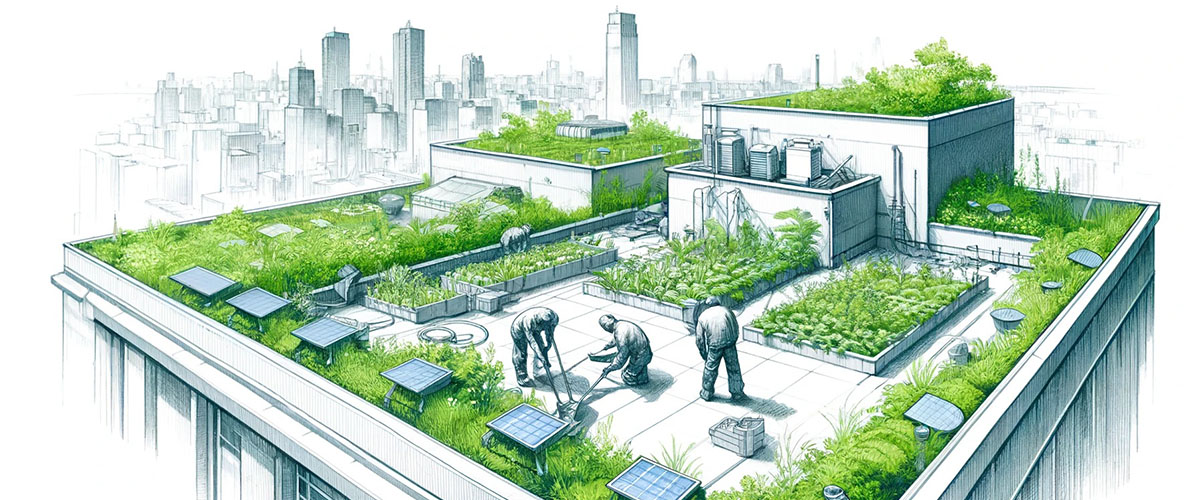
Types of green roofs and their maintenance requirements
Maintenance and care of green roofs varies radically depending on the construction typology. Extensive green roofs (substrate depth 6-15 cm, saturated weight 80-180 kg/m², low-profile vegetation: Sedum, mosses, xerophytic grasses) are designed as low-maintenance systems: 2-4 annual visits for inspection, weed removal, review of singular points (drains, wall junctions, skylights) and light fertilization. Annual maintenance cost ranges from 3-8 EUR/m² (FLL, 2018). Semi-intensive green roofs (substrate 15-25 cm, weight 180-350 kg/m², perennial herbaceous plants, grasses, aromatics) require 4-8 annual visits with supplemental irrigation in summer and costs of 8-18 EUR/m²·year. Intensive green roofs (substrate 25-100+ cm, weight 350-1,200 kg/m², shrubs, small trees, lawn) demand maintenance comparable to a conventional garden: 10-20 annual visits, scheduled irrigation, pruning, mowing, phytosanitary control, and costs of 15-40 EUR/m²·year.
The FLL standard (Forschungsgesellschaft Landschaftsentwicklung Landschaftsbau, Green Roofing Guidelines, 2018 edition) is the international technical reference for green roof maintenance. It establishes three phases: establishment period (first 12-24 months, with frequent irrigation, replanting of losses at 10-20% and 4-6 inspections), development maintenance (years 2-5, 3-4 annual visits, fertilization adjustment based on substrate analysis) and conservation maintenance (from year 5 onward, stabilized regime of 2-4 visits for extensive roofs). The FLL also sets requirements for the root-resistant protection layer (polyethylene membrane or TPO/FPO with root resistance certification per EN 13948), whose integrity must be verified at every inspection. Green roofs exceeding 1,000 m² require a specific maintenance plan drafted by a qualified professional, with an operations calendar, condition indicators and incident response protocols.
Maintenance program for extensive green roofs
Extensive green roof maintenance is structured around an annual calendar with seasonal operations. In spring (March-April): general inspection of vegetation condition (minimum acceptable coverage: 80% per FLL), identification and manual removal of invasive weeds (pulling before fruiting, dedicating 5-15 minutes/m² during the first annual intervention), verification of drains and outlets (clearing of leaves and sediment, confirming free flow), and application of slow-release fertilizer (NPK 12-8-16 + micronutrients, dose 30-50 g/m², equivalent to 4-6 g N/m²). In summer (June-July): inspection for water stress (Sedum species tolerate droughts of 4-8 weeks by entering dormancy, with 90-95% recovery after the first autumn rains), emergency irrigation only if temperatures exceed 40°C for more than 5 consecutive days and vegetation shows signs of mortality (completely dry leaves and detachment from substrate).
In autumn (October-November): second general inspection, removal of autumn weeds (especially invasive grasses such as Bromus and Poa annua that can displace Sedum), replenishment of substrate in areas eroded by wind or rain (typical loss of 1-3 mm/year from wind erosion, correctable with 5-10 liters of substrate/m² every 3-5 years), and verification of the drainage layer (inspection of at least 2 control points per 500 m², lifting the substrate layer to check that drainage is not clogged). In winter: visual inspection after severe frost events (temperatures below -10°C) or snowfalls exceeding 20 cm, checking that snow does not block drains and that accumulated snow weight does not exceed the design load (typically 100-200 kg/m² for extensive roofs). Documentation of every intervention — date, operations performed, vegetation condition (coverage percentage by species), incidents detected — is mandatory and forms the basis for long-term monitoring of the roof.
Inspection and care of waterproofing and substrate
The waterproofing membrane is the most critical element of the green roof system: its failure causes leaks that are costly to repair (80-300 EUR/m² if removal and replacement of layers is required). Paradoxically, green roofs protect the waterproofing membrane from the agents that degrade it most: UV radiation (the primary cause of aging in exposed membranes), extreme thermal cycling (an exposed membrane experiences fluctuations of -10°C to +80°C compared to 0°C to +35°C under a vegetated substrate) and hail. Studies by the National Research Council of Canada (NRC, Liu & Baskaran, 2003) documented that membranes under green roofs maintain their elasticity and mechanical strength after 20 years of service at levels comparable to new membranes, while identical membranes without vegetation protection showed significant degradation after 10-15 years. The estimated service life of waterproofing under a green roof is 40-60 years, compared to 15-25 years for exposed roofs.
Waterproofing inspection is performed using electronic leak detection (ELD) in accordance with ASTM D7877, a non-destructive technique that applies an electric field across the membrane and detects perforations with an accuracy of ±5 cm. A full ELD test is recommended during the construction phase (before substrate placement) and periodic tests every 5-10 years at accessible points (perimeters, junctions, drains). The substrate should be analyzed every 3-5 years: pH (optimal range 6.0-8.0), organic matter content (4-8% by weight for extensive roofs per FLL), electrical conductivity (< 3.5 dS/m), particle size distribution (mineral fraction > 2 mm should represent 60-80% to maintain drainage capacity) and permeability (≥ 0.6 mm/min per FLL). Partial substrate replenishment is carried out when depth falls more than 20% below the design thickness or when analysis reveals excessive compaction (dry bulk density > 1,200 kg/m³, indicating loss of porosity and water retention capacity).
Comparative costs and long-term benefits of maintenance
The total life cycle cost of an extensive green roof, including installation and 40 years of maintenance, ranges from 120-250 EUR/m² (installation: 40-90 EUR/m², accumulated maintenance: 80-160 EUR/m²). A conventional gravel-on-bituminous-membrane roof costs 30-60 EUR/m² to install but requires complete re-waterproofing every 15-20 years (cost 40-80 EUR/m² × 2 interventions over 40 years = 80-160 EUR/m²), resulting in a life cycle cost of 110-220 EUR/m², comparable to that of the green roof. The difference is that the green roof delivers quantifiable benefits the conventional roof does not: stormwater retention of 40-80% of annual precipitation (drainage infrastructure savings: 15-40 EUR/m²), 25-40% reduction in cooling demand for the top floor (energy savings: 1-3 EUR/m²·year), urban heat island mitigation, biodiversity enhancement (extensive roofs support 30-80 invertebrate species and 5-15 bird species) and property value increase of 3-7%.
Lack of maintenance is the primary cause of green roof failure. A study by the Green Roof Centre at the University of Sheffield (Dunnett & Kingsbury, 2008) across 50 green roofs in the United Kingdom documented that 30% exhibited problems attributable to insufficient maintenance: invasion by woody weeds (Buddleja davidii, Betula pendula) whose roots perforated the root barrier membrane in 12% of cases, drain blockage causing prolonged waterlogging (> 48 hours) and Sedum root rot in 18%, and unreplaced substrate erosion leaving the membrane exposed at edges and corners. The cost of repairing these failures (50-200 EUR/m² per affected area) far exceeds the cost of preventive maintenance (3-8 EUR/m²·year). Maintenance and care of green roofs is an investment that protects the waterproofing, ensures hydraulic and thermal performance, and secures vegetation survival throughout the building's service life.
References
- [1]Guidelines for the Planning, Construction and Maintenance of Green Roofing — Green Roofing GuidelineFLL, Bonn. ISBN: 978-3-940122-61-0
- [2]Thermal Performance of Green Roofs Through Field EvaluationNational Research Council Canada, Report NRCC-46412.
- [3]Planting Green Roofs and Living WallsTimber Press. ISBN: 978-0-88192-911-9
- [4]Green Roofs as Urban Ecosystems: Ecological Structures, Functions, and ServicesBioScience, 57(10), 823-833.
- [5]ASTM D7877 — Standard Guide for Electronic Methods for Detecting and Locating Leaks in Waterproof MembranesASTM International, West Conshohocken.


Comments 0
No comments yet. Be the first!
Leave a comment