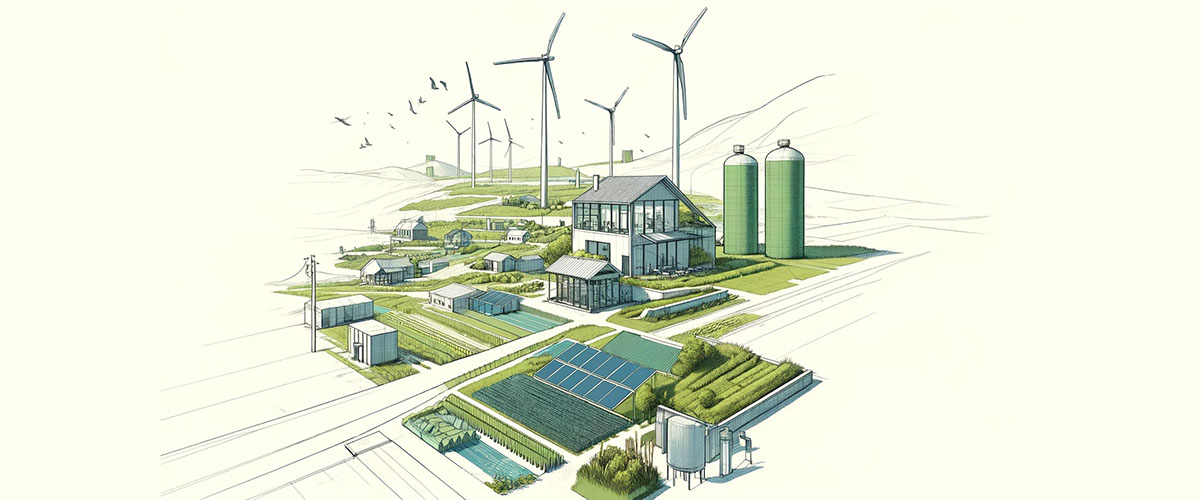
From net-zero to total autarky: the independence scale
The vision of fully autonomous buildings represents the pinnacle of building independence: a building that imports no energy, water, or food and exports no waste. This autarky is measured on a progressive scale: level 1 (annual net-zero energy, with the grid as seasonal balance), level 2 (off-grid energy with own storage), level 3 (off-grid energy + net-zero water), level 4 (off-grid energy + water + zero waste), and level 5 (complete autarky, including food production). Currently, the most advanced buildings achieve level 3–4; level 5 exists only in experimental projects such as Earthships and the ReGen Villages project (Almere, Netherlands).
The incremental cost of autarky compared to a grid-connected building varies by level: a net-zero energy building (level 1) adds 5–15% to the construction cost (BPIE, 2021), an off-grid energy system (level 2) adds 20–40%, and a complete level 4 adds 50–80%. However, operational costs are reduced by 70–95%, and the 30-year life cycle cost (LCC, Life Cycle Cost) can be equal to or lower than a conventional building when connection charges, tariffs, and centralised infrastructure maintenance costs are included.
Artificial intelligence and IoT: the brain of the autonomous building
Autonomous management requires an energy management system (EMS) based on artificial intelligence that optimises in real time the interaction between generation (PV, small wind), storage (batteries, DHW, thermal mass), demand (HVAC, lighting, appliances), and external conditions (irradiance, temperature, wind, precipitation). Model Predictive Control (MPC) algorithms use 24–72-hour weather forecasts to anticipate production and demand, deciding when to charge batteries, when to activate the heat pump, and when to use natural ventilation.
NEST (Next Evolution in Sustainable Building Technologies) at Empa/Eawag in Dübendorf (Switzerland) is the world’s most advanced building laboratory: a 5-storey modular building where each unit (apartment, office) functions as an experimental laboratory with more than 500 IoT sensors. The DFAB HOUSE unit (2019) demonstrated that an EMS with MPC reduces energy consumption by an additional 25% beyond an already nZEB building, by optimising battery charge/discharge and TABS thermal mass activation based on solar forecasting.
Seasonal storage: the missing piece
The main obstacle to annual off-grid autonomy is seasonal storage: at mid-latitudes (35–50°N), photovoltaic production in December is 25–35% of June production. Lithium batteries, with daily cycles, are not viable for seasonal storage (2,000–5,000 kWh would be needed for a dwelling, at costs of €300,000–1,000,000). The technical alternatives are: green hydrogen (electrolysis in summer, fuel cell in winter, round-trip efficiency of 30–40%), borehole thermal energy storage (BTES, efficiency of 50–70%, demonstrated at Drake Landing Solar Community), and molten salts or high-temperature PCM (in the experimental phase).
The Drake Landing Solar Community project (Okotoks, Canada) stores summer solar heat in 144 boreholes of 35 m depth via 800 m² of solar thermal collectors. After 5 years of operation, the system achieved a 97% solar fraction for heating 52 dwellings, with a borehole field temperature stabilising at 80 °C at the end of summer and 40 °C at the end of winter. The cost of seasonal storage was €30–50/MWh, competitive with natural gas in Canada. This technology is directly applicable to Spain’s continental climate (Soria, Teruel, Burgos) with untapped market potential.
Adaptive and self-healing materials
Long-term autarky requires materials that minimise maintenance. Self-healing concrete incorporates capsules of Bacillus bacteria that precipitate calcite upon contact with water through cracks, sealing fissures up to 0.8 mm (Jonkers et al., 2010, TU Delft). Electrochromic glass adjusts its solar transmittance from 0.60 to 0.05 by applying electrical voltage (1–5 V), acting as dynamic solar protection that eliminates the need for motorised blinds or shutters.
BIPV (Building-Integrated Photovoltaics) panels replace conventional cladding materials (tiles, facade glass, metal sheeting) with generating modules, amortising their cost by eliminating the material they replace. Photovoltaic tiles achieve efficiencies of 18–22% (2024) and costs of €150–250/m², comparable to a slate roof (€100–180/m²) plus a separate PV installation. PCM (Phase Change Materials) microencapsulated in gypsum boards (Micronal by BASF, melting point 23–26 °C) store 200–250 kJ/m² of latent heat, equivalent to 10–15 cm of concrete, in only 15 mm of thickness.
Regulatory framework and economic viability
Current Spanish regulation does not explicitly address autonomous buildings. The CTE requires connection to water supply networks (DB-HS4) and sanitation networks (DB-HS5), which legally hinders off-grid dwellings on urban land. However, on rural land, regional legislation permits isolated dwellings with their own systems provided they meet minimum sanitary requirements (RD 140/2003 for drinking water, RD 1620/2007 for reuse). Directive (EU) 2018/2001 (RED II) recognises the right to self-consumption and energy communities, opening the door to collective autonomy models.
Economically, a 30-year LCC analysis of the Bullitt Center in Seattle (Miller Hull, 2013, Living Building Challenge certified, 4,800 m²) showed that the construction cost ($355/ft², $3,800/m²) was 35% higher than the local office standard, but the annual operating cost ($0.80/ft²) was 80% lower than the average Seattle building. Over 30 years, the total LCC is lower than that of an equivalent conventional building. The building generates 100% of its energy with 242 kW of rooftop PV, treats 100% of its wastewater on-site with a constructed wetland system, and diverts 100% of waste from landfill.
References
- [1]Living Building Challenge 4.0 StandardILFI.
- [2]Application of bacteria as self-healing agent for the development of sustainable concreteEcological Engineering, 36(2), 230-235.
- [3]NEST: Next Evolution in Sustainable Building Technologies — DFAB HOUSE UnitEmpa / Eawag.
- [4]The performance of a high solar fraction seasonal storage district heating system — Five years of operationEnergy Procedia, 30, 856-865.
- [5]On the way to a climate-neutral Europe — Costs and benefits of deep renovationBPIE.
Comments 0
No comments yet. Be the first!
Leave a comment