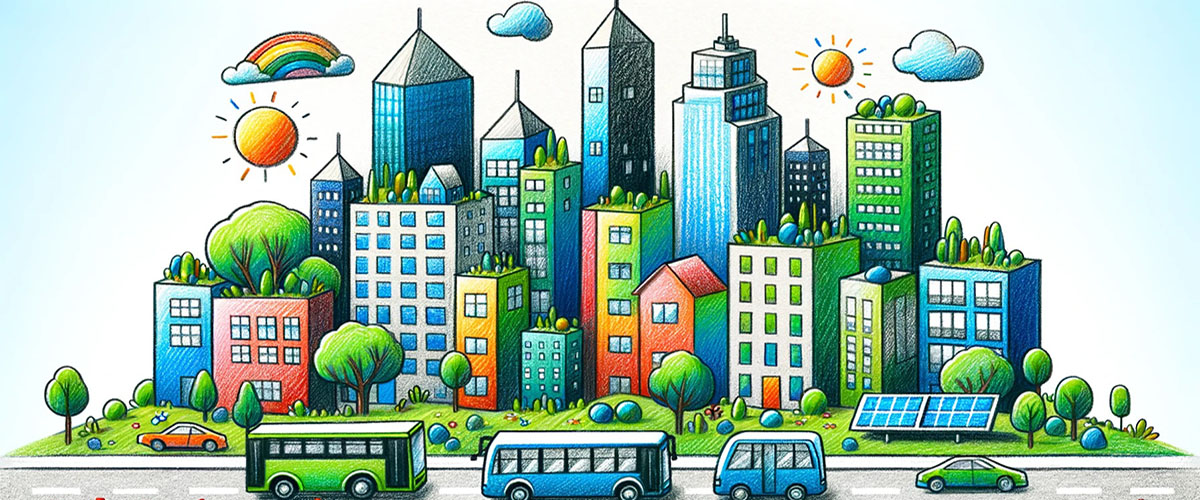
Origin and evolution: from USGBC 1998 to LEED v4.1
An introduction to LEED certification: what it is and why it matters must begin with the system's genesis. The U.S. Green Building Council (USGBC) launched LEED version 1.0 in 1998 as a voluntary consensus-based rating framework for commercial buildings. Over successive iterations — v2.0 (2000), v2.2 (2005), v3/2009, v4 (2013), and the current v4.1 (2021) — the system expanded from a single rating tool to a family of five rating systems covering new construction, interiors, operations, neighbourhoods, and residential projects. Each revision tightened performance baselines and incorporated evolving science on energy, water, materials, and indoor environment quality.
The programme's reach reflects its market acceptance: as of 2024, over 110,600 projects have registered and more than 37,200 have achieved certification across 185 countries, encompassing approximately 2.6 billion gross square metres. LEED's governance structure separates standard development (USGBC member-ballot committees) from certification administration (GBCI, the Green Business Certification Inc.), ensuring independence between rule-making and compliance assessment. This institutional separation, modelled on ISO accreditation principles, underpins the credibility that has made LEED the default green-building language for multinational tenants, sovereign wealth funds, and development-finance institutions operating across jurisdictions with disparate local codes.
Structure: nine categories, twelve prerequisites, and 110 points
LEED v4.1 BD+C organises credits into nine categories, each addressing a distinct sustainability dimension. Energy and Atmosphere (EA) commands the largest allocation at 33 points, reflecting the outsized environmental and economic impact of operational energy. Indoor Environmental Quality (EQ) and Location and Transportation (LT) each contribute 16 points, recognising that occupant health and urban-integration patterns are foundational to sustainable outcomes. Materials and Resources (MR) offers 13 points, Water Efficiency (WE) 11 points, and Sustainable Sites (SS) 10 points. Three supplementary categories — Innovation (IN, 6 points), Regional Priority (RP, 4 points), and Integrative Process (IP, 1 point) — round out the 110-point total.
Twelve prerequisites operate as mandatory gates: no project can achieve any certification level without satisfying every prerequisite in every attempted category. These non-negotiable requirements include Minimum Energy Performance (a baseline of ASHRAE 90.1-2016 compliance), Fundamental Commissioning and Verification, Building-Level Water Metering, Storage and Collection of Recyclables, and Minimum Indoor Air Quality Performance. The prerequisite structure ensures a consistent performance floor across all LEED buildings regardless of total points achieved, preventing projects from accumulating credits in narrow areas while ignoring fundamental sustainability obligations. Credits above the prerequisites are optional and allow project teams to customise their sustainability strategy according to climate, programme, budget, and market priorities.
Certification levels and global achievement distribution
LEED awards four certification levels based on accumulated points: Certified (40-49 points), Silver (50-59 points), Gold (60-79 points), and Platinum (80-110 points). The distribution across the certified portfolio skews toward the upper tiers: approximately 41% of certified projects achieve Gold and 12% achieve Platinum, indicating that teams pursuing LEED typically aim for ambitious targets rather than minimum compliance. The Bullitt Center in Seattle, often cited as one of the greenest commercial buildings in the world, earned 83 LEED Platinum points through net-zero energy design, composting toilets, rainwater-to-potable treatment, and FSC-certified heavy-timber structure.
Certification levels serve as shorthand in real-estate markets, lease negotiations, and ESG reporting. Institutional investors increasingly require LEED Gold or above as a portfolio-entry criterion, and municipal green-building ordinances in cities such as Washington D.C., Dubai, and Singapore mandate LEED certification for public-sector projects. The level achieved also correlates with measured performance: a GSA study of 22 LEED-certified federal buildings (2015) found that Platinum buildings consumed 25% less energy per square metre than Gold buildings and 45% less than Certified buildings, confirming that higher credit achievement translates into tangible operational differences rather than merely incremental paperwork.
Verified benefits: energy, water, waste, and financial returns
The empirical evidence base for LEED benefits spans thousands of buildings and multiple independent studies. Energy reductions of 25-35% relative to code-minimum baselines are the most consistently documented outcome, driven by envelope improvements, high-efficiency HVAC systems, LED lighting with daylight-harvesting controls, and commissioning that closes the design-to-operation performance gap. Water savings of 11-30% derive from low-flow fixtures, efficient cooling-tower management, and rainwater or greywater reuse systems. Construction-waste diversion rates of 50-80% are achieved through on-site sorting, material-reuse protocols, and contractual requirements imposed through LEED MR credits.
Financial returns substantiate the business case. LEED-certified office buildings command rental premiums of 3-8% and occupancy rates 2-4 percentage points higher than non-certified comparables, according to longitudinal analyses by McGraw-Hill Construction (2018) and CBRE Green Building Adoption Index reports. Operating-cost reductions of 20-30% yield a return on investment in the range of 50-150 USD/m² over a 20-year building life cycle, comfortably exceeding the 1-3% certification-cost premium. For institutional owners managing portfolios of 100,000 m² or more, these differentials aggregate into millions of euros of net present value, making LEED certification an asset-management tool rather than a mere environmental badge.
Global context: ACP paths, Spain, and comparison with BREEAM and VERDE
LEED's international deployment relies on Alternative Compliance Paths (ACPs) that substitute local codes, standards, and climate data for U.S.-centric references. In Spain, the CTE DB-HE (Basic Document on Energy Saving) can replace ASHRAE 90.1 as the energy baseline, and EN-class EPDs substitute for North American product-disclosure formats. The Spain Green Building Council (GBCe) supports local LEED applicants through training, translation resources, and liaison with GBCI reviewers. Approximately 350 LEED-certified projects operate in Spain, concentrated in Madrid and Barcelona's prime office segments where international corporate tenants demand globally recognised sustainability credentials.
LEED coexists with other rating systems that dominate specific geographies. BREEAM, developed by BRE in the UK in 1990, has issued over 600,000 certificates worldwide and holds the largest market share in Europe, with particular strength in the UK, Netherlands, and Scandinavia. In Spain, both systems compete alongside VERDE, the nationally developed tool administered by GBCe, which maps directly to CTE requirements and Spanish regulatory language. The three systems share approximately 70-80% of their assessed criteria but differ in weighting, documentation format, and assessor accreditation. For multinational portfolios, LEED's single global platform simplifies benchmarking; for single-country Spanish developers, VERDE or BREEAM ES may offer a more streamlined path. Strategic selection depends on the target tenant profile, investor requirements, and the regulatory incentives — such as planning bonuses or tax deductions — offered by the local municipality for specific certification brands.
References
- [1]LEED v4.1 Rating SystemU.S. Green Building Council.
- [2]Benefits of Green BuildingU.S. Green Building Council.
- [3]Green Building Performance: A Post-Occupancy Evaluation of 22 GSA BuildingsU.S. General Services Administration.
- [4]World Green Building Trends — Smart Market ReportDodge Data & Analytics. ISBN: 978-1-940291-15-5
- [5]Informe anual de edificación sostenible en EspañaGreen Building Council España.
Comments 0
No comments yet. Be the first!
Leave a comment