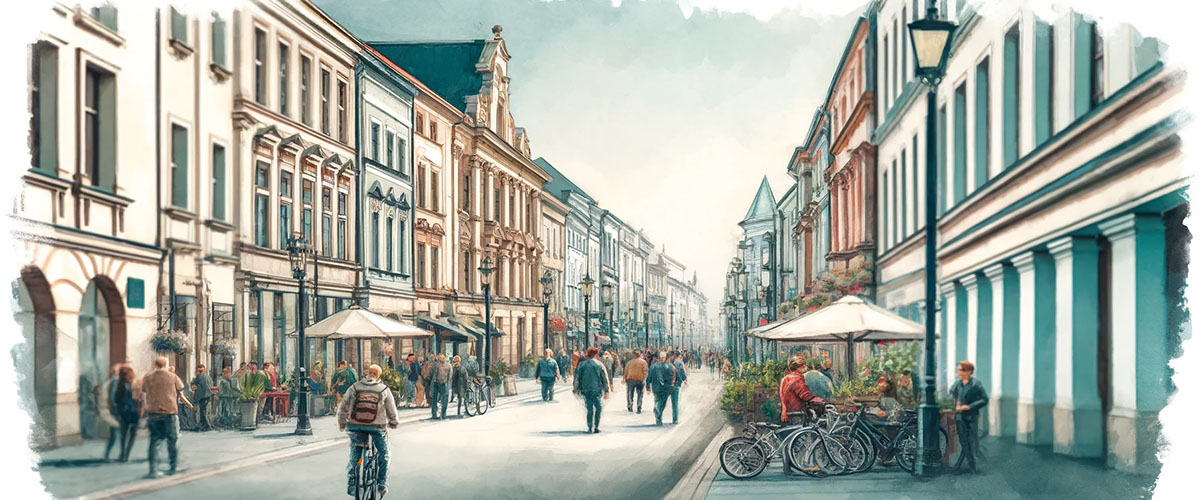
Phase 1 — Registration and rating-system selection
The LEED certification process step by step begins with project registration on the LEED Online platform, the formal declaration that a project intends to pursue certification. Registration fees range from 1,200 to 1,500 USD depending on project size and USGBC membership status, and the act unlocks access to credit templates, documentation forms, and the review dashboard. At this stage the project team must select among five rating systems — BD+C (Building Design and Construction), ID+C (Interior Design and Construction), O+M (Operations and Maintenance), ND (Neighbourhood Development), and Homes — each tailored to a distinct scope and occupancy type. LEED v4.1, the current iteration released in 2021, structures credits across 9 categories totalling 110 available points.
Early registration confers strategic advantages: it locks the applicable rating-system version for the project's duration, establishes the GBCI review timeline, and signals market intent to tenants, investors, and regulators. The 9 credit categories — Energy and Atmosphere (EA, 33 points), Indoor Environmental Quality (EQ, 16 points), Location and Transportation (LT, 16 points), Materials and Resources (MR, 13 points), Water Efficiency (WE, 11 points), Sustainable Sites (SS, 10 points), Innovation (IN, 6 points), Regional Priority (RP, 4 points), and Integrative Process (IP, 1 point) — collectively define the project's sustainability ambition. Understanding the point distribution at the outset enables cost-benefit prioritisation: EA credits typically deliver the highest long-term operational savings per point pursued, while LT credits are largely determined by site selection and carry no additional construction cost.
Phase 2 — Integrative design and energy modelling
Effective LEED projects embed sustainability targets into design from the earliest conceptual stages through an integrative charrette process. A charrette convenes architects, MEP engineers, landscape designers, cost consultants, and the sustainability coordinator for structured workshops lasting one to three days. The objective is to identify synergies — for example, a high-performance envelope that reduces HVAC capacity requirements, lowering both EA credit compliance costs and first-cost investment in plant. LEED v4.1 awards 1 point under the Integrative Process (IP) credit for demonstrating early-stage analysis of energy- and water-related systems interactions.
Energy simulation forms the quantitative backbone of EA credit pursuit. ASHRAE Standard 90.1-2016 Appendix G establishes the baseline-building methodology: a code-compliant reference model is generated automatically from the proposed design geometry, and percentage improvements are calculated across heating, cooling, lighting, and plug loads. Savings of 6% (new construction) or 3% (major renovation) earn the first EA Optimise Energy Performance point; the scale extends to 50% savings for the maximum 18 points. Simulation tools — EnergyPlus, IES VE, eQUEST — must model 8,760 hourly intervals and account for climate-zone-specific parameters (ASHRAE climate zones 1-8). The resulting energy model also feeds EA Prerequisite: Minimum Energy Performance, a mandatory gate that every project must pass before any optional credits are scored.
Phase 3 — Documentation and credit submission
LEED documentation is the translation of design intent and construction execution into auditable evidence. Each of the 12 prerequisites must be satisfied without exception — they carry no points but represent non-negotiable performance thresholds covering minimum energy efficiency, fundamental refrigerant management, storage and collection of recyclables, and construction-activity pollution prevention, among others. The 52 optional credits each require specific forms, calculations, narratives, and supporting documents uploaded to LEED Online. A typical BD+C submission package comprises 500 to 2,000 pages of combined narrative, drawings, specifications, commissioning reports, product data sheets, and environmental product declarations (EPDs) conforming to EN 15804.
Credit documentation falls into two temporal categories: design-phase credits (submitted after construction documents are complete) and construction-phase credits (submitted after substantial completion). Splitting the review into two rounds allows the team to resolve design-phase queries before construction begins, reducing the risk of costly field modifications. Material-related credits (MR) demand particular rigour: EPDs must be programme-operator-verified and cover cradle-to-gate impacts; Health Product Declarations (HPDs) or Declare labels support material-ingredient credits. Commissioning documentation under EA Prerequisite: Fundamental Commissioning encompasses the owner's project requirements (OPR), basis of design (BOD), commissioning plan, functional-performance test scripts, and the commissioning report — a dossier that frequently exceeds 200 pages for buildings above 5,000 m².
Phase 4 — GBCI review and certification decision
The Green Business Certification Inc. (GBCI) conducts an independent technical review of the submitted documentation. The standard review process includes two rounds: a preliminary review that classifies each credit as Anticipated (likely to be awarded), Pending (requiring additional information), or Denied (insufficient evidence), followed by a final review after the team submits supplemental documentation or appeals. Review fees are scaled to project size at approximately 0.033 USD per square foot for the combined design-and-construction review; an expedited review option, which reduces turnaround from 20-25 business days to 10-12 business days per round, carries a 50% surcharge.
Total certification costs — encompassing registration, review fees, sustainability consultant hours, energy modelling, commissioning, and enhanced testing — typically amount to 1-3% of total construction cost. For a 10,000 m² office building with a construction budget of 15 million EUR, the certification investment ranges from 150,000 to 450,000 EUR. This expenditure is offset by documented operational savings of 25-35% in energy and 11-30% in water, higher rental premiums of 3-8%, and improved asset marketability. Upon satisfactory review, GBCI awards the certification level corresponding to the total points achieved: Certified (40-49 points), Silver (50-59), Gold (60-79), or Platinum (80-110). Approximately 41% of certified projects achieve Gold and 12% achieve Platinum.
Phase 5 — Certification maintenance and recertification via Arc
LEED certification is not a one-time achievement but the beginning of an ongoing performance commitment. USGBC's Arc platform enables certified buildings to track actual energy, water, waste, transportation, and human-experience performance against LEED benchmarks on a continuous basis. The Arc Performance Score, ranging from 0 to 100 for each category, allows facility managers to identify degradation trends and prioritise operational improvements. Buildings that maintain or improve their performance may pursue recertification under LEED O+M at intervals chosen by the owner, reinforcing the market signal that the building continues to perform at the certified level.
The global reach of the programme underscores its influence: as of 2024, over 110,000 projects have registered and more than 37,000 have achieved certification across 185 countries. Spain hosts approximately 350 LEED-certified projects, concentrated in Madrid and Barcelona office markets where international tenants and ESG-aligned investors drive demand. The recertification pathway through Arc aligns with the EU Taxonomy's requirement for ongoing climate-performance verification in sustainable-finance disclosures, making LEED a practical compliance tool for European asset managers. For project teams embarking on the process, early engagement of an experienced LEED consultant, rigorous documentation protocols, and realistic credit targeting remain the three pillars that separate efficient certifications from costly delays.
References
- [1]LEED v4.1 Rating SystemU.S. Green Building Council.
- [2]LEED Certification Review ProcessGreen Business Certification Inc..
- [3]ASHRAE Standard 90.1-2016: Energy Standard for Buildings Except Low-Rise Residential BuildingsASHRAE. ISBN: 978-1-939200-73-1
- [4]LEED in Motion: Global Market TrendsU.S. Green Building Council.
- [5]Reinventing Green BuildingNew Society Publishers. ISBN: 978-1-59726-178-6
Comments 0
No comments yet. Be the first!
Leave a comment