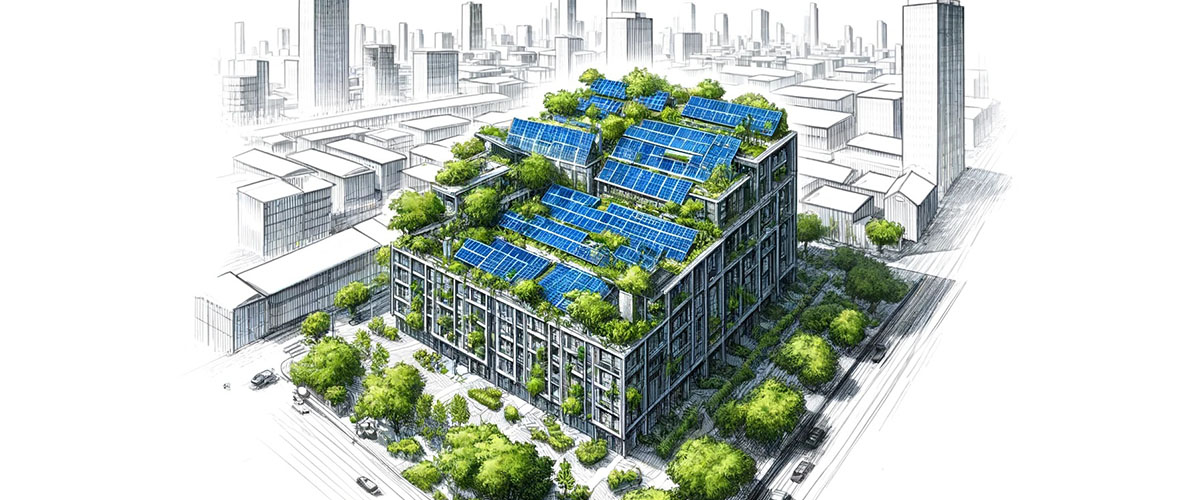
From Superimposed Panels to BIPV: Evolution of Solar Design
The integration of solar panels in architectural design has traversed three generations. The first generation (1990-2010) simply superimposed panels onto existing roofs with metallic support structures: functional but aesthetically intrusive. The second generation (2010-2020) incorporated photovoltaic modules as a substitute roofing element (in-roof systems), eliminating the tile beneath the panel and reducing the visual impact. The third generation — BIPV (Building Integrated Photovoltaics) — integrates photovoltaic cells into the construction material itself: glass, ceramic, metal, membrane, so that the photovoltaic component simultaneously fulfills functions of electricity generation, weather protection, thermal insulation and aesthetics.
The global BIPV market reached 4,200 million USD in 2023 (Allied Market Research) and is projected to reach 11,000 million USD by 2030 (CAGR 15%). The Spanish CTE (DB HE-5, 2022 update) mandates a minimum photovoltaic contribution of 0.5-1.0 W/m² of built surface area in new tertiary buildings exceeding 3,000 m², driving the adoption of BIPV as a solution that simultaneously meets energy and envelope requirements. The standard EN 50583-1:2016 (BIPV modules) and EN 50583-2:2016 (BIPV systems) define the electrical, mechanical and fire safety requirements specific to photovoltaic modules integrated into the envelope. The efficiency of BIPV modules varies between 6-22% depending on the technology: monocrystalline silicon (18-22%), CIGS (14-17%), CdTe (12-16%) and amorphous silicon (6-10%).
BIPV Facades: Curtain Wall and Ventilated Photovoltaic Facade
BIPV facades represent the largest potential generation surface in high-rise buildings. A 10-story office building with 2,000 m² of south and east/west facade can integrate 800-1,200 m² of BIPV modules, generating 60,000-120,000 kWh/year (equivalent to 20-40% of the building's electricity consumption). The two main typologies are: (1) BIPV curtain wall (Schüco ProSol TF system, Wicona WICTEC 50 SG BIPV) with laminated glass-glass modules that replace vision glass or spandrel panels, achieving power outputs of 100-170 Wp/m² in opaque modules and 30-80 Wp/m² in semitransparent modules; (2) ventilated BIPV facade with modules mounted on a metal substructure with an air cavity of 30-80 mm.
The rear ventilation of the BIPV facade reduces cell temperature by 10-20°C compared to a module without ventilation, recovering 3-8% of efficiency. The cost of the ventilated BIPV facade is 200-450 EUR/m² installed (module + substructure + wiring), comparable to ventilated facades of natural stone or high-end composite. The CIS Tower (Manchester, 2005) was a pioneer with 7,244 BIPV modules (391 kWp) integrated into the south and west facades, generating 180 MWh/year. The Copenhagen International School (2017, C.F. Møller Architects) integrates 12,000 solar panels of blue-green colored glass on the facade, with a capacity of 720 kWp and a production of 300 MWh/year — 50% of the building's electricity consumption. Each panel has a different angle of inclination, creating a scale-like visual effect that changes with daylight.
Sunshades, Pergolas and Photovoltaic Shading Elements
Photovoltaic sunshades (BIPV shading devices) combine the function of solar protection with electricity generation: each m² of south-facing sunshade at 36-43°N generates 80-150 kWh/year depending on the inclination (optimal: 20-35° to maximize winter capture). Horizontal sunshades (overhangs, brise-soleil) on the south facade block 85-100% of summer sun (angle >65°) while capturing solar radiation throughout the year. Adjustable photovoltaic louvres (Colt Shadovoltaic, SunLouvre) adjust their angle according to solar position and shading demand, simultaneously maximizing solar protection and generation.
Photovoltaic pergolas for car parks and outdoor spaces generate 120-180 kWh/m²·year with bifacial modules tilted at 5-15° (pavement albedo: 0.2-0.4). A solar car park of 500 m² (50 spaces) with 100 kWp generates 140,000-170,000 kWh/year and provides shade that reduces vehicle interior temperature by 15-25°C. The Forum Barcelona (2004) integrated a photovoltaic pergola of 4,500 m² (1 MWp) that was the largest BIPV installation in Europe at the time. BIPV canopies for bus and tram stops (production: 50-80 kWh/m²·year with variable orientation) and photovoltaic balustrades for balconies (glass-glass vertical modules of 300-400 Wp/unit) complete the catalogue of solar architectural elements. In Germany, plug-in balcony modules (Balkonkraftwerk) of 300-800 Wp connect directly to a domestic socket and generate 250-600 kWh/year without permits or construction work.
BIPV Skylights and Integrated Solar Roofs
BIPV skylights replace conventional skylight glass with semitransparent photovoltaic glass, generating electricity while illuminating the interior space with filtered natural light. The visible transmittance (Tv) of BIPV skylights ranges between 0.10-0.40 depending on cell density, providing natural shading that reduces solar gain by 60-90% compared to clear glass and eliminates the need for mechanical solar protection. A horizontal BIPV skylight of 200 m² generates 24,000-36,000 kWh/year (120-180 kWh/m²·year) in Spain.
The Kaohsiung National Stadium (Taiwan, 2009, Toyo Ito) integrates 8,844 solar panels (1 MWp) into the undulating roof structure, generating 100% of the stadium's electricity during events. Apple Park (Cupertino, 2017, Foster + Partners) covers the circular roof of 260,000 m² with 17 MW of integrated photovoltaic panels that generate 75% of the campus's electricity. BIPV ETFE + photovoltaic membrane roofs (Texlon, Vector Foiltec) combine the lightness of ETFE (0.35 kg/m²) with adhered thin-film cells, achieving power outputs of 40-80 Wp/m² with a total weight of 1-2 kg/m² (compared to 12-15 kg/m² for a rigid glass-glass module). This technology is ideal for long-span roofs where weight is determinant: stadiums, atria, shopping centers.
Integrated Design Criteria: Orientation, Performance and Aesthetics
The effective integration of solar panels in architectural design requires coordinating 5 criteria: (1) orientation and angle — production varies from 100% (south, optimal tilt 30-35° at 40°N) to 90% (southeast/southwest), 70% (east/west) and 55-65% (south-facing vertical facade); (2) thermal performance — the BIPV module must meet the U-value, g-value and airtightness requirements of the envelope per DB HE-1; (3) fire safety — fire classification of the module per EN 13501-1 (minimum B-s2,d0 for facades); (4) electrical safety — arc fault fire protection with AFCI (arc fault circuit interrupter) and rapid shutdown devices (NEC 690.12, UNE-HD 60364-7-712); (5) aesthetics — color, texture, reflectance, modulation and relationship with the architectural language of the building.
Colored BIPV modules (Kromatix/SwissINSO, LOF Solar) use nanometric dichroic filters that reflect specific colors (red, blue, green, gold, terracotta, grey) with an efficiency loss of 10-25% compared to the standard black module. The technology allows BIPV to blend with traditional materials: ceramic tile, stone, brick, exposed concrete. The simulation tool PVsyst 7 models BIPV production considering orientation, 3D shading, cell temperature and degradation, with accuracies of ±3-5%. The LEED EA Renewable Energy standard awards up to 5 points for on-site renewable generation covering 5-20% of the building's energy cost. The current trend is the energy-positive building (E+) that generates more energy than it consumes, achievable with BIPV on roof + south facade + pergolas in buildings of ≤ 5 stories in climates with GHI > 1,600 kWh/m²·year.
References
- [1]Building integrated photovoltaic products: A state-of-the-art review and future research opportunitiesSolar Energy Materials and Solar Cells, 100, 69-96.
- [2]EN 50583-1:2016 — Photovoltaics in buildings. BIPV modulesEuropean Committee for Electrotechnical Standardization (CENELEC).
- [3]Building Integrated Photovoltaics (BIPV) Market by Type, Application and End User: Global Opportunity Analysis and Industry Forecast, 2023-2030Allied Market Research.
- [4]Building Integrated Photovoltaics (BIPV): Review, Potentials, Barriers and MythsGreen, 3(2), 125-156.
- [5]Photovoltaic Glass Technical Datasheet: Transparency, Power Output and Thermal PerformanceOnyx Solar Group LLC.


Comments 0
No comments yet. Be the first!
Leave a comment