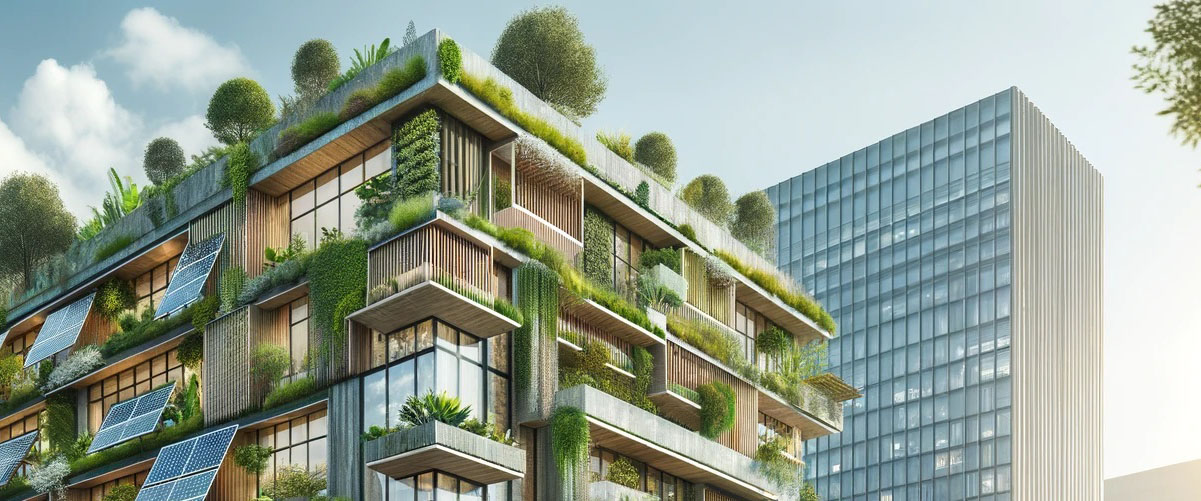
Biological Principles Applicable to Architectural Design.
Inspiration from nature in architectural design. is not an aesthetic metaphor but a technical discipline: biomimicry (Benyus, 1997) extracts functional principles from living organisms and translates them into measurable construction solutions. The 4 biological principles directly applicable to architecture are: (1) resource efficiency — nature builds with minimal material and maximum functionality (a femur bone supports 10 times the body weight using only 25% dense material concentrated in stress zones), (2) environmental adaptation — organisms modulate their response to the environment in real time (the human iris adjusts its aperture from 2 to 8 mm according to light levels), (3) closed-loop cycles — the waste of one organism becomes the resource of another (99.9% of matter in a mature ecosystem is recycled), and (4) resilience — ecosystems absorb disturbances and regenerate (forests recover from fire events within 20-50 years).
The standard ISO 18458:2015 (Biomimetics — Terminology, concepts and methodology) formalizes the process of translating biology into technical design through 4 phases: design challenge identification, biological analogy search, functional principle abstraction, and technical application with validation. The AskNature database (Biomimicry Institute) catalogs more than 1,700 biological strategies classified by function (protect, move, harvest energy, manage water, regulate temperature, manufacture), facilitating the search for applicable analogies. The economic potential is significant: a Da Vinci Index (2013) report estimated that biomimicry-based patents generate $1.6 billion USD/year in products and services, with annual growth of 15%.
Structural Efficiency: Learning from Bones, Shells and Trees
Biological structural efficiency surpasses conventional engineering because it optimizes material distribution along stress trajectories. Trabecular bone concentrates material in the directions of load and removes it where no stress occurs: computational topology optimization (Altair OptiStruct, Autodesk Generative Design) replicates this principle, eliminating 40-60% of material compared to a uniform design of equal strength. The Bionic Partition (Airbus + Autodesk, 2016) for aircraft seating, designed through bone-inspired topology optimization, weighs 45% less than the conventional version while meeting identical structural load requirements.
In architecture, bivalve shells inspire thin-shell reinforced concrete structures: Felix Candela demonstrated at the Restaurante Los Manantiales (Mexico City, 1958) that a hyperbolic paraboloid just 40 mm thick in reinforced concrete can span 30 m of clear distance. Tree-like branching inspires the arborescent columns at Stuttgart Airport (von Gerkan, Marg and Partners, 1991): steel columns that bifurcate like branches distribute roof loads using 30% less steel than equivalent straight columns. The ICD/ITKE Research Pavilion (University of Stuttgart, 2012-2016) employs robotically wound carbon fiber replicating the exoskeleton structure of beetles, covering 40 m2 with panels only 4 mm thick and weighing just 7.6 kg/m2, demonstrating that nature-inspired architectural design achieves material efficiencies far beyond conventional structural approaches.
Adaptive Facades: The Building Skin as a Living Organ
Adaptive facades transform the building envelope from a static barrier into a dynamic organ that responds to environmental stimuli, replicating the function of biological skin. The Institut du Monde Arabe (Paris, 1987, Jean Nouvel) incorporates 240 mechanical diaphragms on the south facade inspired by the human iris: they open and close with exterior light levels, regulating daylight admission. The Al Bahar Towers (Abu Dhabi, 2012, Aedas) deploy 2,000 folding panels inspired by the traditional mashrabiya screen and the petal movement of Strelitzia flowers: each panel opens and closes automatically based on solar position, reducing solar heat gain by 50% and cooling demand by 40%.
Biocomposite facades replicate the multifunctionality of biological surfaces: the HygroSkin Pavilion (Achim Menges, ICD Stuttgart, 2013) uses wood veneer elements that open and close with ambient humidity — without sensors, without motors, without energy consumption — replicating the hygroscopic mechanism of pine cones. The algae bioreactor modules of the BIQ building (Hamburg, 2013) cultivate Chlorella vulgaris in glass facade panels, producing 150 kWh/m2 per year of thermal energy and 30 kWh/m2 per year of biomass, replicating plant photosynthesis at architectural scale. The inspiration from nature in these adaptive facades demonstrates that architectural design can integrate autonomous environmental response without energy input, a capability that conventional engineering alone cannot replicate.
Passive Climate Control: Termite Mounds, Burrows and Courtyard Typologies
Bio-inspired passive climate control systems eliminate or drastically reduce the need for mechanical conditioning. The Eastgate Centre (Harare, Zimbabwe, 1996, Mick Pearce) replicates the ventilation strategy of Macrotermes termite mounds: central chimneys that generate ascending convection and a basement that preconditions air to 14-18 degrees Celsius. The measured result: the building consumes 90% less energy than comparable mechanically conditioned buildings, saving $3.5 million USD annually. Prairie dog burrows exploit the Bernoulli effect: two entrances at different heights generate natural ventilation through dynamic wind pressure differentials. This principle is applied in the ventilation cowls at BedZED (London, 2002, Bill Dunster): rotating rooftop ducts that capture prevailing wind and ventilate apartments without mechanical fans.
The traditional courtyard is a verified bioclimatic solution that replicates oasis microclimate conditions: shade from surrounding walls (low albedo at ground level), evapotranspiration from vegetation, and thermal inertia of perimeter masonry walls (600 mm of stone or brick) reduce air temperature within the courtyard by 3-8 degrees Celsius compared to exterior conditions during summer (Rojas et al., 2012). Rooms ventilating toward the courtyard maintain temperatures of 24-27 degrees Celsius when exterior temperatures reach 40 degrees Celsius. The Persian wind tower (badgir) captures wind at 10-15 m height and channels it downward into the interior, cooling it through evaporation as it passes over water vessels or underground fountains: temperature reductions of 8-15 degrees Celsius have been documented in historic buildings of Yazd, Iran. These ancestral systems demonstrate that nature and traditional building practice offer passive climate control solutions with zero operational energy cost.
Built Ecosystems and Regenerative Design.
The most advanced level of inspiration from nature in architectural design. is regenerative design: buildings that do not merely minimize their impact but actively improve the surrounding ecosystem. The Bullitt Center (Seattle, 2013, Miller Hull Partnership) functions as a self-sufficient organism: it produces 100% of its energy with 242 kW of rooftop photovoltaics, captures 100% of its water from rainfall (150,000 litres of storage capacity), composts 100% of its organic waste, and generates zero waste to landfill. Its measured energy consumption is 16 kWh/m2 per year, lower than the average Passivhaus building.
The Living Building Challenge (LBC) from the International Living Future Institute requires buildings to deliver net positive performance across 7 petals: Place (site ecology), Water (water autonomy), Energy (net positive energy), Health and Happiness (occupant wellbeing), Materials (safe and circular materials), Equity (social justice), and Beauty (aesthetic and educational value). Only 30 buildings worldwide have achieved full Living Building certification as of 2024, demonstrating that regenerative design represents the most demanding frontier of nature-inspired architectural practice. The Frick Environmental Center (Pittsburgh, 2016, Bohlin Cywinski Jackson) is the first municipal building with full Living Building certification: it produces 30% more energy than it consumes, treats 100% of its wastewater through constructed wetlands, and uses materials free from the 800+ chemical substances on the LBC Red List, embodying the fullest expression of architectural design drawn from nature.
References
- [1]Biomimicry: Innovation Inspired by NatureWilliam Morrow & Company. ISBN: 978-0-06-053322-9
- [2]ISO 18458:2015 Biomimetics — Terminology, concepts and methodologyInternational Organization for Standardization.
- [3]The microclimate of Andalusian historic courtyards: An evaluation methodBuilding and Environment, 56, 255-267.
- [4]Biomimicry in ArchitectureRIBA Publishing, 2nd ed.. ISBN: 978-1-85946-628-5
- [5]Living Building Challenge 4.0: A Visionary Path to a Regenerative FutureILFI.
Comments 0
No comments yet. Be the first!
Leave a comment