Vernacular architecture as a centuries-old bioclimatic laboratory
The sustainable strategies of traditional Spanish architecture by region constitute a heritage of bioclimatic knowledge accumulated over centuries of adaptation to the environment. Spain, with 13 climatic zones recognized by the CTE (combinations of winter severity A-E and summer severity 1-4), 4 main climatic domains (Mediterranean, oceanic, continental, and mountain), and an annual rainfall range from 150 mm (Cabo de Gata) to 2,500 mm (Atlantic Galicia), presents a diversity of vernacular building solutions unparalleled in Europe. Scientific analysis of these solutions — through energy simulation, hygrothermal monitoring, and life cycle assessment — has demonstrated that many of them achieve performance comparable to or exceeding that of contemporary technologies. A study by the Eduardo Torroja Institute of Construction Sciences (CSIC) documented that traditional adobe and rammed earth dwellings in Castile have heating demands of 40-65 kWh/m²·year, 30-50% lower than conventional concrete block dwellings in the same zone built between the 1960s and 1980s (Cañas Guerrero et al., 2005).
Traditional Spanish architecture employs 4 main bioclimatic strategies adapted to each region: solar protection and heat dissipation (Andalusia, Levante, Extremadura: whitewash with solar reflectance of 0.80-0.90, courtyards, cross ventilation, thick walls); passive solar gain and insulation (Castile and Leon, inland Aragon: south orientation, high thermal mass walls of 50-80 cm, roofs with ventilated air cavities); rain protection and solar capture (Galicia, Cantabria, Basque Country: glazed galleries, sun porches, pitched roofs with eaves of 60-100 cm, stone walls with interior lining); and adaptation to altitude and wind (Pyrenees, Sierra Nevada, Central System: maximum compactness, stone walls of 60-100 cm, slate or stone roofs with slopes of 60-100%, south orientation with northern protection). Each regional solution responds to an empirical analysis of local resources (available materials, climate, topography) that contemporary science validates quantitatively.
Andalusia and Levante: the art of passive cooling
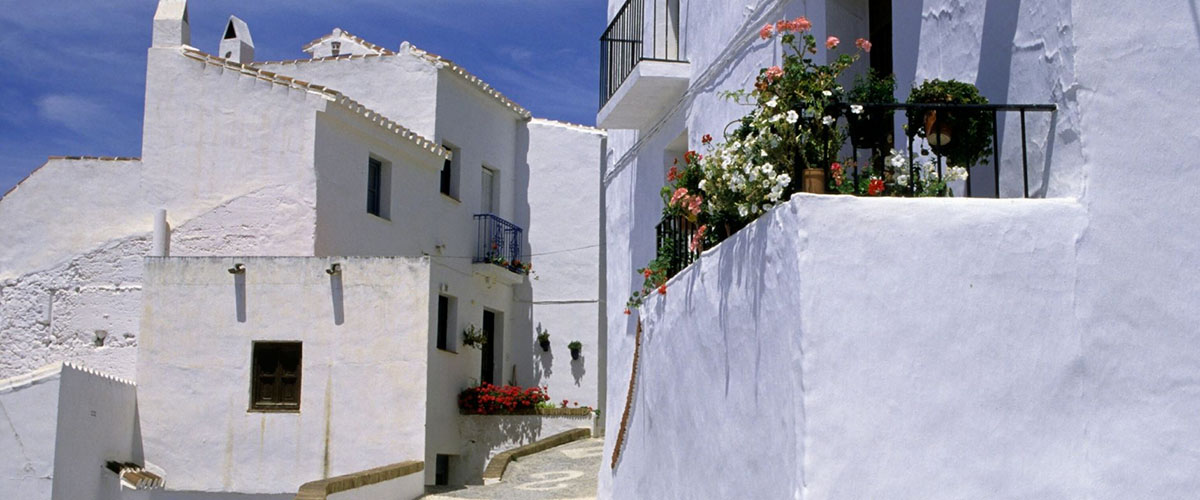
The traditional architecture of Andalusia and Levante is a built treatise on passive cooling. The Andalusian white village (Casares, Frigiliana, Arcos de la Frontera, Vejer) uses whitewash as a thermal strategy: a whitewashed surface reflects 80-90% of incident solar radiation (solar reflectance 0.80-0.90), reducing the wall surface temperature by 15-25°C compared to a dark surface (reflectance 0.20-0.30). The courtyard — present in 70% of traditional dwellings in the Guadalquivir valley (Coch, 1998) — functions as a thermal regulator: during the day, shadows cast by the walls keep courtyard air 4-8°C cooler than the exterior; at night, radiation toward the sky cools courtyard surfaces, generating an inverted chimney effect that draws hot air out of the rooms. Courtyards with vegetation and fountains (such as the cármenes of Granada) add evaporative cooling that reduces air temperature by another 2-4°C with a relative humidity increase of 15-25 percentage points.
The walls of traditional Andalusian and Levantine dwellings are 40-60 cm thick in limestone, rammed earth, or solid brick, with a surface mass of 600-1,200 kg/m² providing a thermal lag of 8-12 hours — the midday heat wave from outside reaches the interior at night, when open windows allow nighttime ventilation. Windows are small (window-to-wall ratio of 10-15%) and protected with lattice screens (mashrabiya of Islamic heritage) that reduce direct solar radiation by 70-85% while allowing ventilation. Ventilated roofs — Arabic tiles over reed matting with an air cavity of 5-10 cm — reduce solar heat transfer to the dwelling by 40-60% compared to a solid roof. Cross ventilation is optimized through the positioning of openings on opposite facades and street geometry: the narrow streets (H/W > 3:1) of historic town centers generate a Venturi effect that accelerates wind by 20-40% at street level, facilitating air renewal in dwellings at rates of 5-15 air changes/hour without any energy consumption.
Castile, Galicia, and the Cantabrian coast: thermal mass and solar capture
On the Castilian plateau (CTE climate zone D-E, annual thermal oscillation of 40-50°C, winters with temperatures from -5 to -15°C), traditional architecture prioritizes thermal mass and compactness. Adobe dwellings (raw earth with straw, density 1,600-1,800 kg/m³) and rammed earth (compacted earth, density 1,800-2,100 kg/m³) use walls of 50-80 cm thickness with a thermal transmittance of 1.0-1.5 W/m²·K — below current standards but offset by thermal inertia: the heat storage capacity of 250-400 kJ/m²·K allows storing daytime solar gains and internal gains (wood stove, occupancy) and releasing them over 10-14 hours. South orientation predominates: an analysis of 1,200 traditional dwellings in Tierra de Campos (Valladolid, Palencia, Zamora) revealed that 78% have their main facade oriented between S-SE and S-SW, with a window-to-wall ratio of 15-25% on the south facade and 3-8% on the north facade (Cañas Guerrero et al., 2005).
In Galicia and the Cantabrian coast (climate zone C1, rainfall 1,200-2,500 mm/year, 150-200 rainy days, mild temperatures of 8-18°C), the priority is protection from rain and capturing scarce solar radiation. The glazed gallery — enclosed with single glass in wooden frames, attached to the south or southwest facade — is the most distinctive element: it functions as a passive greenhouse capturing 2.0-3.5 kWh/m²·day of solar energy in winter (December-February), preheating air to 25-35°C on sunny days before it circulates into the dwelling interior. Monitoring by the University of A Coruña (Carreira et al., 2015) documented that galleries reduce heating demand by 15-25% compared to the same dwelling without a gallery. The Basque baserri integrates dwelling, livestock, and storage under a single gable roof with a slope of 40-60%: livestock on the ground floor generates 80-120 W of sensible heat per animal, which rises to the upper floor, functioning as biological heating. Sandstone walls of 60-80 cm with exterior lime render provide waterproofing and a thermal resistance of 0.6-0.8 m²·K/W. Traditional Spanish architecture by region is a compendium of sustainable strategies validated by time and quantifiable with contemporary tools.
Catalonia, Aragon, and mountain areas: the farmhouse and highland architecture
The Catalan farmhouse (masía) is the vernacular typology of greatest bioclimatic complexity on the Iberian Peninsula, adapted to a climatic range spanning from the Mediterranean coast (zone C2) to the Pre-Pyrenees (zone D1-E1). The typical masía has 3 floors: ground floor (storage, wine cellar, stable: thermal mass of the ground and stable temperature of 14-18°C), first floor (main dwelling: south orientation, hall with a large central fireplace distributing radiant heat at 4-6 kW), and second floor (granary, drying room: cross ventilation and ventilated roof). Stone walls of 50-70 cm (surface mass 1,000-1,600 kg/m²) provide a thermal damping factor of 0.05-0.10 (the interior oscillation is only 5-10% of the exterior) and a lag of 12-16 hours. The threshing floor or sun terrace oriented to the south functions as a transition space and passive solar collector. A study by the Universitat Politècnica de Catalunya (Cuchí and Pagès, 2007) analyzed 350 farmhouses and documented heating demands of 45-75 kWh/m²·year, comparable to new dwellings in the same climate without specific energy certification.
In high mountain zones (Pyrenees, Picos de Europa, Central System, Sierra Nevada: elevations > 1,000 m, mean annual temperatures of 4-10°C, 3,000-4,500 heating degree-days), traditional architecture achieves maximum compactness and insulation possible with local materials. The Pyrenean bordas (Pallars, Val d'Aran, Sobrarbe) use granite or slate stone walls of 70-100 cm with lime mortar, form factor < 0.5 m⁻¹, slate roofs with slopes of 60-100% (for snow shedding), and a single habitable floor above a ground floor used for livestock. Snow accumulated on the roof (thickness of 30-80 cm, conductivity λ = 0.05-0.25 W/m·K) functions as natural insulation that reduces roof losses by 30-60% during the coldest months. Windows are concentrated on the south facade (window-to-wall ratio 10-20% south, 2-5% north) and minimized on facades exposed to the prevailing north wind. Inland Aragon (zone D-E) employs gypsum rammed earth — soil with 15-25% gypsum addition — which improves rain resistance and reduces thermal conductivity to 0.50-0.70 W/m·K. The sustainable strategies of traditional Spanish architecture by region demonstrate that sustainability is not a contemporary invention but a historical necessity resolved through local building intelligence.
References
- [1]Thermal-physical aspects of materials used for building in Tierra de Campos, Castilla y León, SpainConstruction and Building Materials, 19(8), 595-603.
- [2]Bioclimatism in vernacular architectureRenewable and Sustainable Energy Reviews, 2(1-2), 67-87.
- [3]Sobre una estrategia para dirigir al sector de la edificación hacia la eficiencia en la emisión de gases de efecto invernadero (GEI)Ministerio de Vivienda de España.
- [4]Thermal behaviour of Galician glazed galleries: Experimental measurements and numerical simulationsEnergy and Buildings, 86, 781-789.
- [5]La restauración de la arquitectura de tapia en la Península Ibérica. Criterios, técnicas, resultados y perspectivasEditorial TC Cuadernos. ISBN: 978-84-96409-80-6
- [6]Arquitectura bioclimática en un entorno sostenibleEditorial Munilla-Lería, Madrid. ISBN: 978-84-89150-64-0


Comments 0
No comments yet. Be the first!
Leave a comment