Building Orientation and Window-to-Wall Ratio: The Cost-Free Foundation
Design strategies for maximizing natural light in buildings begin with two foundational decisions made during the concept phase that carry zero additional construction cost: building orientation and window-to-wall ratio (WWR). The south-facing facade (in the northern hemisphere) receives the most stable and controllable daylight: direct solar radiation at a low angle of 20-30 degrees during winter (at latitude 40N) and a high angle of 65-75 degrees during summer, which allows a simple horizontal overhang to combine winter solar admission with summer solar rejection. The north-facing facade receives consistent diffuse light without direct solar penetration, making it ideal for spaces requiring uniform illumination free from glare, such as museums, studios, and screen-intensive office environments.
The optimal WWR varies by orientation and climate zone: parametric studies by Ghisi and Tinker (2005) demonstrated that the optimal WWR for offices in temperate climates is 30-40% on the south facade (balancing daylight admission against thermal losses), 20-30% on the north facade, and 15-20% on east and west facades (where unwanted solar heat gain is highest). Exceeding 40% WWR on south facades increases available daylight by less than 10% while raising thermal losses by 20-30% and glare incidence by 40-60%. The practical rule for illuminated floor depth states: 2.0-2.5 times the window head height (measured from the floor to the top of the glazing) will achieve a Daylight Factor of 2% or greater at the deepest point of the room. These strategies for maximizing natural light represent the highest-leverage decisions in any daylighting design process.
Light Shelves, Reflectors and Daylight Redistribution Systems
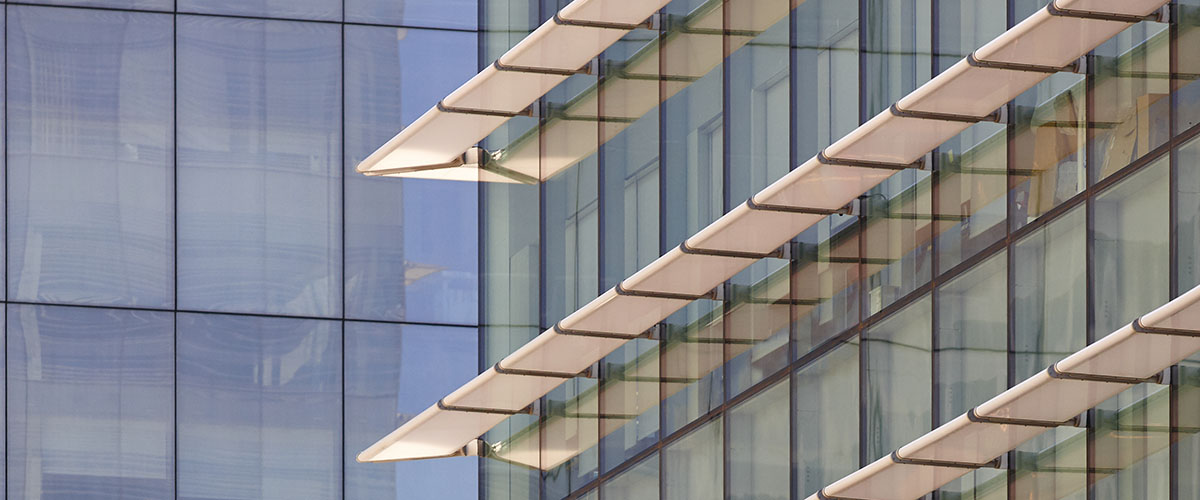
Light shelves are horizontal elements installed at a height of 2.1-2.4 m that divide the window into two functional zones: the lower vision zone and the upper daylighting zone. The top surface of the shelf is finished with a highly reflective material (white matte coating with an albedo of 0.80-0.90, or anodized aluminum with an albedo of 0.85-0.95) that redirects incoming sunlight upward onto the ceiling, projecting usable daylight 6-10 m deep into the floor plate from the facade. Research by Claros and Soler (2002) demonstrated that light shelves increase illuminance at a depth of 6 m by 40-60% compared to an equivalent window without a shelf.
Advanced daylight guidance systems extend this principle with optical precision: holographic prismatic films (thin laminated films with micro-diffraction gratings that redirect direct sunlight toward the ceiling, manufactured by Koester in Germany), anidolic reflectors (compound parabolic profiles developed at LESO-EPFL that concentrate diffuse sky light from overcast conditions and redirect it horizontally deep into the interior), and reflective venetian blinds (concave slat profiles with specular finishes that bounce light onto the ceiling while blocking direct solar views). The Edge building (Amsterdam, 2015, PLP Architecture, BREEAM Outstanding with a score of 98.4%) employs a 15-story central atrium with light shelves at every level and solar control glazing, achieving an sDA of 80% across 90% of its office floor area.
Atria, Light Wells and Skylights: Illuminating Deep Floor Plates
Atria represent the most effective strategy for delivering natural light to buildings with deep floor plans: a 10 by 10 m atrium with a glazed roof can illuminate all 4 interior facades to a depth of 6-8 m per floor, achieving a Daylight Factor of 2% or greater around the entire perimeter. Atrium efficiency depends critically on its aspect ratio (height to width): a ratio of 3:1 or less maintains adequate illumination levels on the lowest floors; taller ratios require highly reflective interior wall finishes (white surface with reflectance of 80% or higher) or angled mirror panels to redirect light downward. Light wells (open to the sky) outperform enclosed atria because they simultaneously ventilate and illuminate, though they are only practical in climates with moderate annual precipitation.
Skylights illuminate spaces directly beneath the roof with efficiencies 3-5 times greater than vertical windows per unit of glazed area (because they view the entire sky vault rather than a single portion). The optimal skylight-to-floor ratio is 3-5% for office spaces and 4-8% for industrial facilities (ASHRAE 90.1 Appendix C). Skylights fitted with diffusing glass (diffuse transmittance of 50-70%) eliminate direct solar glare and distribute illumination evenly. ETFE cushion canopies (deployed at Khan Academy HQ in Mountain View, 2018, and The Spheres by Amazon in Seattle, 2018) combine overhead daylighting, thermal insulation (U-value of 1.8-2.5 W/m2K with 3 layers), and extreme lightness (1% of the weight of equivalent glass), enabling large-span skylights with minimal structural impact.
Solar Tubes and Fiber Optic Systems: Transporting Light to Windowless Spaces
Solar tubes (light pipes or sun tunnels) transport natural light from the roof into interior spaces that have no direct access to a facade or rooftop. The system consists of a rooftop collector (acrylic or polycarbonate dome), a highly reflective conduit (specular aluminum with reflectance of 98% or higher, such as the Solatube system with Spectralight Infinity technology), and a ceiling-mounted diffuser in the target space. A solar tube with a 530 mm diameter illuminates 20-30 m2 at levels of 200-500 lux during midday, equivalent in output to a 1.5 m2 window. Maximum effective length is 6-10 m for straight runs and 3-5 m for runs with bends (each 90-degree elbow reduces transmitted light by 30-40%).
Fiber optic solar systems (manufactured by Parans and Himawari) concentrate sunlight using Fresnel lenses or parabolic mirrors onto a bundle of optical fibers that transport the light up to 15-20 m with losses of 1-2% per meter. The cost is substantially higher (5,000-15,000 EUR per luminaire versus 500-1,500 EUR for a standard solar tube), but these systems can illuminate deeply buried or remote interior spaces. Verification metrics for all these strategies include: sDA of 55% or higher for LEED EQ Daylight (2 points), sDA of 75% or higher (3 points), ASE below 10% (confirming absence of excessive direct sunlight), and DF of 2% or higher across 80% of the occupied area for BREEAM Hea 01. Combining multiple strategies for maximizing natural light reduces artificial lighting energy from a typical office baseline of 40-80 kWh/m2 per year down to 15-40 kWh/m2 per year, representing savings of 40-60%.
High-Performance Glazing and Glare Control Technologies
High-performance optical glazing maximizes visible light transmittance (Tv) while minimizing total solar energy gain (solar factor g): spectrally selective solar control glasses (Guardian ClimaGuard, Saint-Gobain Cool-Lite) achieve selectivity ratios of Tv/g exceeding 1.5 (for example, Tv = 0.65 combined with g = 0.35), transmitting 65% of visible light while admitting only 35% of total solar energy. Electrochromic glazing (SageGlass, View Dynamic Glass) varies its transmittance from Tv = 0.01 (fully tinted) to Tv = 0.60 (fully clear) via a low-voltage signal of 1-5 V, eliminating the need for blinds or curtains. The cost is 500-800 EUR/m2 (compared to 200-350 EUR/m2 for conventional solar control glass), but electrochromic glazing reduces cooling demand by 20-25% and eliminates maintenance costs associated with external shading devices.
Glare control is essential to ensure that natural light remains comfortable for occupants: glare probability is measured using the DGP (Daylight Glare Probability) index, where DGP below 0.35 indicates imperceptible glare and DGP above 0.45 indicates intolerable glare. Control strategies include: interior venetian blinds (manual adjustment, limited effectiveness), roller screens of woven fabric (Tv = 0.03-0.10, preserving exterior views), motorized external louvers (the most effective solution, blocking 85-95% of solar radiation before it reaches the glass), and micro-louvers integrated within insulated glazing units (Okalux, ScreenLine: 14 mm louvers sealed inside the glazing cavity, maintenance-free). The Deloitte Edge building deploys luminosity sensors at every workstation connected to the building automation system, adjusting supplementary LED lighting to maintain a constant 500 lux at the task plane while consuming only 4.2 W/m2 for artificial lighting.
References
- [1]An ideal window area concept for energy efficient integration of daylight and artificial light in buildingsBuilding and Environment, 40(1), 51-61.
- [2]Indoor daylight climate — influence of light shelf and model reflectance on light shelf performanceBuilding and Environment, 37(4), 357-365.
- [3]Windows and Offices: A Study of Office Worker Performance and the Indoor EnvironmentCalifornia Energy Commission, PIER Program, CEC-500-2003-082.
- [4]Examples of Climate-Based Daylight ModellingCIBSE National Conference, London.
- [5]Solatube Daylighting Systems: Technical Performance DataSolatube International Inc..


Comments 0
No comments yet. Be the first!
Leave a comment