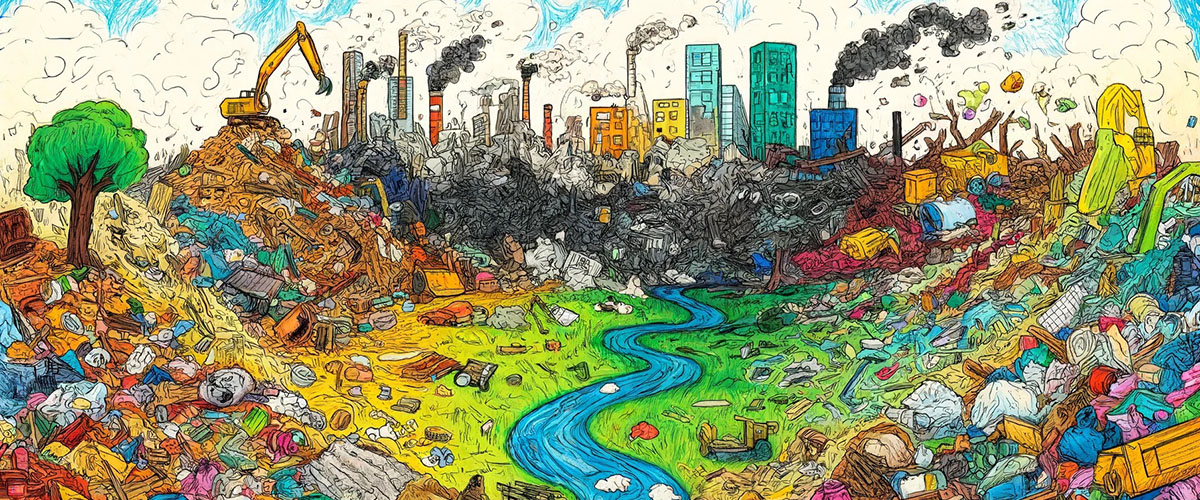
Economic dimension of inadequate waste management at the global scale
The economic and environmental impact of inadequate waste management represents one of the largest negative externalities of the contemporary economy. According to the World Bank (What a Waste 2.0, 2022 update), the direct costs of deficient solid waste management — including insufficient collection, uncontrolled dumping and lack of treatment — amount to 375 billion USD annually at the global level when environmental and health externalities are factored in. In low-income countries, where less than 50% of generated waste is collected, the cost of externalities equals 5% of GDP, compared to 0.5% in high-income countries with established management systems. Uncontrolled landfills, which receive 33% of the world's solid waste (660 million tonnes annually), generate future remediation costs estimated at 40 to 100 USD per tonne of dumped waste, compared to the 5 to 15 USD per tonne that proper management at the source would have cost. This 5:1 to 10:1 ratio between remediation and prevention demonstrates that inadequate management is not a savings measure but a deferred environmental debt.
The economic impact manifests through five quantifiable vectors. The first is the loss of material value: the linear waste economy annually destroys recyclable materials worth 80 to 120 billion USD (Ellen MacArthur Foundation, 2019). The second is the healthcare cost: diseases associated with exposure to poorly managed waste generate direct medical expenses of 20 to 50 billion USD annually and productivity losses from premature mortality (400,000 deaths annually attributable according to the WHO, 2022) estimated at 100 to 200 billion USD. The third vector is property depreciation: contingent valuation studies document reductions of 5% to 15% in property values within a 3 km radius of active or non-remediated former landfills (Ready, 2010). The fourth is the cost of contaminated soil remediation: the European Environment Agency estimates that Member States spend 6.5 billion EUR annually on remediation of the 340,000 contaminated sites identified. The fifth is the loss of tourism revenue in coastal areas affected by marine litter, estimated at 622 million EUR annually in the Mediterranean region alone.
Soil and groundwater contamination from uncontrolled dumping
Inadequate waste management contaminates soils through three main mechanisms: leachate infiltration, heavy metal deposition and persistent organic pollutant accumulation. Leachate from unlined landfills exhibits BOD₅ concentrations of 2,000 to 60,000 mg/l (versus the discharge limit of 25 mg/l under Directive 91/271/EEC), ammoniacal nitrogen of 500 to 3,000 mg/l (limit: 10 mg/l), and heavy metals such as lead (0.5-5 mg/l, limit: 0.05 mg/l), cadmium (0.05-0.5 mg/l, limit: 0.005 mg/l) and total chromium (0.5-3 mg/l, limit: 0.05 mg/l). The migration velocity of leachate depends on soil permeability: in sandy soils (permeability of 10⁻⁴ to 10⁻² m/s) the contaminant front can reach the water table within weeks; in clay soils (10⁻⁹ to 10⁻⁷ m/s) the process takes decades, but the resulting contamination persists for centuries. A study by the Instituto Geológico y Minero de España (IGME, 2020) documented that 18% of groundwater bodies in areas with closed landfills show nitrate concentrations exceeding the 50 mg/l established by the Nitrates Directive 91/676/EEC.
Soils contaminated by inadequate waste management lose their productive capacity and ecosystem function. Heavy metal contamination is virtually irreversible: lead has a soil residence time of 150 to 5,000 years, cadmium 15 to 1,100 years, and mercury 500 to 1,000 years, depending on pH, organic matter content and soil texture (Alloway, 2013). Remediation techniques (excavation and confinement, soil washing, phytoremediation, chemical stabilization) carry costs ranging from 30 to 500 EUR per m³ of treated soil. An emblematic case is the Bens landfill (La Coruña, Spain), whose collapse in 1996 dumped 100,000 m³ of waste into the Atlantic Ocean, causing contamination of 2 km of coastline, vegetation death across 15 hectares, and remediation and compensation costs exceeding 50 million EUR. In Naples (Italy), the 2008 waste crisis left 200,000 tonnes of garbage accumulated in the streets for weeks, with emergency costs of 750 million EUR and a documented 9% increase in cancer incidence in the most affected areas during the following decade.
Impact on public health and air quality
The impact of inadequate waste management on public health manifests through four exposure pathways: inhalation (particles, toxic gases, bioaerosols), ingestion (contaminated water and food), dermal contact and vector transmission (proliferation of mosquitoes, rats and cockroaches in waste accumulations). The WHO estimates that 400,000 people die prematurely each year from causes directly attributable to deficient waste management, predominantly in low- and middle-income countries. Open-air burning of waste, practiced by 41% of the world's population as a routine disposal method (UNEP, 2021), emits dioxins (PCDD/PCDF: 10 to 1,000 ng I-TEQ/kg of burned waste), furans, polycyclic aromatic hydrocarbons (PAHs) and fine particles PM2.5 (emission factor: 5 to 15 g/kg of waste). Chronic exposure to these emissions increases lung cancer risk by 30% to 70% among populations residing within 1 km of regular burning sites (Wiedinmyer et al., 2014).
Informal waste workers — between 15 and 20 million people worldwide (World Bank, 2022) — suffer the most severe consequences of inadequate management. Epidemiological studies document respiratory disease rates 3 to 5 times higher than in the general population, contact dermatitis prevalence of 40% to 60%, musculoskeletal injury rates of 50% to 70%, and heavy metal exposure with blood lead levels of 15 to 40 µg/dl (OSHA's action limit is 50 µg/dl, but neurocognitive effects are documented from 5 µg/dl). Active landfills generate detectable odors within a 1 to 5 km radius, with H₂S concentrations of 5 to 50 ppb (odor threshold: 0.5 ppb) and volatile organic compounds (benzene, toluene, xylene) that exceed WHO guideline values within a 500 m radius. In tropical zones, waste accumulation with standing water increases dengue vector density (Aedes aegypti) by 5 to 10 times, contributing to the estimated 390 million annual infections according to the WHO. The economic and environmental impact of inadequate waste management is thus amplified in a health spiral that disproportionately affects the most vulnerable communities.
Costs of inaction and economic benefits of proper management
The comparison between the costs of inaction and the benefits of proper management demonstrates that inadequate waste management is the most expensive option in the medium and long term. A cost-benefit analysis by the World Bank across 20 cities in developing countries estimated that each USD invested in proper waste management infrastructure generates a return of 3 to 6 USD in avoided externalities (reduced healthcare costs, preservation of water resources, maintenance of property values, material recovery). The German waste separation and recycling program, implemented since 1991 with the Green Dot (Grüner Punkt) system, generates an annual value of 6 billion EUR in secondary raw materials, directly employs 290,000 people in the recycling sector, and has reduced greenhouse gas emissions from the waste sector by 76% compared to 1990 (Umweltbundesamt, 2023). The total system cost (selective collection, sorting plants, treatment) is 100 to 150 EUR per inhabitant per year, compared to the 200 to 500 EUR per inhabitant of externalized costs generated by inadequate management.
Circular economy models applied to waste management amplify the economic benefits. The Ellen MacArthur Foundation estimates that the transition to a circular economy in Europe would generate a net economic benefit of 1.8 trillion EUR by 2030, with 700,000 new jobs and a 48% reduction in CO₂ emissions from industrial sectors. In the specific field of construction, proper demolition waste management can recover 90% of materials by weight: recycled concrete as aggregate has a value of 3 to 8 EUR per tonne (versus a landfill cost of 15 to 80 EUR per tonne in the EU), recovered structural steel reaches a value of 200 to 400 EUR per tonne, and clean recycled timber 20 to 60 EUR per tonne. The HISER project (Holistic Innovative Solutions for an Efficient Recycling, Horizon 2020) demonstrated across 4 pilot demolition sites that selective deconstruction increases demolition costs by 10% to 30%, but the value of recovered materials exceeds the additional cost by a factor of 1.5 to 3, transforming waste into an economic asset. The economic and environmental impact of inadequate waste management constitutes, in sum, an irrefutable argument in favor of investing in circular management infrastructure.
References
- [1]What a Waste 2.0: A Global Snapshot of Solid Waste Management to 2050 — Updated DatasetWorld Bank Group. ISBN: 978-1-4648-1329-0
- [2]Completing the Picture: How the Circular Economy Tackles Climate ChangeEllen MacArthur Foundation.
- [3]Heavy Metals in Soils: Trace Metals and Metalloids in Soils and Their Bioavailability (3rd ed.)Springer Netherlands. ISBN: 978-94-007-4469-1
- [4]Global Emissions of Trace Gases, Particulate Matter, and Hazardous Air Pollutants from Open Burning of Domestic WasteEnvironmental Science & Technology, 48(16), 9523-9530.
- [5]Compendium of WHO Recommendations on Health and the Environment — Waste ManagementWorld Health Organization. ISBN: 978-92-4-004931-4
- [6]Waste Management in Germany 2023: Facts, Data, DiagramsGerman Federal Environment Agency.


Comments 0
No comments yet. Be the first!
Leave a comment