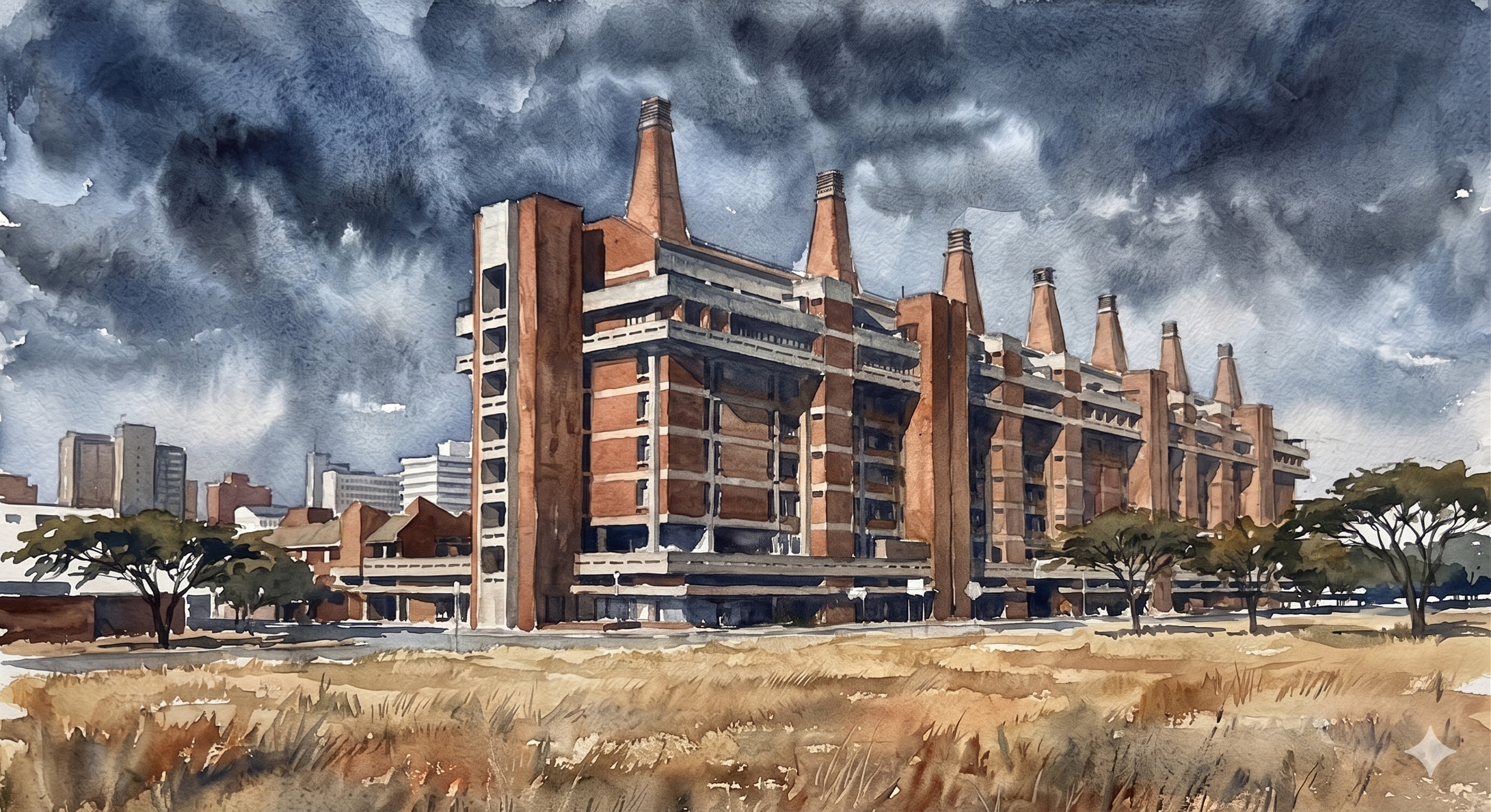
In 1996 a building opened in Harare, Zimbabwe's capital, that the international press immediately turned into an icon of biomimetic architecture: the Eastgate Centre, an office and shopping complex of about 26,000 square metres designed by Zimbabwean architect Mick Pearce with Ove Arup and Partners as engineers. The project's promise was radical for 1990s Harare: doing away entirely with central air conditioning. The declared inspiration came from the mounds of Macrotermes termites, abundant in the country and described in popular literature as nature's example of near-perfect thermal regulation. The building works: in operation it has consumed less than half the energy of a comparable HVAC building and roughly 90% less in the ventilation line item. The story that followed is more interesting. The biology Pearce relied on was a simplification; later science found the actual mechanism to be different and, paradoxically, even closer to how Pearce's building actually works.
Mick Pearce and Harare's radical 1996 solution
Harare sits 1,500 metres above sea level. Summer days top out near 30 °C with night-time minima around 10 °C; winter nights can drop close to freezing. Daily temperature swings of 15-20 °C are normal. That swing is the raw material of any passive cooling system based on thermal mass and night ventilation. Pearce and the Arup team exploited this climate trait through three project decisions: a heavy concrete envelope with high thermal inertia and external fins shading windows and façades; a layout of two towers separated by a central atrium acting as a ventilation chimney; and a bank of low-power fans that during the night extract warm internal air, allowing cool outside air to flow through the concrete masses and chill them for the day ahead.
The building works as a living thermal accumulator. At night it is «charged» with cold. During the day, heat from occupants, equipment and solar gains is absorbed gradually by the masses, keeping interior temperature within a comfort range without compressor cooling. Mechanical energy is the bare minimum needed to drive the night-time fans. The rest is passive physics.
The termite-mound analogy Pearce applied
The Eastgate biomimetic story, repeated in thousands of articles, goes like this: Macrotermes termites keep their mound at a constant temperature despite extreme outside swings, thanks to a chimney-and-conduit architecture that ventilates the interior by stack effect (warm air rises out at the top, cool air enters at the base). Pearce took the image literally, translated it into architectural language and built towers with passive ventilation conduits mimicking those mound «lungs».
The narrative is elegant and didactic. It has two problems. First, savanna termite mounds are not air conditioners: they are gas-regulation nests with a secondary thermal role. Second, the dominant mechanism for air movement inside the mound is not permanent stack-effect convection but the cyclic diurnal oscillation of air driven by solar heating of the outer wall. Both corrections reached the construction sector years after the Eastgate was already in operation.
Korb 2003: the mound is not a thermostat
Ethologist Judith Korb published in 2003 in Naturwissenschaften a critical review of the literature on termite mound thermoregulation and ventilation. Her measurements in Macrotermes bellicosus colonies showed that nest temperature does fluctuate with ambient temperature, contrary to the popular image of an isothermal mound. Regulation is partial and costly: the mound adjusts wall thickness and surface complexity depending on whether the climate is cool forest or open savanna, and there is a trade-off between minimising heat loss and maximising gas exchange. The nest produces CO₂ from termite metabolism and from the symbiotic fungi cultivated in specialised chambers; that CO₂ has to leave, which limits how tightly the nest can be sealed against heat.
The mound is therefore not an air-conditioning system. It is a respiratory organ for the colony, with secondary thermal regulation. Pearce's image had conflated the dominant mechanism (gas exchange) with a derived effect (thermal damping) and had over-attributed thermostatic capability to the mound.
King, Ocko and Mahadevan 2015: the mound as a diurnal pump
Hunter King, Samuel Ocko and Lakshminarayanan Mahadevan published in 2015 in PNAS an experimental study on Odontotermes obesus, an Indian species of the same group. They directly measured airflow inside the mound's surface conduits with sensors installed in situ over several 24-hour cycles. The result refuted both the continuous chimney-effect picture and the idea that wind is the main driver of internal flow. The actual driver is the diurnal thermal oscillation: during the day, outer walls heat up by solar radiation much faster than the mound's core (which stays insulated by its mass); air at the walls rises, exits through the apex and pulls fresh, oxygen-rich air up from the base. At night the flow reverses: walls cool faster than the core and air sinks through the outer conduits. The structure exploits its own differential thermal inertia to pump air with no metabolic cost.
The Eastgate's irony is that the actual termite mound mechanism (diurnal oscillation coupling thermal mass and ventilation) is structurally closer to how the building works (a night-charged thermal accumulator discharged by daytime convection) than the surface chimney-effect analogy Pearce had originally sold. The metaphor was rhetorically imperfect but thermodynamically more correct than people thought.
What Eastgate delivers: operational figures
Metrics reported by Mick Pearce's office and by independent reviews agree on magnitudes. Eastgate consumes less than 50% of the energy of a comparable HVAC building in Harare. In the specific ventilation line item, savings against a conventional mechanical system reach roughly 90%. The capital cost premium versus a conventional AC office building was below 10% of total cost and has been amortised comfortably by operating savings over the first two decades. Occupant comfort has been acceptable for 50 of the 52 weeks per year; the remaining two correspond to occasional heatwaves when interior temperature can briefly rise above the optimal range.
The most relevant generalisable indicator is operating energy intensity. Eastgate runs at an intensity significantly lower than the European shopping-centre average (around 270 kWh/m²·year) and that of conventional offices (165-200 kWh/m²·year). The exact figure varies by year and methodology, but the order of magnitude is undisputed.
Why Eastgate has not been replicated at scale
If the solution works and is cheap to operate, the reasonable question is why we are not building Eastgates anywhere on the planet with high diurnal thermal swing. Three factors explain the silence. First, climate. Eastgate exploits a Harare trait (large daily amplitude, low humidity, subtropical altitude) that many other cities do not share. Madrid or Seville could replicate the logic; Singapore or Jakarta cannot, because of combined humidity and high night-time temperature. Second, the economic model. The typical shopping-centre developer maximises lettable floor area and minimises construction cost; Eastgate's solid walls and passive atria consume usable percentage and do not appear in the standard return calculations. Third, project culture. Central air conditioning has standardised as expected amenity, and a building with no AC is perceived as a degraded product in higher-income markets.
The consequence is that Eastgate is cited as a biomimetic milestone in every sustainability handbook, but derived projects are rare. Mick Pearce has produced subsequent works with the same logic (Council House 2 in Melbourne, Banco Santander Río in Buenos Aires, schools and offices in South Africa), but the model has not spread to the conventional development sector. The required upfront premium is not prohibitive (≤ 10%), but the asymmetry between who pays for construction and who pays for operation prevents diffusion.
Lessons for biomimicry in construction
Eastgate leaves three operational lessons for the sector. The first is that useful biomimicry is not surface analogy with an organism, it is the translation of an identifiable physical principle. Pearce got it right because he used thermal mass and inertia with proper aerodynamic sense, not because he copied «termite chimneys». If the analogy had failed, the building could still have worked thanks to its physics; if the physics had failed, the analogy would not have saved it.
The second lesson is that natural science is work in progress, not a closed set of examples. A 1996 project may end up correct against later refined biological data; the symmetric risk also exists (a project that literally copies a poorly understood biological mechanism may fail by imitating a caricature). The professional safeguard is to work with biologists and physicists alongside the architects.
The third lesson is regulatory. Eastgate works because Harare allows operating an office building without certified air-conditioning systems. In Spain, the Building Code (CTE DB-HE) and HVAC regulations (RITE) impose comfort criteria that, as currently drafted, penalise purely passive solutions oscillating seasonally beyond a narrow range. To make the Eastgate model legal in Spain, comfort certification needs to be updated (operative temperature, humidity, air velocity), not just the instantaneous performance of equipment. That update is on the table with the recast EPBD and, if transposed properly, will open the door to buildings designed on the same principle as the corrected termite mound and the corrected Eastgate: diurnal oscillation coupled with thermal mass.
Conclusion
The Eastgate Centre in Harare has been operating for nearly three decades on less than half the energy of a conventional building. It was built by an architect inspired by a biological idea that science later refined and that, paradoxically, in its updated form explains even better why the building works. Useful biomimicry uncovers physical principles shared between living forms and built forms, not formal resemblances. Sustainable construction does not need more metaphors: it needs more diurnal thermal oscillations harnessed, more mass, more night ventilation, fewer compressors switched on at eleven in the morning. Termites, after forty million years of natural selection, already know what to do. The construction industry, two centuries into the industrial revolution, lags behind with plenty of room to improve.
References
- Korb, J. (2003). Thermoregulation and ventilation of termite mounds. Naturwissenschaften, 90(5), 212-219. DOI: 10.1007/s00114-002-0401-4
- King, H., Ocko, S., & Mahadevan, L. (2015). Termite mounds harness diurnal temperature oscillations for ventilation. Proceedings of the National Academy of Sciences, 112(37), 11589-11593. DOI: 10.1073/pnas.1423242112
- Turner, J. S., & Soar, R. C. (2008). Beyond biomimicry: What termites can tell us about realising the living building. Proceedings of the 1st International Conference on Industrialised, Integrated, Intelligent Construction (I3CON), Loughborough University, 14-16 May 2008.
- Pearce, M. (1996). Eastgate Centre, Harare: Design rationale and operational performance. Harare: Mick Pearce & Pearce Partnership / Arup.
- Soar, R. C., Bardunias, P., Petersen, K., & Turner, J. S. (2017). Solar-powered ventilation of African termite mounds. Journal of Experimental Biology, 220(18), 3260-3269. DOI: 10.1242/jeb.160895

Comments 0
No comments yet. Be the first!
Leave a comment