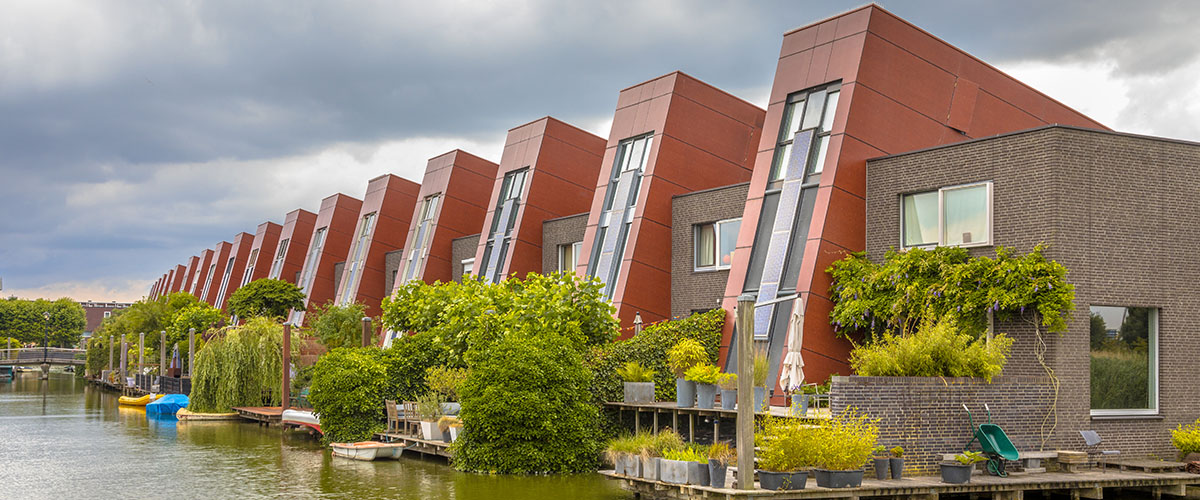
Solar Harvesting: Winter Capture and Summer Protection Strategies
Site-responsive design to harness natural conditions for energy performance rests on a measurable principle: the free energy sources available at every building site (sun, wind, water) can satisfy 50-80% of the heating, cooling, and lighting demand of buildings when the architectural form is deliberately shaped to capture and distribute them. Passive solar harvesting is the first natural condition to integrate: at latitudes between 36 and 43 degrees north, the south-facing facade receives 3-5 kWh/m2 per day of solar radiation during winter months, sufficient to cover 30-50% of heating demand in a well-insulated dwelling through glazed surfaces with a solar factor between g = 0.50 and g = 0.65.
Solar capture strategies include: south-facing windows with calibrated overhangs (projection depth P = 0.5-0.8 times the window height H, sized to block summer sun at 65-75 degrees altitude while admitting winter sun at 20-30 degrees), Trombe walls (a heavyweight masonry wall painted dark behind a glass pane, capturing 150-250 kWh/m2 per year in Mediterranean climates), attached sunspaces (buffer zones that raise air temperature 5-15C above exterior conditions during winter), and glazed galleries (a traditional building typology featuring south-facing enclosed balconies that function as solar collectors and transitional living spaces). Summer protection exploits the high solar altitude angle: a 1m overhang above a 2m-tall window blocks direct sunlight from June through August while admitting full solar gain from October through March at latitudes of 38-42 degrees north. This approach to harnessing natural conditions represents the foundation of climate-responsive architectural practice.
Wind as a Design Resource: Ventilation, Cooling and Protection
Wind constitutes the second major natural condition available for passive building performance: natural ventilation delivers free cooling when outdoor temperatures remain below 26-28C and provides continuous dilution of indoor air pollutants. Designing with wind requires analysis of the wind rose for the project site: prevailing wind direction, mean seasonal velocity, and frequency of calm periods. In coastal Mediterranean regions, sea breezes of 2-5 m/s blowing from the southeast to south dominate during summer months, offering a direct opportunity for passive cooling without any mechanical energy input.
Wind-responsive design strategies include: cross ventilation (openings on opposing facades aligned with the prevailing wind direction, generating airflow rates of 10-20 air changes per hour at wind speeds of 2-4 m/s), stack-effect ventilation (solar chimneys 4-8 m tall that generate 3-5 Pa of negative pressure and deliver 4-8 air changes per hour even in calm conditions), wind catchers (roof-mounted scoops that capture airflow at higher elevations and channel it downward into occupied spaces), and courtyards with Venturi acceleration (constricted passages that accelerate airflow through pressure differential). In regions with cold winter winds (typically from the north and northeast in continental climates), the design must incorporate windbreaks: evergreen vegetation, masonry walls, or earth berms that reduce wind velocity by 50-70% across a protected zone extending 5-10 times their height, cutting infiltration losses by 20-30%.
Water and Topography: Site Resources for Passive Comfort
Water as a natural condition offers 3 distinct design strategies: (1) evaporative cooling whereby the evaporation of 1 liter of water absorbs 2,450 kJ (680 Wh) of heat energy, lowering air temperature by 5-10C in dry climates with relative humidity below 40%; fountains, channels, and shallow pools positioned in courtyards and building entries create measurable cool microclimates; (2) rainwater harvesting whereby a 200 m2 roof in a climate zone receiving 600 mm of annual rainfall captures approximately 120,000 liters per year, sufficient to supply 50-70% of irrigation and toilet flushing demand for a 10-unit residential building; and (3) ground thermal mass whereby at depths of 2-3 m, soil temperature stabilizes at 14-18C year-round in temperate regions, enabling earth-to-air heat exchange for preheating ventilation air in winter and precooling it in summer.
Topography directly shapes the microclimate of any building site: south-facing slopes receive 10-30% more solar radiation than north-facing slopes (at 40 degrees latitude with a 10% gradient). Valley floors accumulate cold air through nocturnal thermal inversion (temperatures 3-8C lower than adjacent hillsides), making them disadvantageous for heating but favorable for passive night cooling strategies. Earth-sheltered and semi-buried construction leverages the thermal inertia of surrounding ground: buildings with the north facade fully buried (earth berming) reduce thermal losses through that facade by 70-90% and stabilize interior temperatures to 16-20C without any active heating or cooling system. The Casa de la Lluvia (Juan Herreros Architects, Cantabria, Spain, 2014) exploits sloping terrain to bury the north facade while directing all glazing southward, achieving a heating demand of only 18 kWh/m2 per year in an Atlantic climate with 1,800 heating degree days.
Vegetation and Microclimate: Landscape as a Passive Performance System
Vegetation is a natural condition that simultaneously functions as solar shading, thermal insulation, humidity regulation, and acoustic buffer. Deciduous trees planted on the south side of a building block 60-90% of solar radiation in summer (when the canopy is fully leafed) while allowing 60-80% of solar radiation to pass through in winter (when branches are bare), acting as a self-regulating natural sunscreen. Research by Akbari et al. (2001, LBNL) demonstrated that 3 strategically positioned trees around a residential building reduce cooling demand by 20-30% and heating demand by 10-15% through wind protection.
Extensive green roofs (substrate depth of 8-15 cm, planted with sedum and native grasses) reduce roof surface temperature by 30-40C during summer (Sailor, 2008), cut solar heat gain through the roof by 50-70%, and retain 40-70% of annual precipitation (functioning as sustainable drainage systems). Green walls on east and west facades reduce surface temperature by 5-8C and cooling energy consumption by 15-25%. Xeriscaping (landscape design using drought-adapted native species) reduces irrigation water consumption by 50-80% compared to conventional turf-based landscaping. Site-responsive design integrates vegetation as a quantifiable building system with measurable thermal, acoustic, and hydrological performance, treating landscape not as an aesthetic afterthought but as an engineered component of the building envelope strategy.
Integrated Natural Conditions: Verified Built Case Studies
Integrating all natural conditions available at a building site produces structures with minimal energy demand and maximum occupant comfort. The Entrepatios housing cooperative (Madrid, 2020) combines: a south-facing glazed gallery for passive solar capture, external wall insulation of 200 mm thickness (U-value of 0.17 W/m2K), east-west cross ventilation for night cooling, an extensive green roof, rainwater harvesting collecting 20,000 liters per year, and deciduous tree planting on the south elevation. The measured outcome: total energy consumption of 25 kWh/m2 per year with an A-rated energy certificate. The Salburua Wetlands Interpretation Center (Vitoria, Spain, ACXT Architects, 2008) is semi-buried into the surrounding meadow with an integrated green roof, south-facing glazing protected by a 1.5 m overhang, and stack-effect natural ventilation: heating demand of 22 kWh/m2 per year in a continental climate zone.
At the international scale, the California Academy of Sciences (San Francisco, 2008, Renzo Piano Building Workshop) features an undulating 10,000 m2 green roof that replicates the topography of surrounding hills, automated skylights that ventilate the museum through stack effect, rainwater collection systems, and rooftop photovoltaics. The result: 30% lower energy consumption than a conventional museum of equivalent program, with LEED Platinum certification. The Khoo Teck Puat Hospital (Singapore, 2010, CPG Consultants) harnesses tropical climate conditions: natural cross ventilation in 70% of public areas, vertical gardens covering 45% of facade surfaces, and rainwater retention ponds that cool ambient air through evaporation by 3-4C. The result: energy consumption 35% below comparable hospitals in Singapore, achieving BCA Green Mark Platinum. These verified cases confirm that harnessing natural conditions is not an aesthetic choice but a quantifiable engineering strategy with measurable returns on both energy and cost.
References
- [1]Cool surfaces and shade trees to reduce energy use and improve air quality in urban areasSolar Energy, 70(3), 295-310.
- [2]A green roof model for building energy simulation programsEnergy and Buildings, 40(8), 1466-1478.
- [3]Passive and Low Energy Cooling of BuildingsJohn Wiley & Sons. ISBN: 978-0-471-28473-4
- [4]Introduction to Architectural Science: The Basis of Sustainable DesignRoutledge, 3rd ed.. ISBN: 978-0-415-82498-7
- [5]CTE DB-HE: Documento Básico de Ahorro de EnergíaBOE.

Comments 0
No comments yet. Be the first!
Leave a comment