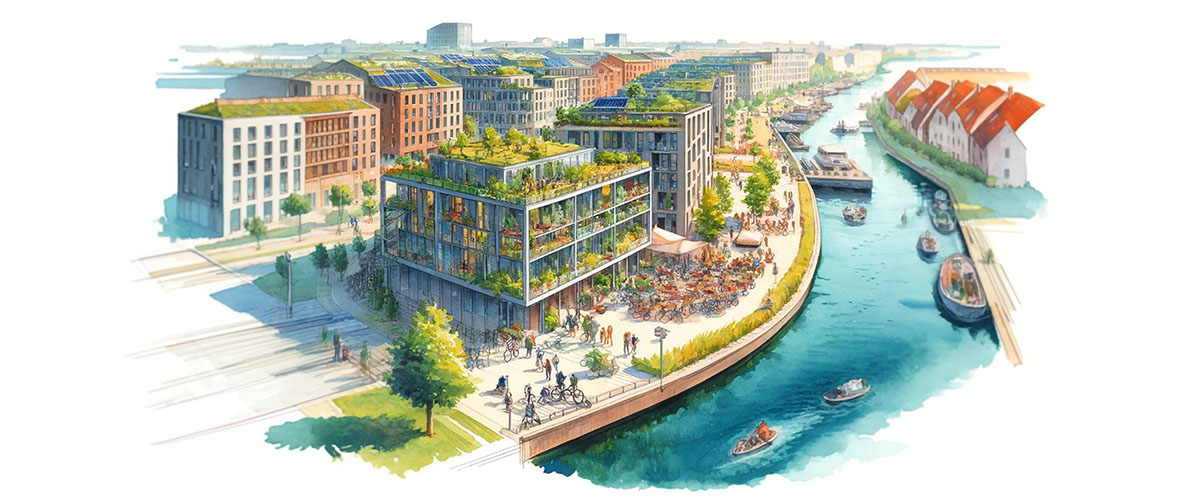
Hammarby Sjostad: from industrial landfill to green building model. Historical context
Urban developments and green building policies. Case study: Hammarby Sjostad is the most thoroughly documented example in the world of how to transform a degraded industrial zone into a large-scale sustainable residential district. Located southeast of central Stockholm, Hammarby was a 200-hectare area of port facilities, industrial landfills and contaminated soil. The project began in 1996 as part of Stockholm's bid for the 2004 Olympic Games (ultimately not awarded), but the municipality decided to continue the development as a showcase for urban sustainability.
As of 2024, Hammarby Sjostad houses 11,000 dwellings, 26,000 inhabitants and 10,000 jobs in a compact urban fabric with a density of 110 dwellings/hectare and 50% public space (parks, lakeside promenades along Lake Hammarby, canals). The initial objective — known as the Hammarby Model — established that the district's environmental impact should be 50% lower than that of a standard Stockholm residential district built in the 1990s in: CO2 emissions, energy consumption, water consumption, waste generation and land use. The monitoring indicators — published annually by the municipality since 1999 — demonstrate 80-90% compliance with the original targets.
The Hammarby Model: circular urban metabolism
The fundamental innovation of Hammarby is the circular urban metabolism model — an integrated system where energy, water and waste flows are interconnected: (1) organic waste (collected by underground pneumatic suction: Envac system with 3 fractions — organic, combustible, non-recyclable — and speed of 70 km/h in underground pipes) is converted into biogas through anaerobic digestion (35 days at 37 degrees C); (2) the biogas fuels 1,000 urban buses in Stockholm and the gas cooktops in district dwellings; (3) sewage sludge is dewatered and used as agricultural fertilizer (complete N-P-K nutrient cycle); (4) non-recyclable waste is incinerated in a cogeneration plant that supplies district heating (efficiency: 85-90%).
The water cycle is equally circular: potable water comes from Lake Malaren (conventional treatment), wastewater is treated at the Henriksdal plant (Europe's largest MBR biological membrane treatment plant, capacity: 900,000 m3/day), and residual heat from the treated water is recovered through large-scale heat pumps (180 MW thermal) for district heating. Rainwater is managed through SUDS: vegetated roofs (100% of new buildings), rain gardens, open channels and bioretention ponds that retain 70-80% of runoff and remove 80-90% of pollutants before discharge into Lake Hammarby. This integrated model was codified in the Hammarby diagram (symbiosis model) that has been replicated in more than 20 districts in Sweden, China, Canada and Australia.
Energy and buildings: district heating and green building regulations
District heating in Hammarby Sjostad supplies 100% of buildings with heat generated by: biofuel cogeneration (40%), residual heat from waste incineration (30%), heat pumps powered by treated wastewater heat (20%) and solar thermal + geothermal (10%). Heating emissions are 30-50 gCO2/kWh — 75-85% lower than the European average for individual natural gas heating (200-250 gCO2/kWh). The average building energy consumption is 80 kWh/m2·year for heating + domestic hot water — 40% below the Swedish residential stock average (130 kWh/m2·year) — thanks to: envelope with U < 0.18 W/m2K in walls, triple-glazed windows (Uw < 1.0 W/m2K), heat recovery with MVHR (efficiency 85-90%) and airtightness n50 < 1.0 ACH.
The photovoltaic systems installed on roofs and facades across the district total 2,000 kWp with production of 1,700 MWh/year (yield: 850 kWh/kWp·year at Stockholm's latitude: 59 degrees N, GHI = 1,000 kWh/m2·year). The green building policy of Stockholm municipality imposes requirements more stringent than the national Building Code (BBR): mandatory environmental certification (Sweden Green Building Council — Miljoebyggnad Silver or higher), maximum heating demand of 55 kWh/m2·year (BBR29, 2021, for Stockholm's climate zone III), and mandatory life cycle assessment (LCA) under the klimatdeklaration law (2022) that requires declaring the embodied carbon of all new buildings > 100 m2.
Water, waste and mobility: 25-year performance metrics
Potable water consumption in Hammarby Sjostad is 100 liters/person·day — 40% below the Swedish average (170 l/person·day) — thanks to: low-flow faucets (4-6 l/min), dual-flush toilets (3/6 l), class A appliances (washing machine: 40-50 l/cycle), citizen awareness and progressive pricing. The waste recycling rate is 40-45% (including composting and biogas), with 50% energy recovery and only 5-10% to landfill (compared to the 30-50% European average). The Envac pneumatic collection system (3 suction stations, 35 km of underground pipes) eliminates surface containers, collection trucks and odors.
The district's mobility prioritizes public transport (Sparvag City tram + Sjovagen ferry + expanded metro) and cycling (protected lanes: 15 km within the district, connected to Stockholm's cycling network). 40% of trips are made by public transport, 25% on foot, 15% by bicycle and 20% by car — compared to the typical Stockholm modal split (35% public transport, 10% bicycle, 15% walking, 40% car). The parking ratio is 0.55 spaces/dwelling (compared to 1.0-1.5 of the Swedish standard), with 100% of spaces equipped with electric vehicle charging. The 25-year monitoring confirms that the Hammarby Model objectives have been met at 80-90%: per capita CO2 emissions are 50% below the Stockholm average, energy consumption 40% lower, water consumption 40% lower and landfill waste generation 80-90% lower.
Replicability and evolution: from Hammarby to Stockholm Royal Seaport
The replicability of the Hammarby model has been demonstrated in more than 20 international projects that have wholly or partially adopted the circular metabolism diagram: Sino-Swedish Eco-City Wuxi (China, 100,000 inhabitants), Western Harbour Malmo (Sweden, 10,000 inhabitants: Sweden's first 100% renewable district), Dockside Green (Victoria, Canada: LEED Platinum ND, on-site wastewater treatment) and One Planet Sutton (London: BioRegional's One Planet Living concept). The keys to replicability are: (1) institutional integration — Hammarby's success stems from coordination between the urban planning department, service companies (Stockholm Vatten, Fortum Varme) and private developers from the planning phase; (2) long-term financing — district infrastructures (heating, pneumatic collection, SUDS) require initial public investment of 1,000-2,000 EUR/dwelling, recovered in 10-15 years through service tariffs.
The Stockholm Royal Seaport (Norra Djurgardsstaden) (under development 2011-2030, 12,000 dwellings, 35,000 jobs, 236 ha) is the successor to Hammarby with more ambitious targets: zero fossil carbon CO2 emissions by 2030, heating demand of 45 kWh/m2·year (compared to 55 in BBR29 and 80 in Hammarby), mandatory LCA for all buildings with an embodied carbon limit of 300 kgCO2eq/m2, and a target of zero waste to landfill. The Royal Seaport integrates Hammarby's lessons with technologies available in 2020-2030: smart grid with neighborhood battery storage (1 MWh), shared electric vehicles (ratio 0.3 spaces/dwelling), and real-time monitoring of energy, water and waste flows through a municipal IoT platform. The evolution from Hammarby (1996) to Royal Seaport (2025) documents 30 years of accumulated institutional learning on how to plan, build and operate sustainable urban districts at scale.
References
- [1]Hammarby Sjöstad — A Unique Environmental Project in StockholmGlashusEtt / Stockholm City Planning Administration.
- [2]The development of a sustainable urban district in Hammarby Sjöstad, Stockholm, Sweden?Environment, Development and Sustainability, 13(6), 1043-1064.
- [3]Automated Waste Collection at Hammarby Sjöstad: 20 Years of Operational DataEnvac AB.
- [4]Stockholm Royal Seaport Sustainability Programme v3.0Stockholm City Development Administration.
- [5]BBR 29 — Boverkets byggregler (Swedish National Board of Housing, Building and Planning Regulations)Boverket.


Comments 0
No comments yet. Be the first!
Leave a comment