Scale of the problem: water stress in Spain
The challenges and solutions for water management in arid zones have direct relevance for Spain, where the water exploitation index (WEI+) exceeds 40% in the Segura, Júcar, and Southern basins (an indicator of severe water stress according to the European Environment Agency). Mean precipitation ranges from 300 mm/year in the southeast (Almería, Murcia) to 1,600 mm/year in Galicia. The National Hydrological Plan (PHN 2023–2027) estimates a structural deficit of 3,500 hm³/year in the Mediterranean basins.
The building sector consumes 12–15% of potable water in Spain (INE, 2022), with an average per-capita consumption of 132 litres/day. Of these, only 3–5 litres require potable quality (drinking, cooking); the remainder (shower, toilet, washing machine, irrigation) can be covered with lower-quality water. This disproportion between the quality supplied and the quality required is the basis of the efficient water management strategy for buildings in arid zones.
Desalination: seawater at a quantifiable cost
Spain is the fourth largest country in the world in desalination capacity (5.7 hm³/day, 2023) and the first in Europe, with more than 765 plants. The dominant technology is reverse osmosis (RO), with an energy consumption of 3.0–4.5 kWh/m³ of water produced (compared to 15–25 kWh/m³ of the first distillation plants in the 1970s). The current cost of desalinated water is €0.50–0.80/m³, comparable to the cost of potable water in many Spanish cities (€0.80–2.50/m³ including sanitation).
The Torrevieja desalination plant (Alicante), with a capacity of 240,000 m³/day, is the largest in Europe and the second largest in the world. Improvements in membranes (latest-generation TFC polymers) and energy recovery through pressure exchangers (PX by Energy Recovery Inc., 98% efficiency) have reduced consumption to 2.5–3.0 kWh/m³ in the most efficient plants. The main environmental impact is brine (2x seawater concentration) discharged back to the sea; the Water Framework Directive requires impact studies and controlled dilution.
Rainwater harvesting and greywater reuse in buildings
Rooftop rainwater harvesting is the most direct solution for buildings in arid zones. The captured volume is calculated as V = P·A·Ce, where P is annual precipitation (mm), A the catchment area (m²), and Ce the runoff coefficient (0.80–0.90 for pitched roofs, 0.50–0.70 for green roofs). In Almería (230 mm/year), a 200 m² roof captures 37,000–41,000 litres/year; in Murcia (300 mm/year), 48,000–54,000 litres. These volumes cover 15–25% of the non-potable demand (cisterns, irrigation, cleaning) of a 20-dwelling apartment building.
Greywater reuse (shower, washbasin, washing machine) multiplies the water yield: greywater represents 50–65% of total domestic flow (70–85 litres/person·day). Treatment with membrane bioreactors (MBR) produces an effluent with BOD5 < 5 mg/l and turbidity < 1 NTU, suitable for cisterns, irrigation, and cleaning. Royal Decree 1620/2007 regulates the reuse of reclaimed water in Spain, establishing quality parameters by use. The cost of MBR treatment at building scale is €0.80–1.50/m³, lower than the potable water price in most arid-zone municipalities. The combination of rainwater harvesting + greywater reuse reduces mains potable water consumption by 40–60%.
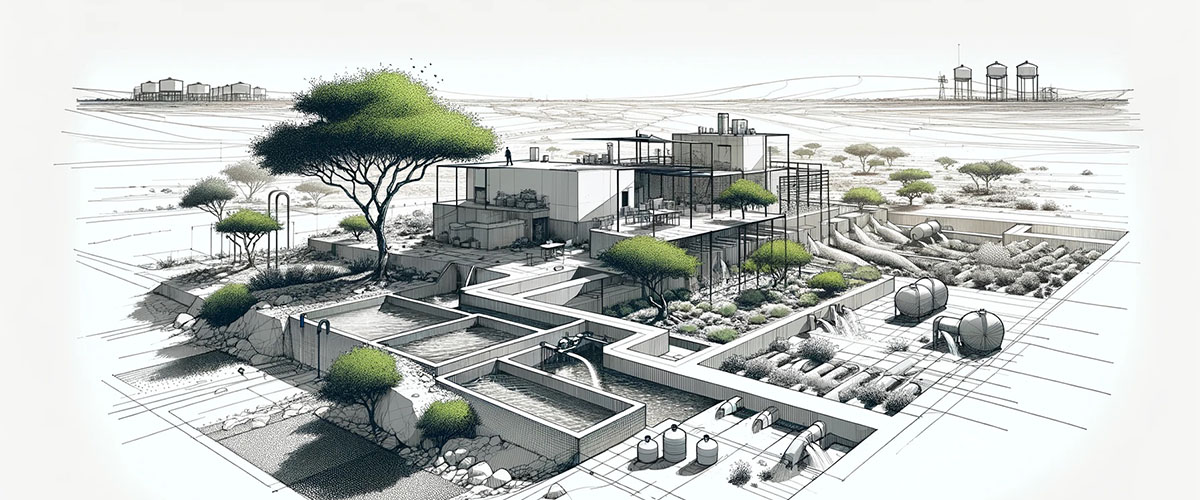
Sustainable Urban Drainage Systems (SUDS)
SUDS manage urban runoff at source, infiltrating, retaining, or reusing rainwater rather than evacuating it through the sewer network. In arid zones, their primary function is to retain every drop for infiltration or later use. The main typologies are: infiltration trenches (infiltration capacity of 50–200 mm/h depending on soil), permeable paving (porosity of 15–25%, runoff coefficient < 0.10 versus 0.85–0.95 for conventional asphalt), rain gardens (bioretention with 50–100 cm filter substrate that retains 80–90% of suspended solids and 50–70% of nutrients), and cisterns (underground concrete or polyethylene tanks of 5–50 m³).
In Spain, Royal Decree 638/2016 on flood risk management and the Technical Instructions for Hydraulic Works of several autonomous communities (Basque Country, Catalonia, Valencian Community) require SUDS implementation in new urban developments. The Sarriguren neighbourhood (Navarra) integrated SUDS throughout 100% of its urbanisation (2003–2008), with permeable paving, infiltration trenches, and retention ponds, reducing runoff by 65% and recharging the local aquifer with 150,000 m³/year. This model is replicable across all Spanish arid zones where soil conditions allow infiltration.
Integrated strategies for building in arid zones
Comprehensive water management in an arid-zone building combines all the above strategies into a closed water plan: low-flow fittings (≤ 6 l/min, savings of 30–50% compared to standard), dual-flush toilets (3/6 litres, 60% savings compared to 9 litres), rainwater harvesting for irrigation and cisterns, treated greywater reuse for toilets and irrigation, and perimeter SUDS for surplus infiltration.
The Masdar City project (Abu Dhabi, Foster + Partners, 2008–under construction) was designed for water consumption 54% lower than the Abu Dhabi average: 200 litres/person·day versus 430 litres/day. The LEED v4.1 certification (WE credit) requires a minimum 20% reduction in indoor water consumption relative to the ASHRAE 189.1 baseline, and awards additional points for rainwater harvesting, greywater reuse, and efficient irrigation. In the Spanish context, combining all strategies can reduce mains potable water demand from the current 132 litres/person·day to 40–60 litres/person·day, making sustainable construction viable even in the most arid areas of the Peninsula.
References
- [1]Plan Hidrológico Nacional 2023-2027: Revisión del tercer cicloMITECO.
- [2]Real Decreto 1620/2007: Régimen jurídico de la reutilización de aguas depuradasBOE.
- [3]Water resources across Europe — Confronting water stress: An updated assessmentEEA. ISBN: 978-92-9480-388-4
- [4]Estadística sobre el suministro y saneamiento del agua — Año 2020INE.
- [5]The SuDS Manual (C753)CIRIA. ISBN: 978-0-86017-760-9

Comments 0
No comments yet. Be the first!
Leave a comment