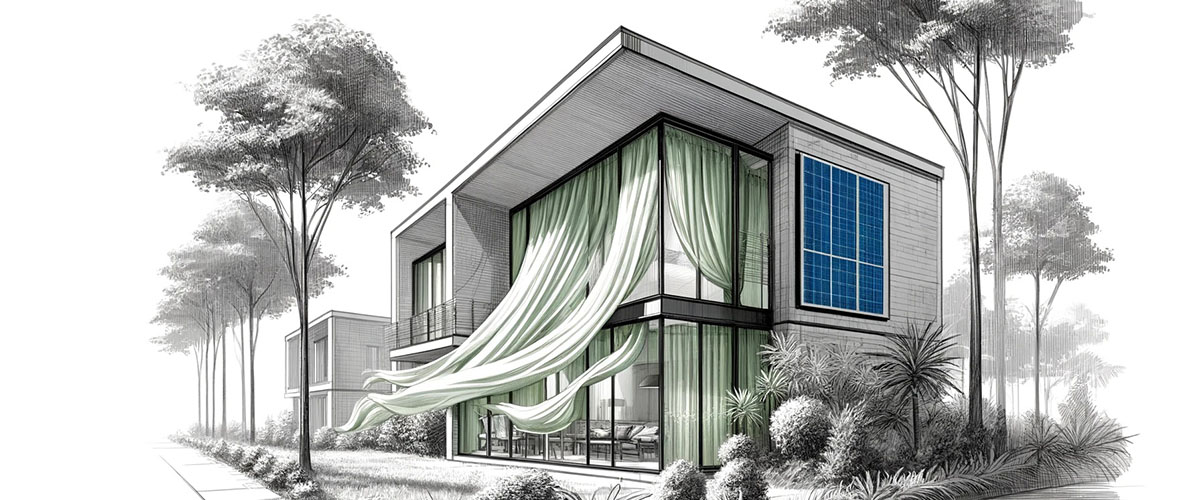
Challenge 1: wind variability and airflow reliability
The challenges and solutions in implementing natural ventilation systems start from a physical limitation: airflow rates depend on variable natural forces. Wind-driven ventilation generates pressures proportional to the square of velocity: ΔP = 0.5·ρ·v²·(Cp_windward - Cp_leeward), where pressure coefficients Cp range from +0.6 to -0.7 depending on building geometry and wind angle of incidence (EN 1991-1-4). On calm days (v < 1 m/s), the driving pressure drops below 0.5 Pa, insufficient to guarantee the minimum flow rates of 12.5 l/s per person required by EN 16798-1 (category II).
The most effective solution combines wind-driven ventilation with the stack effect: a vertical atrium or duct 6-15 m high generates pressures of 1-3 Pa per degree of difference between indoor and outdoor temperature, regardless of wind. The Queen's Building at De Montfort University (Leicester, Short & Ford, 1993) combines 12 m stacks with cross-ventilation, maintaining flow rates above 8 l/s per person for 98% of occupied hours without mechanical assistance, according to post-occupancy measurements published by Short and Lomas (2007).
Challenge 2: outdoor noise in urban environments
Opening windows on a facade exposed to an urban road with average traffic results in indoor noise levels of 55-65 dB(A) (facade 10 m from a road with AADT > 10,000 vehicles/day), well above the 35-40 dB(A) limit for offices (EN ISO 12354-3) and 30-35 dB(A) for bedrooms (CTE DB-HR). This conflict between ventilation and acoustic insulation is the most frequent challenge in implementing natural ventilation in urban settings.
Proven solutions include: acoustic double-leaf windows with staggered openings (20-30 dB attenuation while maintaining ventilation), acoustic intake ducts with labyrinth silencers (15-25 dB attenuation, Dn,e,w per EN ISO 10140), and relocating openings to protected facades or interior courtyards. The Federal Environment Agency (UBA) in Dessau (Sauerbruch Hutton, 2005) uses a double-skin facade with a 90 cm ventilated cavity providing natural ventilation with 35 dB acoustic attenuation, enabling natural ventilation on all 4 facades despite being surrounded by traffic routes.
Challenge 3: outdoor air quality and filtration
In cities with NO₂ levels exceeding 40 μg/m³ (annual limit under Directive 2008/50/EC) or PM2.5 concentrations above 25 μg/m³, natural ventilation introduces pollutants that may worsen indoor air quality. Madrid, Barcelona, and Seville regularly exceed these limits at traffic stations (MITECO, Air Quality Reports). This challenge questions the viability of pure natural ventilation in polluted urban centres.
The technical response is hybrid ventilation with filtration: a system that uses natural ventilation when outdoor air quality is acceptable (facade-mounted CO₂, NO₂, and PM2.5 sensors) and activates mechanical ventilation with F7-F9 filters (EN ISO 16890: ePM2.5 > 80%) when thresholds are exceeded. The Astro building in Zurich (Basler & Hofmann, 2018) automatically alternates between natural ventilation (70% of occupied hours) and mechanical (30%), reducing fan energy consumption by 65% versus a 100% mechanical system while maintaining indoor PM2.5 < 10 μg/m³.
Challenge 4: fire safety regulations and tall buildings
Fire safety regulations limit natural ventilation in buildings over 28 m of evacuation height (CTE DB-SI), requiring vertical compartmentalisation that prevents the open inter-floor connections needed for the stack effect. Vertical ventilation ducts must incorporate fire dampers (EI 60/90 per DB-SI 1) that close automatically in the event of fire, interrupting natural ventilation flow.
Solutions include: double-skin facades with horizontal compartmentalisation every 3 floors (as in the Commerzbank in Frankfurt, Foster + Partners, 1997, which alternates winter gardens with fire barriers while maintaining natural ventilation up to floor 56), external solar chimneys at the building perimeter (which do not count as internal ducts and do not require the same compartmentalisation), and low-pressure fan-assisted natural ventilation systems (mixed-mode) that maintain airflow during emergencies. BS 9999 (formerly BS 5588-9) and the CIBSE AM10 guide provide specific procedures for designing natural ventilation compatible with fire safety.
Design tools: CFD and post-occupancy monitoring
Reliable natural ventilation design requires CFD (Computational Fluid Dynamics) simulation to predict velocity, temperature, and pollutant concentration fields. Reference software includes ANSYS Fluent, OpenFOAM (open-source, validated per AIAA), and DesignBuilder CFD (integrated with EnergyPlus). The realisable k-ε turbulence model is most widely used for building ventilation, with prediction errors of 10-20% compared to wind tunnel measurements per the AIJ (Architectural Institute of Japan) benchmark.
Post-occupancy evaluation (POE) closes the design loop. The Lanchester Library at Coventry University (Short & Associates, 2000) implemented a stack-driven natural ventilation system with CO₂ monitors on every floor. Five years of operational data (published by Lomas and Cook, 2005, in Energy and Buildings) demonstrated that CO₂ levels remained below 1,000 ppm for 95% of occupied hours, with ventilation energy consumption 67% lower than an equivalent mechanical system delivering the same airflow rates.
References
- [1]Exploiting a hybrid environmental design strategy in a US continental climateBuilding Research & Information, 35(2), 119-143.
- [2]Sustainable buildings for a warmer world: lessons from the Lanchester LibraryProceedings of World Sustainable Building Conference, Tokyo.
- [3]AM10: Natural ventilation in non-domestic buildings (updated 2014)Chartered Institution of Building Services Engineers. ISBN: 978-1-903287-56-5
- [4]EN 16798-1:2019 Energy performance of buildings — Ventilation for buildings — Part 1: Indoor environmental input parametersEuropean Committee for Standardization.
- [5]AIJ guidelines for practical applications of CFD to pedestrian wind environment around buildingsJournal of Wind Engineering and Industrial Aerodynamics, 96(10-11), 1749-1761.


Comments 0
No comments yet. Be the first!
Leave a comment