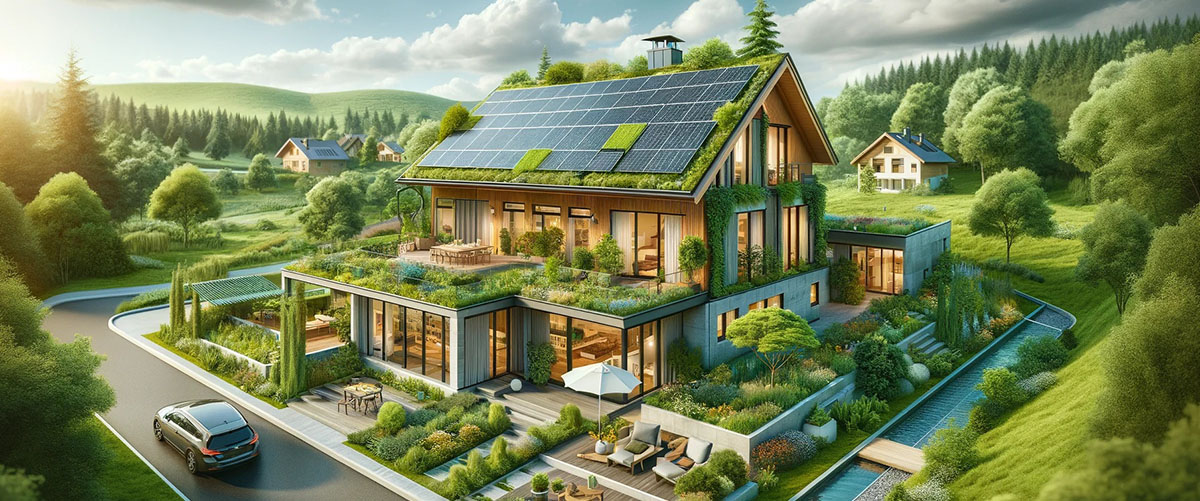
Climate Analysis as the Foundation of Bioclimatic Design
The concepts and principles of bioclimatic design rest on a measurable axiom: adapting a building to its climate reduces energy demand more effectively than any mechanical system. The first principle is site-specific climate analysis, which quantifies 5 variables: temperature (monthly averages, extremes, and diurnal range: amplitudes exceeding 10 degrees Celsius favor night-flush ventilation strategies), solar radiation (kWh/m2 per day on horizontal and vertical surfaces by orientation: a south-facing wall at 40 degrees N latitude receives 3-5 kWh/m2 per day during winter), wind (mean velocity, prevailing direction, and frequency: winds of 2-4 m/s enable effective cross-ventilation), relative humidity (monthly averages: below 40% requires humidification, above 70% requires dehumidification), and precipitation (mm/year: determines rainwater harvesting potential).
The tools for climate analysis include: Climate Consultant (UCLA, free software that generates bioclimatic diagrams from EPW weather files), Meteonorm (a climate database covering 8,300+ monitoring stations worldwide), and international standards such as ASHRAE 169-2021 (climate data for building design, classifying locations into 8 climate zones and 3 moisture regimes). The Olgyay diagram (1963) plots the comfort zone on axes of temperature and humidity, indicating which corrective strategies are needed (shading, ventilation, solar heating). The Givoni diagram (1969) improves upon Olgyay by overlaying passive strategies onto a psychrometric chart (temperature versus absolute humidity), identifying with precision what percentage of annual hours fall within comfort and which strategy addresses each discomfort zone. Both diagrams remain foundational to bioclimatic design practice in 2024.
Solar Orientation and Building Form: Zero-Cost Design Decisions
Solar orientation is the bioclimatic principle with the greatest impact at zero additional cost. At latitudes between 36 and 43 degrees N (southern Europe, central United States, northern China), a facade oriented toward true south (within 15 degrees) receives 40-60% more solar radiation during winter (low solar angle: 20-30 degrees above the horizon at December solstice) and 20-30% less during summer (high solar angle: 65-75 degrees at June solstice), facilitating winter solar gain and summer protection through horizontal overhangs. A parametric study by Gratia and De Herde (2003) demonstrated that optimal orientation reduces total energy demand by 15-25% compared to the worst-case orientation.
The building form determines the surface-to-volume ratio (S/V): the lower the S/V ratio, the lower the thermal losses through the envelope. A cube has S/V = 6/a (where a is the edge length in meters); an elongated east-west block maximizes the south-facing facade (solar gain) while minimizing east and west exposures (unwanted heat gain). The form factor of buildings ranges from 0.3 m-1 (compact 20-story tower) to 1.2 m-1 (detached single-family house). International energy codes establish thermal transmittance limits that vary by climate zone: for example, IECC 2021 requires wall assemblies of R-20 (U-value of 0.28 W/m2K) in Climate Zone 5 and R-13+10 continuous insulation in Climate Zone 6. The Passivhaus standard demands U-values of 0.15 W/m2K or less for walls regardless of climate zone, compensating for form factor through superior insulation and airtightness performance.
Thermal Mass: The Passive Temperature Regulator
Thermal mass is the capacity of a material to absorb, store, and release heat, thereby dampening exterior temperature oscillations. The relevant metric is areal heat capacity (kappa, kJ/m2K): reinforced concrete at 200 mm thickness yields kappa values of 250-300 kJ/m2K, solid brick achieves 150-200 kJ/m2K, timber reaches 50-80 kJ/m2K, and lightweight plasterboard delivers only 15-25 kJ/m2K. Thermal mass is most effective when the diurnal temperature swing exceeds 10 degrees Celsius: the material absorbs heat during the day (when outdoor temperature exceeds indoor temperature) and releases it at night (when the reverse occurs), maintaining stable interior conditions.
The quantified effect: a building with heavy thermal mass (exposed interior concrete with kappa exceeding 200 kJ/m2K) exhibits an indoor temperature swing of only 2-4 degrees Celsius compared to 8-12 degrees Celsius in a lightweight building (steel frame with sandwich panels, kappa below 50 kJ/m2K) during a day with a 20 degree Celsius outdoor amplitude. Thermal mass combined with night-flush ventilation (opening windows overnight to cool the mass) reduces peak daytime temperature by an additional 3-5 degrees Celsius (Artmann et al., 2008). In Mediterranean and continental climates (diurnal amplitudes of 15-20 degrees Celsius in summer), this combination can eliminate the need for mechanical cooling during 60-80% of summer hours. The standard EN ISO 13786 defines calculation methods for effective thermal capacity and the decrement factor of the envelope, providing the engineering basis for these bioclimatic design principles.
Natural Ventilation and Solar Protection: Passive Cooling Strategies
Natural ventilation is the preeminent bioclimatic principle for passive cooling. Cross-ventilation (openings on opposite facades) generates airflow rates of 10-20 air changes per hour with wind speeds of 2-4 m/s: the inlet opening should be 50-70% smaller than the outlet to create a Venturi effect that accelerates the flow. Stack ventilation (buoyancy-driven airflow) exploits the temperature difference between warm interior air and cooler exterior air: a solar chimney 6 m tall generates a pressure differential of 3-5 Pa, sufficient for 4-8 air changes per hour in zero-wind conditions.
Solar protection must be dimensioned according to the solar geometry of the site latitude. At 40 degrees N (Madrid, New York, Beijing): the solar altitude angle at noon varies from 27 degrees in December to 73 degrees in June. A horizontal overhang with depth P = 0.6 multiplied by H (where H is the window height) blocks direct sun from June through August while admitting it from October through March. Adjustable louvers allow protection to be tuned by time of day: external horizontal louvers with a solar reduction factor g_ext of 0.10-0.15 block 85-90% of solar radiation before it reaches the glazing. External roller shutters achieve g_ext values of 0.04-0.08 (blocking 92-96%). Modern energy codes establish solar control parameters: for example, ASHRAE 90.1-2019 limits the Solar Heat Gain Coefficient (SHGC) to 0.25 in Climate Zone 1 and 0.40 in Climate Zone 5-8, mandating that solar protection be addressed during the design phase of every project applying these bioclimatic concepts.
Climate-Adaptive Envelope and Integrated Strategies by Climate Zone
The climate-adaptive envelope integrates insulation, airtightness, thermal mass, and solar protection into a coherent system. Reference values from international standards for representative climate zones include: ASHRAE Climate Zone 2A (Houston, hot-humid): wall U-value of 0.48 W/m2K or less, roof U-value of 0.18 W/m2K or less, priority on solar protection and dehumidification; Climate Zone 4A (New York, mixed): wall U-value of 0.28 W/m2K or less, roof U-value of 0.15 W/m2K or less, balanced heating and cooling demand; Climate Zone 6A (Minneapolis, cold): wall U-value of 0.21 W/m2K or less, roof U-value of 0.13 W/m2K or less, priority on insulation and solar gain. The Passivhaus standard unifies at U-values of 0.15 W/m2K or less for walls and airtightness of n50 of 0.6 ACH or less across all zones.
The integrated strategies by climate zone are: in hot-arid climates: heavy thermal mass + cross-ventilation + external solar shading + high-albedo facades (albedo above 0.40) + courtyard typology as a microclimate regulator. In mixed/continental climates: external wall insulation of 100-150 mm + south-facing solar gain with attached sunspace + internal thermal mass + summer night-flush ventilation + MVHR (mechanical ventilation with heat recovery at 80-90% efficiency). In cold climates: external insulation of 200-300 mm + triple glazing (Ug of 0.7 W/m2K or less) + airtightness of n50 of 0.6 or less + MVHR at 90% + passive solar gain with 30-40% south-facing glazing ratio. Systematic application of these concepts and principles of bioclimatic design achieves heating demands of 10-15 kWh/m2 per year (Passivhaus standard) across all climate zones with construction cost premiums of 5-15%.
References
- [1]Design with Climate: Bioclimatic Approach to Architectural RegionalismPrinceton University Press. ISBN: 978-0-691-08296-5
- [2]Climate Considerations in Building and Urban DesignJohn Wiley & Sons. ISBN: 978-0-471-29177-0
- [3]Design of low energy office buildingsEnergy and Buildings, 35(5), 473-491.
- [4]Parameter study on performance of building cooling by night-time ventilationRenewable Energy, 33(12), 2589-2598.
- [5]CTE DB-HE: Documento Básico de Ahorro de Energía — Zonas Climáticas de EspañaBOE.



Comments 0
No comments yet. Be the first!
Leave a comment