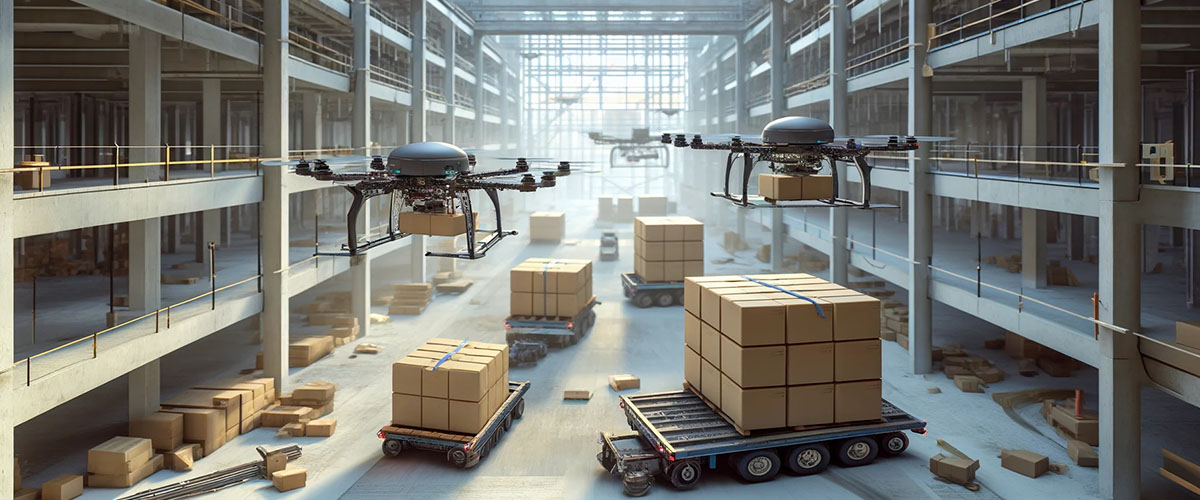
Logistics applications of drones in the construction industry
The use of drones in construction logistics has evolved from occasional aerial photography to an integrated ecosystem of applications that optimize material flows, inventory inspection and construction progress monitoring. The global drone market for the construction industry reached 6.3 billion USD in 2023 and is projected to reach 14.7 billion by 2030, with an annual growth rate of 12.8% (Fortune Business Insights, 2023). A study by the Association for Unmanned Vehicle Systems International (AUVSI) estimates that 35% of construction companies with more than 100 employees in North America and Western Europe use drones in at least one project phase, compared to 8% in 2017. The main logistics applications include: aerial inventory of materials stockpiled on site (counting accuracy of 99% ±1% versus 90-95% for manual counting), topographic and volumetric mapping (resolution of 1 to 3 cm/pixel at flights of 50-120 meters altitude), inspection of unloading zones and access points, and lightweight transport of tools and components across large-scale sites.
Aerial logistics via drones resolve specific bottlenecks in construction. On linear projects (highways, railways, pipelines) stretching several kilometers, ground transport of tools and spare parts between work fronts takes between 30 and 90 minutes per trip in all-terrain vehicles; a cargo drone covers the same distance in 5 to 15 minutes via a direct trajectory. On high-rise vertical projects (buildings over 100 meters, telecommunications towers, wind turbines), drones deliver fasteners, sealants and hand tools to rooftop work points, avoiding the 15 to 30 minutes it takes a worker to descend via the hoist, collect the material and return. The Swiss company Matternet and the American Skydio offer construction-specific solutions with drones that operate autonomously via preprogrammed routes, land on designated pads and recharge automatically at stations with a capacity of 8 to 12 cycles/day.
Cargo drones for material transport on construction sites
Cargo drones represent the most innovative application of drones in construction logistics, with capabilities that have progressed from the 2-5 kg of early commercial models (2016-2018) to the 100-200 kg of current state-of-the-art systems. The DJI FlyCart 30 (launched in 2024) is the first mass-produced commercial cargo drone, with a 30 kg payload capacity, 16 km range at maximum load (28 minutes of flight), cruising speed of 54 km/h and a 20-meter cable cargo release system enabling delivery without landing. Hybrid VTOL (vertical take-off and landing) fixed-wing drones such as the Wingcopter 198 achieve ranges of 75 to 110 km with 6 kg payloads, suitable for supplying lightweight components between the central warehouse and dispersed sites within a 50 km radius. For heavy loads, unmanned helicopter systems such as the Skyways Pelican (200 kg payload, 30 km range) and the Ehang 216-S (220 kg capacity) offer an alternative to conventional helicopter cranes (cost of 8,000 to 15,000 EUR/hour) at an operating cost of 500 to 2,000 EUR/hour, although their certification for material transport operations in urban environments is still in the regulatory development phase.
Practical cargo drone transport applications in construction include the supply of high-strength bolts for steel structures (packages of 10 to 25 kg, delivery urgency under 30 minutes to avoid halting the assembly crew), distribution of concrete samples from site to testing laboratory (test specimens of 3 to 5 kg, requiring rapid transport to comply with standard EN 12390-2 which mandates molding within 40 minutes), and transport of batteries and spare parts for broken-down electric equipment on site. The return on investment for a 30 kg cargo drone such as the DJI FlyCart 30 (price of 15,000 to 20,000 EUR) is achieved within 6 to 12 months on sites with at least 5 transports/day of lightweight materials that currently require ground vehicles with a driver. The logistics company Wing (an Alphabet subsidiary) completed more than 350,000 commercial drone deliveries between 2019 and 2023 in Australia, the United States and Finland, demonstrating the operational maturity of the technology for last-mile deliveries with delivery success rates of 99.7% and average times of 6 to 10 minutes per delivery.
Photogrammetry, inventories and logistics monitoring with drones
Drone photogrammetry applied to construction logistics transforms the management of stockpiled material inventories on site. A photogrammetric flight of 15 to 30 minutes with a drone equipped with a 20 to 48 megapixel camera (models such as the DJI Phantom 4 RTK or DJI Matrice 350 RTK with centimeter-level positioning) covers an area of 5 to 20 hectares and generates a digital surface model with resolution of 1 to 3 cm/pixel and altimetric accuracy of ±2 to 5 cm. Subsequent processing with software such as Pix4D or Agisoft Metashape automatically calculates the volume of each aggregate, soil, gravel or bulk material stockpile with an error below 2%, compared to the 10% to 20% error of manual calculation using tape measure. For a site managing 50,000 m³ of earthworks, the difference between a 2% and a 15% error equates to 6,500 m³ of unaccounted material, with an economic value of 40,000 to 130,000 EUR depending on material type.
Logistics monitoring through periodic drone flights (weekly or biweekly frequency) generates a temporal record of all material movements on site. Automatic comparison of weekly 3D models using change detection algorithms identifies: arrival of new materials (added volumes), consumption of existing stockpiles (reduced volumes), stockpile zone occupancy (planning of future deliveries) and detection of misplaced or abandoned materials. The construction management software DroneDeploy, used across more than 400 million m² of cumulative site area, integrates drone imagery with the BIM model to generate automatic progress reports comparing as-built reality with the design, detecting deviations with an accuracy of ±5 cm and 100% site surface coverage per flight. Inspection of incoming vehicle loads using drone cameras with 4K resolution allows visual conformity verification of materials without stopping the vehicle, reducing receiving times from 15-20 minutes to 3-5 minutes per delivery. Drones equipped with thermal cameras (resolution of 640 x 512 pixels, sensitivity of ±0.05 °C) detect moisture in cement stockpiles, overheating in reactive materials and leaks in liquid tanks, preventing deterioration losses valued at 0.5% to 2% of the materials budget.
Regulations, safety and the future of drones in construction logistics
The regulatory framework for the use of drones in construction logistics is governed in Europe by Regulation (EU) 2019/947 and its delegated rules, which establish three operational categories: open (low risk, drones under 25 kg, maximum altitude of 120 meters, within pilot's visual line of sight), specific (medium risk, requiring operational authorization based on SORA risk assessment) and certified (high risk, requirements equivalent to manned aviation). Logistics operations with cargo drones in urban construction environments are predominantly classified under the specific category, requiring a risk assessment that considers: overflight of people (mitigable with an integrated parachute activating in 0.5 seconds), loss of communication link (automatic return to origin or landing at a predefined safe zone), and obstacle collision (LiDAR, radar and stereoscopic camera detect-and-avoid systems with detection range of 30 to 100 meters). Obtaining operational authorization requires 3 to 6 months of processing before the national aviation authority (AESA in Spain, DGAC in France, CAA in the United Kingdom).
The future of drone use in construction logistics converges toward full autonomy and integration with the site's digital ecosystem. UTM (Unmanned Traffic Management) systems will enable simultaneous operation of multiple drones in a site's airspace, managing separations through V2V (Vehicle-to-Vehicle) and V2I (Vehicle-to-Infrastructure) communication with latencies below 100 ms. The European U-space project (budget of 230 million EUR, phased implementation 2023-2030) establishes the digital infrastructure for drone traffic management in low-altitude airspace (up to 120 meters), enabling beyond visual line of sight (BVLOS) operations that are essential for logistics transport. Swarm drones, coordinated by collective intelligence algorithms, will be able to transport loads of 500 to 2,000 kg distributed among 10 to 50 units flying in formation, overcoming the individual payload limitations of each drone. Projections by the World Economic Forum (2020) estimate that the use of drones in construction logistics will generate global savings of 100 billion USD/year by 2035, with transport emission reductions of 5% to 15% in the sector through the replacement of short-distance ground trips.
References
- [1]Construction Drone Market Size, Share & Industry Analysis, 2023-2030Fortune Business Insights Pvt. Ltd..
- [2]Advanced Drone Operations Toolkit: Accelerating the Drone RevolutionWEF, Geneva.
- [3]Easy Access Rules for Unmanned Aircraft Systems (Regulation (EU) 2019/947)EASA, Cologne.
- [4]A Systematic Review of Unmanned Aerial Vehicle Application Areas and Technologies in the AEC DomainJournal of Information Technology in Construction (ITcon), 24, 381-405.
- [5]Unmanned Aerial System Applications in Construction: A Systematic ReviewConstruction Innovation, 18(4), 453-468.


Comments 0
No comments yet. Be the first!
Leave a comment