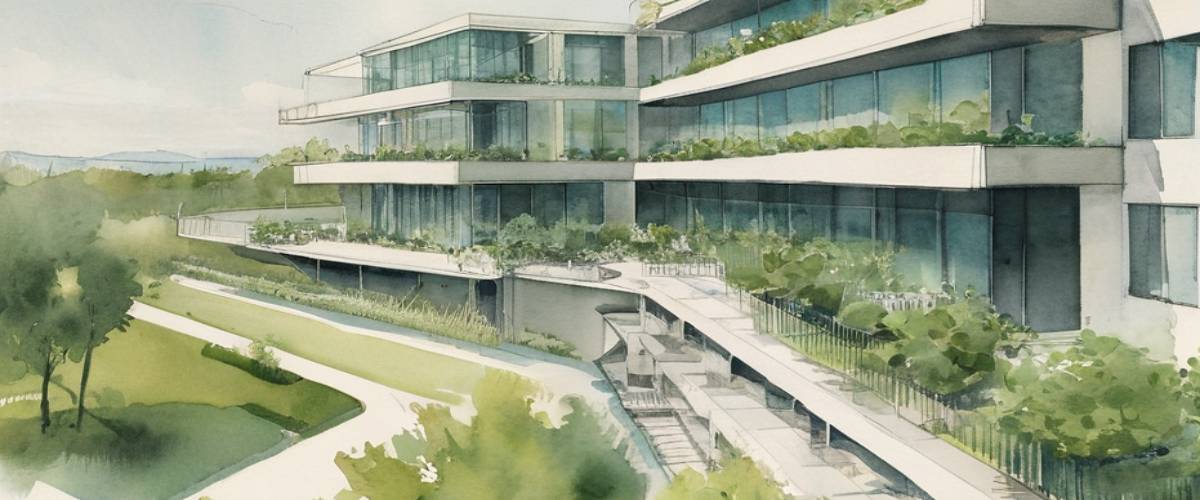
The Fifth Material Revolution: From Environmental Impact to Regeneration
Innovative construction materials for a sustainable future are not incremental improvements on existing products but a paradigm shift: materials that move from minimising their negative impact to generating positive impact -- capturing carbon, purifying air, generating energy or repairing themselves autonomously. The construction materials industry invests 12,000-15,000 million USD per year in research and development (McKinsey, 2023), with 8-12% annual growth in the areas of sustainability and innovation. The World Green Building Council estimates that innovative materials could reduce the construction sector's emissions -- currently 38% of global CO2 emissions (UNEP, 2022) -- by 40% to 60% by 2050, if combined with energy efficiency measures and renewable energy sources.
The five frontiers of innovation are converging: low-footprint cements (LC3, geopolymers, carbonate cements) target the 8% of global emissions attributable to Portland cement; engineered timber (CLT, glulam, LVL) transforms wood from a material for single-family houses into a structural system for towers of 18 storeys; bio-fabricated materials (mycelium, bacterial cellulose, bio-cement) introduce manufacturing processes that operate at low energy and ambient temperature; smart materials (electrochromic, thermochromic, piezoelectric, self-healing) adapt their behaviour to environmental conditions; and carbon-capture materials (carbonatable concretes, mineral-based products that fix CO2 during curing) convert the building into a net carbon sink. Together, these five categories chart a credible pathway toward a construction sector that is regenerative rather than extractive.
Next-Generation Cements: Reducing the Sector From 8% to 3% of Global Emissions
Portland cement (CEM I) emits 0.80-0.90 kgCO2/kg through two mechanisms: the calcination of limestone (CaCO3 to CaO + CO2: 60% of emissions) and the energy required by the rotary kiln at 1,450 degrees C (40%). Innovative cements attack both fronts. LC3 (Limestone Calcined Clay Cement) replaces 50% of the clinker with a blend of calcined clay (30%) and limestone (15%), reducing emissions by 30-40% to 0.45-0.60 kgCO2/kg. Developed by EPFL (Lausanne) and IIT Delhi, LC3 is manufactured using common clays available globally (no scarce raw materials required) and has been validated in pilot projects in India, Cuba, Colombia and Switzerland, with more than 500,000 tonnes produced by 2024. Its compatibility with existing cement plants makes it one of the most immediately deployable decarbonisation technologies.
Carbonate cements (such as that developed by Solidia Technologies) use calcium silicate rather than tricalcium silicate, with a manufacturing temperature of 1,200 degrees C (versus 1,450 degrees C) and CO2 curing (instead of water) that fixes 0.30 kgCO2/kg of cement. The net result is an emission of 0.10-0.20 kgCO2/kg -- 75-90% less than Portland. CarbonCure injects CO2 during the mixing of conventional concrete, fixing 15-25 kgCO2/m3 without affecting performance (over 11 million m3 produced globally by 2024). Geopolymers (alkaline activation of fly ash and slag) eliminate clinker entirely: emissions of 0.10-0.30 kgCO2/kg, with compressive strengths of 40-80 MPa. If next-generation cements were to achieve a 40-50% market share by 2050, the emissions of the cement sector would fall from 8% to 3-4% of the global total -- a saving of 1,500-2,000 million tCO2/year. The technical readiness of these materials is no longer in question; the challenge is scaling production and updating standards.
Engineered Timber and Bio-Fabricated Materials: Building With Biology
Cross-laminated timber (CLT) has revolutionised timber construction: panels 60-300 mm thick, with cross-bonded layers, that function as loadbearing walls and floor slabs with load-carrying capacity comparable to reinforced concrete. The Mjostaarnet building (Brumunddal, Norway, 2019, Voll Arkitekter) -- 18 storeys, 85.4 m tall -- demonstrated the viability of CLT in tall buildings, with a glulam and CLT structure that stores 2,200 tCO2 (compared with the 4,000 tCO2 that an equivalent reinforced concrete structure would have emitted). Global CLT production grew at 15-20% per year between 2015 and 2023, reaching 5 million m3/year (Timber Online, 2024). The European market leads with 70% of global production, with Austria, Germany and the Nordic countries as the principal producers.
Bio-fabricated materials -- grown, not manufactured -- represent the most radical frontier. Mycelium (the filament network of fungi cultivated on agricultural waste) produces insulation panels (thermal conductivity 0.040-0.050 W/m K), lightweight structural blocks (compressive strength 0.5-1.5 MPa) and packaging, in 5-7 days of growth, at ambient temperature, with no industrial energy input. Ecovative Design (USA) produces 2,000 m3/year and has received over 60 million USD in funding. Bio-cement (precipitation of CaCO3 by Sporosarcina pasteurii bacteria) consolidates sand into stone at ambient temperature, without a kiln: the company bioMASON (USA) produces bio-cemented bricks with 85% fewer emissions than fired ceramic bricks. Nanocrystalline cellulose (CNC) -- derived from wood pulp -- achieves strengths of 7,500 MPa (superior to Kevlar) and is being researched as reinforcement for concrete, polymer composites and transparent conductive films. Innovative construction materials for a sustainable future are converging on a vision: buildings as living organisms that capture carbon, generate energy, purify air and repair themselves.
Smart Materials and Carbon Capture: The Building as a Carbon Sink
Smart materials adapt their behaviour to environmental conditions without human intervention. Electrochromic glass (SageGlass, View) transitions from transparent to opaque upon application of a voltage of 1-5 V, controlling solar gain with an energy saving of 20-40% in heating and cooling. Self-healing concrete (capsules containing Bacillus bacteria and nutrients embedded in the matrix: when a crack forms, water activates the bacteria which precipitate CaCO3, sealing cracks up to 0.8 mm wide within 28 days) reduces maintenance costs by 30-50% over the service life of the structure. Shape-memory alloys (SMA) -- NiTi, CuAlNi -- deform under load and recover their original shape when the temperature changes, enabling self-centring structures that resist earthquakes without residual damage, a property of particular value in seismically active regions worldwide.
Carbon-capture materials transform construction from a source into a sink of CO2. Carbonatable concrete (Solidia, CarbonCure, Blue Planet) fixes CO2 during curing or in service; synthetic carbonate aggregates (Blue Planet: manufactured using CO2 captured from industrial flue gas) store 440 kgCO2/tonne of aggregate; and accelerated mineralisation of mineral waste (olivine, wollastonite) fixes CO2 in stable construction products. Timber -- which stores -1.6 kgCO2/kg of dry wood -- is already a recognised carbon sink. A study by Churkina et al. (2020, Nature Sustainability) calculated that if 90% of new urban buildings were constructed with timber, 0.01-0.68 GtC/year (40-2,500 MtCO2/year) would be stored, equivalent to 1-25% of the annual emissions from cement production. The sustainable future of construction does not depend on a single miracle material but on the intelligent combination of low-footprint cements, engineered timber, bio-materials, smart materials and carbon-capture technologies deployed at scale.
References
- [1]Buildings as a global carbon sinkNature Sustainability, 3, 269-276.
- [2]2022 Global Status Report for Buildings and ConstructionUnited Nations Environment Programme. ISBN: 978-92-807-3984-8
- [3]Eco-efficient cements: Potential economically viable solutions for a low-CO2 cement-based materials industryCement and Concrete Research, 114, 2-26.
- [4]The wood from the trees: The use of timber in constructionRenewable and Sustainable Energy Reviews, 68, 333-359.
- [5]Application of bacteria as self-healing agent for the development of sustainable concreteEcological Engineering, 36(2), 230-235.
- [6]CarbonCure Technical Brief: CO₂ Mineralization in Concrete — Process, Performance and LCACarbonCure Technologies Inc..

Comments 0
No comments yet. Be the first!
Leave a comment