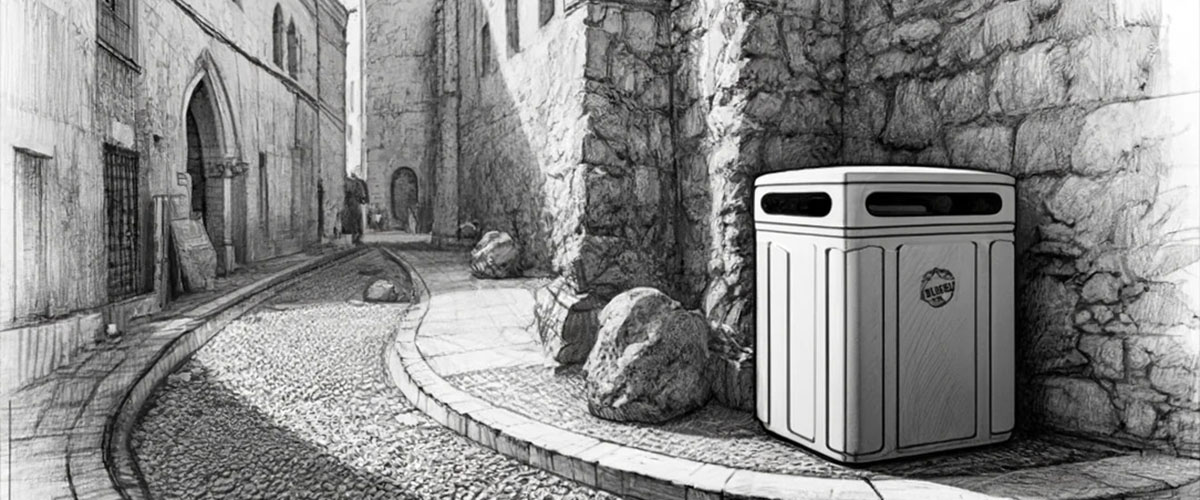
The specific challenge of waste in heritage environments
Waste management in historic zones faces constraints that do not exist in contemporary urban planning. Streets in European old town centers have average widths of 2.5 to 4 meters, turning radii under 6 meters, and weight limitations imposed by historic pavements that restrict access for conventional 26-tonne collection trucks. According to the study Waste Collection in European Historic Centres by the International Association of Educating Cities (AICE, 2021), 78% of historic quarters in European cities with more than 50,000 inhabitants cannot operate collection routes with standard side-loading vehicles. The resulting additional cost ranges between 30% and 45% compared with collection in modern neighborhoods, reaching figures of 85 to 120 euros per tonne versus the typical 60-75 euros.
Waste volumes generated in historic centers exhibit extreme seasonality linked to tourism. Venice, with a resident population of 50,000, receives 30 million visitors annually that triple waste generation during peak season, rising from 180 tonnes per day in winter to 520 tonnes in July-August, according to data from Veritas S.p.A. (2022), the municipal environmental management company. In Dubrovnik, the walled old town of 0.14 km² generates 4,800 tonnes annually, a density of 34,285 tonnes/km² that is 17 times the Croatian urban average. This concentration requires collection frequencies of 3 to 4 times daily in summer, using 3.5-tonne electric vehicles that access through the city gates during nighttime windows from 10:00 p.m. to 6:00 a.m.
Underground and integrated container systems
Underground containers are the predominant solution for reconciling waste collection with the aesthetic preservation of historic zones. The system consists of 3,000 to 5,000-liter tanks buried beneath the pavement, accessible through surface openings of 0.4 m² that blend into the urban environment. Porto installed 420 underground containers in its UNESCO-listed historic center between 2016 and 2022, with an investment of 8.2 million euros, eliminating 1,800 surface containers that occupied 2,700 m² of public space. The recycling rate in areas served by the underground system rose from 18% to 34%, as source separation is facilitated by color-coded openings for each waste stream.
Installing these systems in historic ground requires prior archaeological surveys. In Salamanca, the placement of 56 underground islands in the old town between 2019 and 2023 required 23 archaeological interventions that documented findings from Roman and medieval periods, extending the installation timeline by 35% and increasing costs by 22% over the initial budget of 3.4 million euros. Each underground island houses 4 containers of 3,000 liters (organic, packaging, paper, and general waste) at a depth of 1.8 meters, with hydraulic lifting systems that allow emptying in 90 seconds per container. The Finnish manufacturer Molok, the global leader with more than 200,000 units installed in 43 countries, offers surface finishes in natural stone, corten steel, and cast iron that adapt to the aesthetic of each heritage setting.
Pneumatic collection and advanced technological solutions
Pneumatic waste collection eliminates the need for trucks inside historic quarters by transporting waste through underground pipes at 70 km/h using air suction to a peripheral collection terminal. Envac, the Swedish company that pioneered the system, has installed pneumatic networks in historic centers such as Stockholm (Hammarby Sjöstad district, 35,000 users), Barcelona (Vila Olímpica district, 28,000 users), and León (old town, 8,500 users). The León system, operational since 2012, covers 1.2 km² with 4.5 km of pipes measuring 500 mm in diameter and 78 waste inlets, handling 3,200 tonnes annually with an energy consumption of 28 kWh per tonne.
IoT fill-level sensors optimize collection routes where pneumatic collection is not feasible. Devices manufactured by Bigbelly and Sensoneo measure fill levels in real time and transmit data to management platforms that calculate optimal routes. The Bruges City Council deployed 230 sensors in historic center containers in 2021, reducing collection frequencies by 42% and truck mileage by 37%. The documented annual savings amounted to 185,000 euros in operating costs, against an initial investment of 92,000 euros in sensors and the platform, recouped in 6 months. Bigbelly solar-powered compactors, with an effective capacity of 600 liters in a 120-liter form factor thanks to 5:1 compression, have been installed in more than 60 European historic centers with custom finishes that replicate local materials.
Governance models and sustainable financing
Financing advanced waste management systems in historic zones combines European funds, differentiated municipal fees, and pay-as-you-throw models. The EU LIFE program funded 47 projects on waste management in heritage settings between 2014 and 2023, with a cumulative allocation of 62 million euros. The LIFE WASTE4THINK project (2016-2020) demonstrated in Zamudio (Basque Country) that pay-as-you-throw pricing using smart containers with RFID identification reduced per capita generation by 21% and raised recycling to 68%, at an implementation cost of 45 euros per inhabitant.
Tourist taxes linked to waste management are a growing financing mechanism. Amsterdam allocates 12% of its tourist tax of 7% on accommodation prices to improving waste management in the historic center, which amounted to 14.8 million euros in 2022. Rome has applied since 2019 a differentiated TARI (Tassa sui Rifiuti) that increases the base rate by 30% for hotels and restaurants located within the Centro Storico perimeter, raising an additional 8.3 million euros per year allocated entirely to selective collection in the monumental zone. The European Investment Bank (EIB) has offered since 2020 specific credit lines for waste management infrastructure in heritage cities, with interest rates of 0.5% and repayment terms of up to 25 years, having financed projects worth 230 million euros through 2023.
References
- [1]Rapporto Ambientale 2022 — Gestione Rifiuti Comune di VeneziaVeritas S.p.A..
- [2]Automated Waste Collection Systems: Global Reference ProjectsEnvac AB.
- [3]LIFE WASTE4THINK — Moving towards Life Cycle Thinking by Integrating Advanced Waste Management SystemsEuropean Commission LIFE Programme.
- [4]Deep Collection Systems for Urban Heritage EnvironmentsMolok Ltd.
- [5]EIB Urban Development and Heritage Infrastructure Lending 2020-2023EIB.


Comments 0
No comments yet. Be the first!
Leave a comment