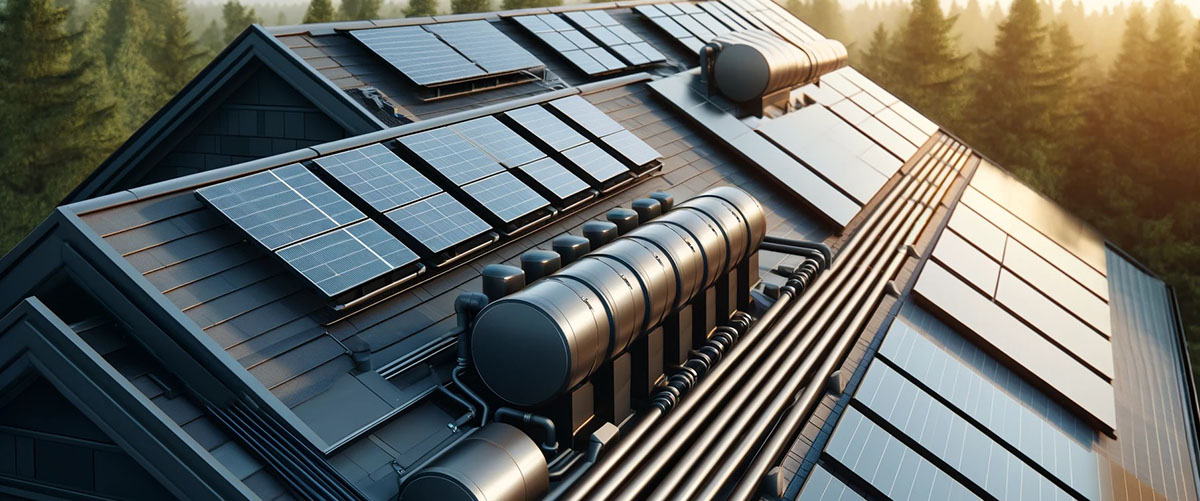
The solar resource: magnitude and harvesting potential in buildings
Solar energy reaches the Earth's surface with an average irradiance of 1,000 W/m2 (standard test conditions STC) and an accumulated annual irradiation that ranges from 800-1,000 kWh/m2/year in northern Europe to 1,600-2,200 kWh/m2/year in southern Spain, North Africa and desert regions. Spain receives an average horizontal solar irradiation of 1,500-1,900 kWh/m2/year (AEMET, Atlas de Radiación Solar en España), making it the European country with the greatest solar resource. The ways to harness this solar energy in the built environment encompass five main technologies: photovoltaic (direct conversion of radiation into electricity), solar thermal (conversion of radiation into heat for DHW and heating), passive solar (capture, storage and distribution of solar heat without mechanical systems), concentrated solar power (CSP, for utility-scale electricity generation) and building-integrated photovoltaics (BIPV, combining constructive function with electricity generation).
The potential of solar energy for buildings is enormous: the roof of a typical single-family home (80-150 m2) can accommodate a photovoltaic installation of 3-10 kWp generating 4,500-15,000 kWh/year in Spain — between 60% and 200% of the average electricity consumption of a Spanish household (3,500-7,500 kWh/year according to IDAE). In multi-family buildings, the roof-to-dwelling ratio is lower (10-25 m2/dwelling), but a generation of 1,500-3,750 kWh/year per dwelling covers 30-70% of individual electricity consumption. According to the Unión Española Fotovoltaica (UNEF, 2023), Spain installed 2,649 MW of self-consumption photovoltaics in 2022, accumulating 5,249 MW in total, with 108% growth compared to 2021. The ways to harness solar energy multiply when combined: a building can integrate rooftop photovoltaics, solar thermal for DHW, passive solar design on the south facade and BIPV on solar shading devices, maximising solar capture on every available surface.
Solar photovoltaic energy: direct conversion of radiation into electricity
Solar electrical energy generated by photovoltaic panels is based on the photoelectric effect: photons from solar radiation excite electrons in the semiconductor material, generating a direct electrical current. Monocrystalline silicon panels dominate the market with efficiencies of 20-22% in commercial modules (cell record: 26.8%, LONGi, 2023) and prices of 0.20-0.35 EUR/Wp (module) in 2024 — a 99% reduction since 1976 (Swanson's Law). Polycrystalline silicon offers slightly lower efficiencies (17-19%) at costs 10-15% lower. Perovskite cells — the most promising emerging technology — have reached laboratory efficiencies of 26.1% in single cells and 33.7% in perovskite/silicon tandems (NREL, 2024), with the potential for manufacturing at far lower cost than silicon through solution deposition at ambient temperature.
A residential self-consumption PV installation in Spain (3-5 kWp, 15-25 m2 of panels) generates 4,500-7,500 kWh/year with an investment of 4,000-8,000 EUR (complete installation with inverter) and a levelised cost of energy (LCOE) of 0.04-0.07 EUR/kWh — significantly below the residential electricity tariff of 0.15-0.25 EUR/kWh. The return on investment falls between 5 and 8 years with a panel service life of 25-30 years (standard guarantee of 80% output at 25 years). With battery storage (5-10 kWh, additional cost of 3,000-6,000 EUR), the self-consumption rate rises from 30-40% (without battery) to 60-80%, and the payback extends to 8-12 years. Royal Decree 244/2019 regulates self-consumption in Spain, permitting simplified surplus compensation, collective self-consumption in housing communities and exemption from the sun tax — a regulatory framework that has driven exponential growth in the building-integrated PV sector.
Solar thermal energy: low and medium temperature heat
Solar thermal energy captured by solar thermal collectors converts solar radiation into useful heat for domestic hot water (DHW), heating and swimming pool heating. Flat plate collectors — the most widely used in residential buildings — achieve optical efficiencies of 70-80% and annual overall efficiencies of 40-60% (ratio of useful energy delivered to incident solar irradiation), with operating temperatures of 30-80°C suitable for DHW and underfloor heating. Evacuated tube collectors improve performance at higher temperatures (50-120°C) thanks to reduced convection losses, with annual efficiencies of 50-70% and applications in high-temperature heating and solar absorption cooling. According to ESTIF (European Solar Thermal Industry Federation, 2022), Europe has 57 million m2 of installed solar thermal collector area, with an equivalent thermal capacity of 40 GWth.
The CTE DB-HE4 requires a minimum solar contribution for DHW in new construction in Spain, varying from 30% to 70% depending on climate zone and demand, equivalent to installing 1.5-3.0 m2 of solar collector per dwelling. A typical installation of 2 m2 of flat plate collector with a 150-200 litre storage tank costs 1,500-3,000 EUR installed and covers 50-70% of the annual DHW demand for a household of 3-4 people (DHW demand: 1,500-2,500 kWh/year), with savings of 150-300 EUR/year on gas or electricity and payback periods of 6-12 years. For large buildings (hotels, care homes, hospitals), centralised solar thermal systems achieve solar fractions of 40-60% with collector areas of 0.5-1.0 m2 per bed/room. The combination of solar thermal for DHW with photovoltaics for electricity maximises the use of the rooftop solar resource, dedicating the optimal south orientation to photovoltaics (higher economic value per kWh) and secondary orientations to thermal (greater tolerance to deviations in orientation and tilt).
Passive solar, concentrated solar power and BIPV: completing the spectrum
Passive solar energy is the oldest and most economical way to harness the sun in buildings: it involves capturing solar radiation through south-facing openings (in the Northern Hemisphere), storing the heat in the building's thermal mass (concrete walls, ceramic floors, water tanks) and distributing it through natural convection or conduction. A well-executed passive solar design — with 40-60% of glazed surface on the south facade, summer solar shading (overhangs calculated by latitude: an overhang of 60-80 cm at 40° latitude blocks the summer sun at 65-70° solar altitude while admitting the winter sun at 25-30°) and thermal mass of 200-400 kJ/m2K — reduces heating demand by 20-40% with no additional mechanical installation cost, solely through architectural design decisions. The Trombe Wall (a high-thermal-mass wall with a glazed air cavity on the south facade) and the attached sunspace are variants that achieve additional reductions of 15-30% in cold climates.
Concentrated solar power (CSP) uses mirrors to concentrate solar radiation (50-1,000 suns) onto a receiver that heats a fluid to 300-600°C to generate electricity through a steam turbine. With 5.5 GW installed globally (Spain: 2.3 GW, world leader with 50 plants), CSP enables thermal energy storage in molten salts (6-15 hours), which differentiates it from photovoltaics by enabling electricity generation after sunset. Building-integrated photovoltaics (BIPV) combines constructive function (facade glazing, roof tiles, sunshades, railings) with electricity generation: BIPV crystalline silicon modules achieve efficiencies of 10-18% in semi-transparent applications (double-glazing units with embedded cells) and 15-20% in opaque applications (photovoltaic tiles such as Tesla Solar Roof or SunRoof). The BIPV market grew by 15-20% annually between 2018 and 2023, reaching 8-10 GWp of installed capacity globally (BIPV Report, Becquerel Institute, 2023). The ways to harness solar energy in buildings do not compete with each other but are complementary, covering every energy need — electricity, heat, climate control — with the solar technology best suited to each use and to each available surface of the building.
References
- [1]Informe Anual UNEF 2023: El sector fotovoltaico en EspañaUnión Española Fotovoltaica.
- [2]Best Research-Cell Efficiency Chart (Rev. 01-2024)National Renewable Energy Laboratory, U.S. Department of Energy.
- [3]Solar Thermal Markets in Europe — Trends and Market Statistics 2022Solar Heat Europe / ESTIF.
- [4]BIPV Market and Technology Report 2023: Building-Integrated Photovoltaics Global AssessmentBecquerel Institute / SUPSI.
- [5]The Passive Solar Energy Book: A Complete Guide to Passive Solar Home, Greenhouse and Building DesignRodale Press. ISBN: 0-87857-238-4
- [6]Atlas de Radiación Solar en España utilizando datos del SAF de Clima de EUMETSATAgencia Estatal de Meteorología, Ministerio de Medio Ambiente.



Comments 0
No comments yet. Be the first!
Leave a comment