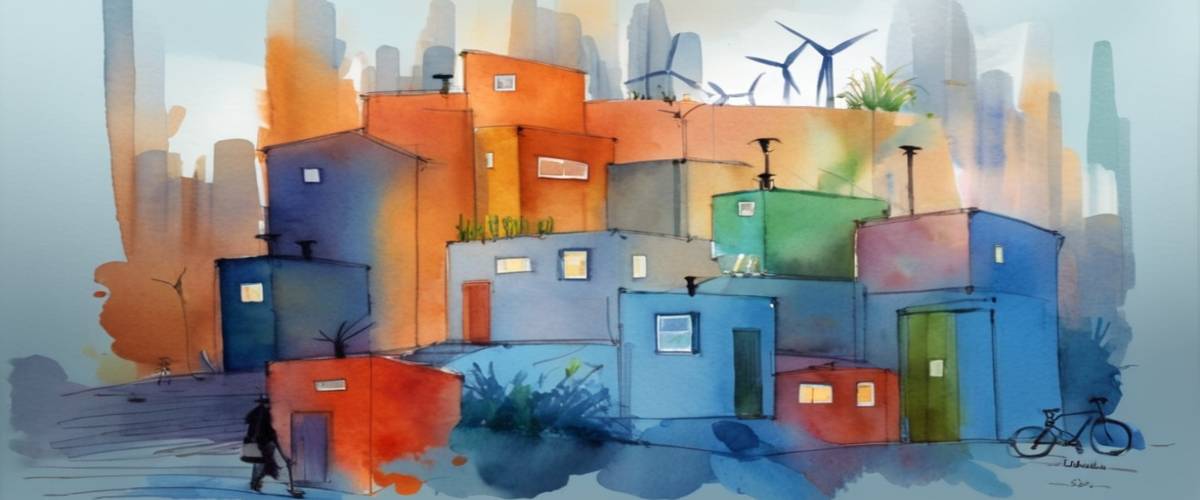
Overview of R&D Investment in Sustainable Construction
Investment in research and development directed at sustainable construction has experienced sustained growth over the past decade. According to OECD data (2023), global R&D investment in building energy efficiency, sustainable construction materials, and sector decarbonization technologies reached 28 billion EUR in 2023, an 85% increase from the 15.1 billion EUR of 2015. The geographic distribution reflects policy priorities: the EU contributes 32% of global public investment through Horizon Europe and national programs, followed by China (24%), the United States (18%), and Japan (8%). The Horizon Europe program, with a budget of 95.5 billion EUR for 2021-2027, allocated 3.2 billion EUR to Cluster 5 (Climate, Energy and Mobility) during the 2021-2024 period, of which 680 million EUR were assigned directly to sustainable building projects, including low-carbon materials, deep renovation, positive energy districts, and sector digitalization.
Private investment complements and exceeds public funding. The 20 largest cement companies in the world jointly invested 1.8 billion EUR in R&D in 2023 (GCCA, 2024), focused on low-carbon cements, CO₂ capture, and waste valorization. Insulation material companies invested 900 million EUR, focused on affordable aerogels, bio-based insulation (wood fiber, hemp, straw), and second-generation vacuum insulation. In Spain, construction sector R&D investment was 285 million EUR in 2022 (INE), representing only 0.15% of sector revenue (190 billion EUR), compared to 0.35% for the European average and 0.55% for Germany. The CSIC, through institutes such as IETcc (Eduardo Torroja) and ICMAB, carried out 42 research projects in sustainable construction between 2020 and 2024, with cumulative funding of 28 million EUR.
Priority Research Lines and Emerging Results
The research lines with the greatest potential impact on construction decarbonization are concentrated in five areas. First, alternative cementitious materials: geopolymers based on metakaolin and slag achieve strengths of 40-80 MPa with emissions 60-80% lower than Portland cement (Provis & van Deventer, 2014; Springer), but their compositional variability and the absence of harmonized standards limit their commercial adoption. The European GEOPOL project (Horizon 2020, 2020-2024, 4.5 million EUR) developed 3 standardized geopolymer formulations and tested them in 6 pilot buildings, demonstrating durability comparable to conventional concrete in 4 years of accelerated exposure. Second, bio-based materials: research into mycelium panels from fungi (compressive strength of 1-5 MPa, density of 60-300 kg/m³, negative embodied carbon) advances from the laboratory (TRL 4-5) toward the first building-scale prototypes (TRL 6-7), with companies like Ecovative (USA) and Biohm (UK) producing 50,000 m² of mycelium insulation panels in 2023.
Third, industrialized deep renovation: the Energiesprong (Netherlands) and Renowatt (Spain) projects develop prefabricated facade and roof solutions that transform existing dwellings into nZEB in 5-10 days of construction work, with 25-year energy performance guarantees. The Energiesprong model has renovated 6,000 dwellings in the Netherlands, 4,500 in France, and 2,200 in the United Kingdom through 2024, at an average cost of 60,000-80,000 EUR/dwelling financed through energy performance contracts that eliminate the upfront cost for the owner. Fourth, predictive digital twins: research in Digital Twin of Buildings (DTB) integrates thermophysical simulation, real-time IoT data, and machine learning to predict energy consumption with an error below 5% and optimize operations in real time. Fifth, seasonal thermal energy storage technologies: BTES (Borehole Thermal Energy Storage) systems store summer solar heat underground for winter heating with efficiencies of 40-60% and reduce heating demand by 50-80%. The Drake Landing Solar Community system in Canada (2007) demonstrated a solar heating fraction of 97% with 144 boreholes at 37 m depth for 52 dwellings.
Technology Transfer: The Gap Between Laboratory and Construction Site
The average time for transferring an innovation from the laboratory to widespread construction practice is estimated at 15-20 years (Winch, 1998; Building Research & Information), a timeline incompatible with the climate urgency. The TRL (Technology Readiness Level) scale, used by Horizon Europe, classifies technological maturity across 9 levels: the majority of sustainable construction innovations funded by the EU are at TRL 4-6 (laboratory validation to prototype in a relevant environment) at project completion, and only 15-20% reach TRL 8-9 (complete qualified and operational system) within 5 years after the project (European Commission, 2022). The identified barriers are sector fragmentation (the 3 million construction companies in the EU, 95% with fewer than 20 employees, lack the individual capacity for technology absorption), developer risk aversion, and the absence of regulatory incentives for the early adoption of innovations.
The most effective transfer mechanisms combine real-scale demonstration with performance guarantees. Sustainable construction Living Labs, such as the SDE4 at the National University of Singapore (2019, the first net zero energy building on a university campus in the tropics, with consumption of 65 kWh/m²·year and solar generation of 70 kWh/m²·year), allow technologies to be validated under real conditions and generate publishable performance data. In Spain, the CDTI's INNPACTO program funded a total of 28 demonstration projects in sustainable construction between 2020 and 2024 with a public investment of 18 million EUR, including ventilated facade systems with air recirculation, concretes with 100% recycled aggregate, and AI-based energy monitoring systems. Innovation clusters, such as AEICE (Efficient Construction Cluster of Castilla y León), act as intermediaries between research and industry: AEICE has facilitated 45 collaborative projects between 2018 and 2024, involving 120 companies and 15 research centers, with cumulative investment of 32 million EUR.
Proposals to Accelerate Innovation and Future Perspectives
Accelerating technology transfer requires coordinated interventions in regulation, financing, and training. The proposal in the "Accelerating Innovation in Construction" report by the World Economic Forum (2023) includes five quantified measures: (1) mandatory minimum of 5% innovative technologies (TRL 7-8) in public building tenders, which in Spain would represent a captive market of 1.2 billion EUR annually for innovations based on the 24 billion EUR in public construction and building tenders; (2) creation of guarantee funds covering the performance risk of new technologies during the first 5 years, with an estimated cost of 1-2% of project value; (3) simplification of the European Technical Assessment (ETA) process for innovative products, reducing the timeframe from 2-4 years to 6-12 months; (4) tax incentives of 25-40% for R&D investment in sustainable construction; and (5) innovation training programs for 100,000 mid-level managers in the sector across the EU.
Future perspectives indicate an accelerated convergence between research and practice. The European Commission launched in 2023 the "New European Bauhaus" initiative with a budget of 100 million EUR for projects integrating sustainability, aesthetics, and inclusion in the transformation of the built environment. The Built Environment Innovation Partnership, announced for 2025 under Horizon Europe with 500 million EUR, will specifically fund the scaling of sustainable construction technologies from TRL 6 to TRL 9. In Spain, the Spanish Strategy for Science, Technology and Innovation 2021-2027 identifies sustainable building as a priority area and plans to increase public R&D investment in the sector from 45 million EUR/year to 80 million EUR/year by 2027. The well-founded prediction is that the technology transfer cycle in construction will shrink from 15-20 years to 7-10 years in the next decade, driven by digitalization (which allows virtual prototyping and validation before building), regulatory pressure (which generates market demand for decarbonized solutions), and the maturation of sectoral innovation ecosystems connecting laboratory, factory, and construction site.
References
- [1]Alkali Activated Materials: State-of-the-Art Report, RILEM TC 224-AAMSpringer. ISBN: 978-94-007-7671-5
- [2]OECD Green Growth Indicators: Energy Technology RD&D BudgetsOECD Publishing.
- [3]Zephyrs of Creative Destruction: Understanding the Management of Innovation in ConstructionBuilding Research & Information, 26(5), 268-279.
- [4]Horizon Europe Strategic Plan 2025-2027: Cluster 5 — Climate, Energy and MobilityPublications Office of the EU.
- [5]Accelerating Innovation in Construction: An Industry Transformation FrameworkWEF.


Comments 0
No comments yet. Be the first!
Leave a comment