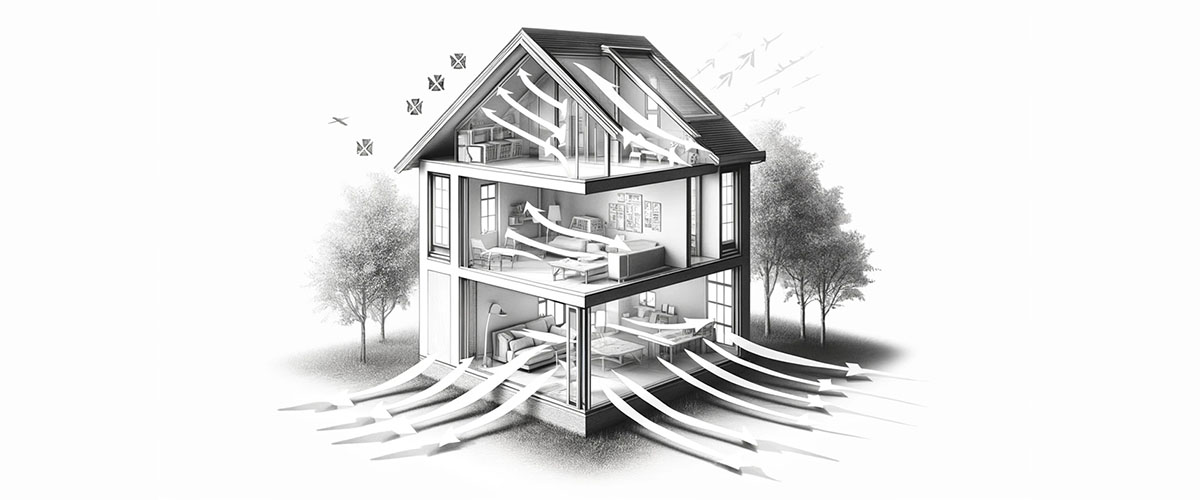
First principle: wind as a pressure driver
The principles of natural ventilation in buildings start from the Bernoulli equation applied to airflow around a solid obstacle. When wind (velocity v, density ρ = 1.2 kg/m³) strikes a building, it converts its kinetic energy into static pressure on the windward facade: P_windward = 0.5·ρ·v²·Cp_windward, with a typical Cp_windward of +0.5 to +0.8 for flat facades perpendicular to the wind. On the leeward side, flow separation generates suction: Cp_leeward of -0.3 to -0.7. The net difference (ΔCp = 0.8–1.5) is the driving force for cross-ventilation.
The pressure coefficients Cp depend on building geometry, wind direction, and the roughness of the urban surroundings. Standard EN 1991-1-4 (Eurocode 1, wind actions) provides tabulated values for simple shapes. For complex geometries, wind tunnel tests or CFD simulations following the AIJ (Architectural Institute of Japan) guidelines are necessary. A critical aspect is that wind speed at roof height (z = 10–30 m) can be 2–3 times higher than the speed at opening height (z = 1–5 m) in dense urban environments, due to the logarithmic velocity profile described by the atmospheric boundary layer equation.
Second principle: thermal buoyancy and stratification
Thermal buoyancy (buoyancy-driven ventilation) is the second fundamental principle. Warm indoor air (density ρ_int) is lighter than cool outdoor air (ρ_ext), generating a pressure difference proportional to the height and the temperature difference: ΔP = (ρ_ext − ρ_int)·g·H ≈ ρ·g·H·ΔT/T_m, where g = 9.81 m/s², H is the height between openings (m), ΔT the temperature difference (°C), and T_m the mean absolute temperature (K). For H = 10 m and ΔT = 4 °C (summer, indoors 28 °C, outdoors 32 °C), ΔP ≈ 1.6 Pa.
Thermal stratification within the space is an associated phenomenon: warmer air accumulates in the upper layers with a gradient of 0.5–2.0 °C/m of height depending on internal loads. This gradient is beneficial because it allows hot air extraction through roof openings without disturbing the occupied zone (0–1.8 m). Thermally Activated Building Systems (TABS), with water pipes embedded in the concrete slab, dampen internal gains and reduce stratification, improving comfort in the occupied zone while maintaining the thermal draft in the upper zone.
Third principle: interaction with topography and microclimate
The immediate surroundings radically alter ventilation conditions. Topography generates local effects: windward-facing slopes accelerate the wind (speed-up effect, factor of 1.2–1.6 depending on slope, EN 1991-1-4 Annex A), while valleys channel flow and generate valley–mountain breezes (daytime anabatic and nocturnal katabatic winds) with velocities of 2–5 m/s that can be harnessed for natural ventilation in buildings situated on hillsides.
In urban environments, the urban heat island effect (2–5 °C warmer than the rural periphery, Oke, 1987) increases the temperature difference between indoor and outdoor at night, favouring thermal buoyancy for nocturnal ventilation. However, urban roughness reduces wind speed at street level by 30–60% compared to open terrain (terrain category IV in the Eurocode). The relative position of neighbouring buildings can create Venturi effects in narrow passages (30–50% acceleration) or calm zones (wind shadow) that nullify wind-driven ventilation. Urban wind analysis requires specific studies with local meteorological data and modelling of the surrounding environment.
Fourth principle: vegetation as an air and temperature regulator
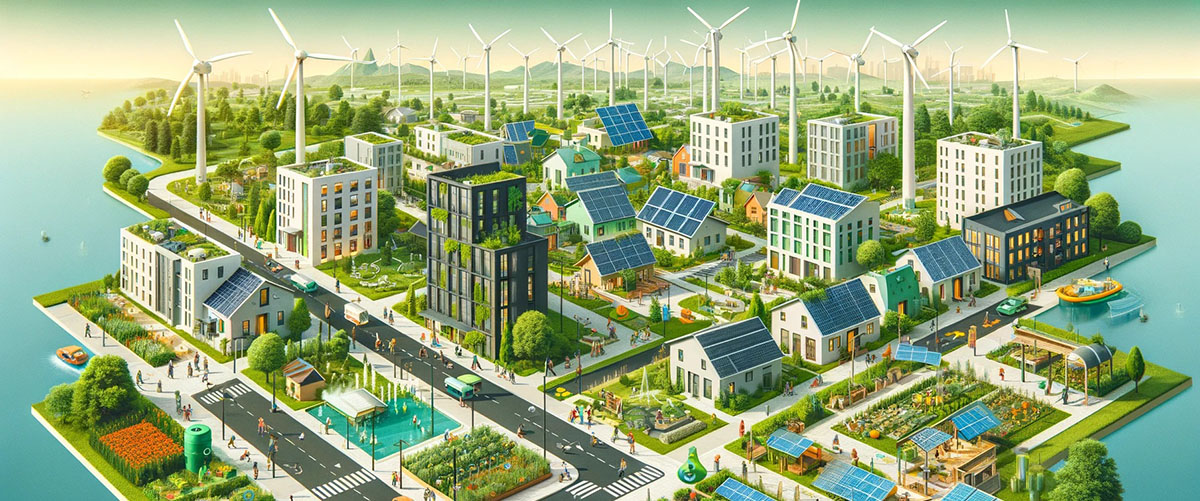
Integrated vegetation modifies the boundary conditions of natural ventilation. Deciduous trees reduce wind speed by 30–50%, acting as porous windbreaks (optical porosity of 30–70% depending on species), while in winter (leafless) they allow wind passage. Extensive green roofs (sedum, 8–15 cm substrate) reduce the roof surface temperature by up to 30 °C compared to a conventional dark roof (Castleton et al., 2010), decreasing the thermal load that the chimney draft must dissipate.
Vertical gardens and green facades create an evapotranspiration layer that cools the adjacent air by 3–5 °C, providing pre-cooled intake air to ventilation openings. A study by the Technical University of Madrid (Pérez et al., 2014, Renewable and Sustainable Energy Reviews) demonstrated that green facades reduce cooling demand by 20–40% in Mediterranean climates. Furthermore, vegetation filters PM10 and PM2.5 particles with efficiencies of 10–30% depending on foliage density (Pugh et al., 2012, Atmospheric Environment), improving intake air quality in urban environments.
Integration of principles: holistic design
The effective application of these principles requires their simultaneous—not sequential—integration. A well-designed building for natural ventilation combines: orientation that maximises ΔCp between facades (long axis perpendicular to the prevailing wind), floor depth ≤ 5H for cross-ventilation (CIBSE AM10), exposed thermal mass on the ceiling (≥ 50% of slab surface without suspended ceiling), chimneys or atria with a height ≥ 6 m for a stack effect independent of wind, and perimeter vegetation for air pre-treatment and noise protection.
The Building Technology Research Institute at NTU Singapore published a study of 40 naturally ventilated buildings in tropical climates (Gratia and De Herde, 2007, Energy and Buildings) which concluded that the correct combination of the above principles reduces HVAC energy consumption by 50–80% compared to fully mechanically ventilated buildings, with occupant satisfaction levels 15–20% higher according to BUS surveys. The key is that no single principle works in isolation: natural ventilation is an integrated system where every design decision affects the performance of all the others.
References
- [1]EN 1991-1-4: Eurocode 1 — Actions on structures — Part 1-4: General actions — Wind actionsEuropean Committee for Standardization.
- [2]AM10: Natural ventilation in non-domestic buildingsChartered Institution of Building Services Engineers. ISBN: 978-1-903287-56-5
- [3]Vertical Greenery Systems (VGS) for energy saving in buildings: A reviewRenewable and Sustainable Energy Reviews, 39, 139-165.
- [4]Effectiveness of green infrastructure for improvement of air quality in urban street canyonsEnvironmental Science & Technology, 46(14), 7692-7699.
- [5]AIJ guidelines for practical applications of CFD to pedestrian wind environment around buildingsJournal of Wind Engineering and Industrial Aerodynamics, 96(10-11), 1749-1761.
Comments 0
No comments yet. Be the first!
Leave a comment